 The airborne drama Skyjacked came out in 1972 and, though it isn’t a disaster movie in the sense that the plane isn’t crashing, it still belongs in the same basic family due to its all-star format and in-flight setting. Starring (who else?!) Charlton Heston as the pilot, it concerns a passenger jet, which someone onboard has decided to blow up if the crew doesn’t change its course to the destination desired. (I deliberately passed this film up in the somewhat chronological order I’ve been musing about disaster movies in, lest someone might think this is strictly a Heston blog, he was in so many of these types of movies in the 1970s!)
Some posters for the film used the popular (and oft-mentioned here) scheme of boxes with faces of the stars. This one tweaked it a bit by arranging them differently rather than in a row at the bottom. It also strove to project a “whodunit” aspect to the film and, though the movie does indeed take pains to shroud the identity of the hijacker for a fairly significant amount of time, the back of the DVD case gives the mystery away completely! So take care if you wish to be surprised when watching and ignore that until later.
During the 70s, feature films and TV movies continually focused on mid-air crises of all kinds. The Airport series featured its own mad bomber along with a collision with a small private craft, a crash beneath the waters of the Bermuda Triangle and finally a skirmish with heat-seeking missiles (clearly most of the ideas had run out by that time!) Various TV-films dealt with ghosts, crashes into the Everglades, murderers and even one in which a plane flies into a skyscraper! Then there’s the loopy Starflight: The Plane That Couldn’t Land (released to video as Starflight One) about a state of the art craft that gets flung into outer space! Check out the old VHS cover here. (Click to enlarge.)
Here, Heston and Co. are on board a passenger jet for Minneapolis when su ddenly there are lipstick-written messages (the first one on a mirror in the lavatory!) demanding that the flight plan be rerouted to Anchorage instead or else a bomb will be detonated. Not only does Heston have to contend with a hijacker/bomber, but also he doesn't even know who the culprit is, just that he or she is likely a member of first class. Meanwhile, the camera keeps finding ways to land on various tubes of red lipstick!
This makes the first 30 minutes  of the film a bit of a mystery. It also makes for some serious tedium, as the script can't allow viewers to know much about the people on board, lest it become obvious who is or is not the passenger with a screw loose. So the various stars have to maintain a certain level of suspicion about them while also striving to deliver facets of themselves that would make the audience give a care about them. For the most part, they aren’t too successful with this, though the script is probably the main culprit.
Heston was a master at playing these types of square-jawed authority figures and he does w ell here, even showing some shades of vulnerability at times. Check out the mushroom cloud of smoke he has coming out of his pipe in the cockpit! Hunky former Tarzan Mike Henry plays his co-pilot and the two are in the midst of a love triangle over attractive chief stewardess Yvette Mimieux. Henry is her current lover, though she used to be with Heston. Their past love affair is displayed in some loony, “arty” flashbacks, the kind Airplane! would later make fun of.
 Football star-turned-actor Rosey Grier plays a nervous musician who carries a big cello case with him. He’s seated next to clean cut soldier James Brolin, on hiatus from his regular role as Dr. Steven Kiley on Marcus Welby, M.D.”
 Confrontational hippie Susan Dey (also on hiatus from her own series The Partri
 dge Family) manages to find time to flirt with sweet Nicholas Hammond. We all remember Hammond, of course, from his appearance as Friedrich Von Trapp in The Sound of Music. He’s on board the flight with his U.S. senator father Walter Pidgeon. Pidgeon attempts in vain to inject weight into his paper-thin part.
Ross Elliott and Jeanne Crain as a married couple are so much furniture, their roles are so un-fleshed-out. (Crain, who lived for three more decades afterwards, never stepped before a movie camera again after this.) A t least Mariette Hartley gets a chance to fret some in her clichéd role of the panicky pregnant woman (and orders a Bloody Mary to drink! Take that PC people.) Claude Akins appears in a role George Kennedy would likely have played if he hadn't been stretched so thin in virtually every other disaster film of the decade. Leslie Uggams, in her film debut, plays a confident stewardess whose final line is amusing if a bit unlikely.
People keep misunderstanding each other's intentions and motives in an effort to  build some mystery about the bomber. Sadly, this just isn't handled well enough to work to the film's advantage. When the hijacker is revealed, things take on a more tense feeling, but there are really very few times when anyone in this movie acts like a real person. The passengers react to the news of a hijacking the way they might react to finding that the plane is out of smokehouse almonds. At least in Airport, the star-studded cast members each got a chance to shine, even if some of the stories were silly. Here, the characters are almost strictly cardboard props.
What's neat about the film are its serene prod uction design and color scheme, its aerial photography, its unusual music score, its generally serious tone and its eclectic cast of familiar faces. I live for those cool, cadet blue stewardess uniforms that once were the norm, though movies always seemed to contain even more sharp ones than real life.
Unfortunately, the script has to count as a debit as it fails to generate any characters o f particular interest or depth. The editing and continuity on the film is also poor. Chunks of activity seem to have been left out such as Henry bandaging Mimieux's cut. Also, Mimieux's hair goes from loose to pulled-back to loose within moments.
Though the film is not nearly campy enough to be funny throughout (despite being released by Warner Brothers as a "Cult Camp Classic"), there are a couple of giggles along the way such as when one passenger is nearly frozen and has a hair full of frost or when busy character actor John Fiedler has his voice hilariously and ludicrously over-dubbed. There's a lack of urgency to the movie, typified by (the still-lovely) Crain when she has a chance to get off the plane and decides to smooth out the suede in her hat instead. It's doubtful that anyone but die-hard buffs will find this anything much beyond tiresome, but at least it isn't an over-the-top mess like so many of today's movies.
Today Sam Elliott is about as grizzled and as masculine a man as one could hope to find, a rough-hewn, longhaired guy for whom a  term such as “manscaping” couldn’t be more foreign. His low, growl of a voice is put to use in countless voiceovers and commercials, notably for the American Beef Council (“Beef. It’s what’s for dinner.”) In his early days, one could search the world and be lucky to find a hairy chest that could equal his and, fortunately, he left some evidence of it behind, though he has long resisted the sex symbol status that has sometimes been applied to him.
A native Californian (Sacramento), Elliott was born under the name he has always gone by to a father who worked for the government and a mother who was a physical training instructor, thus his emphasis on fitness was assured early on. The family eventually moved to Portland, OR when he was a teen and he eventually wound up at college in Washington. He performed in Guys and Dolls there and the reviews in the local paper were good enough to suggest that he pursue acting as a career.
He eventually moved to L.A. where he took acting lessons while also working in construction (this surely contributing to his good ol’ boy manner and strong physicality.) He landed a few bit parts on the TV crime series Felony Squad and appeared as a card player in Butch Cassidy and the Sundance Kid in 1969. After a few more TV guest spots, he was given a supporting role in the  Olympic-themed film The Games as Ryan O’Neal’s fellow marathon runner. He appeared in a towel in a Japanese bathhouse scene.
Following this, he had a part in the TV submarine movie Assault on the Wayne before appearing in 13 episodes of Mission: Impossible as a brief alternative to Peter Lupus’s strongman, who was being considered for elimination. Elliott’s doctor character, while appealing, proved no more useful in the end and fans wanted Lupus back, so he wasn’t used any further.
Next up was the hoot-filled Frogs, a horror film concerning man vs nature and costarring Joan Van A rk, back when she was human, and Ray Milland. Elliott played an ecology-minded photojournalist who comes upon wheelchair-bound Milland’s wealthy family, gathered for a birthday celebration (and being tormented and hollered at by him, seemingly just for fun!) Milland has never shown any respect for the surrounding species and so they apparently decide to get revenge on his family. Oddly, everything conceivable other than frogs, from snakes to spiders to igunasa to turtles, do all the harm until the end of the movie. Speaking of s
 nakes, the already hunkalicious Elliott wears a pair of jeans in the film that ought to be mounted in some sort of shrine to the magic of denim. The 70s were a revealing period in men’s fashion anyway, but ol’ Sam takes the cake here. (And DO click on the top left photo with Milland to get the full effect!) This movie has some of the most amusing 70s costumes, too, on Milland’s family and guests, so is also worth checking out for that.
Elliott worked with Vera Miles in the low-budget western movie Molly and Lawless John that same year. He played a bad guy who seduces his jailer’s wife in order to get free. This, along with appearances on series such as Lancer and Gunsmoke, began building a solid background in the western genre, one that he would thrive in. He also worked frequently in projects with a military nature, such as the nine-hour miniseries Once an Eagle, which depicted the life of a soldier from WWI through WWII.

In 1976, he made what would later be regarded as a tribute to beefcake, the movie Lifeguard. Though the film str ives to be far more than just a sand and surf flick (not that you could tell from the relentlessly tacky and misguided advertising!), it also delivers heavily in the beach body department. Sam plays an aging lifeguard who’s devoted to his profession, though his days are becoming numbered. Parker Stevenson costars as a newbie and Anne Archer and a very young Kathleen Quinlan provide the love interest. The most arresting sequence features a passel of young men in Speedos trying to beat each other in rescue and athletic feats. Sam’s character begins to feel his age in the midst of some stiff competition.

Does anyone else find it startling that this grown man (undeniably masculine, hairy, sexually provocative and ADULT) was considered fodder as a pinup for Teen Beat magazine?! Today, such a male would be considered not only too old, but downright gross because he isn’t waxed, gelled, plucked, rippled and ready to keel over from lack of food.
 In 1978, Elliott filmed the horror film The Legacy in England. It was a fateful project in that the leading lady was Katharine Ross and the pair fell in love for real during the shoot (and are together even now.) She played an American girl brought to a creepy mansion in order to claim a secret inheritance and Sam was her boyfri
 end along for the ride. In it, he had a shower scene in which he is darn near scalded to death and it contains some thankfully gratuitous rear nudity from him. A lot of people fondly recall this sequence, which is usually trimmed for network and basic cable airings, as he truly had an eye-opening physique. I don’t usually post nudity here in The Underworld, but, please, museums have worse than this.
Following this film, Elliott moved more heavily into television for about seven yea rs, filming several western movies and miniseries including The Sacketts, Wild Times and The Shadow Riders. In two of these, he costarred with Tom Selleck playing his brother, though they share very few attributes apart from heavy mustaches and hairy chests. Their voices certainly couldn’t be more diametrically opposite! He also menaced Farrah Fawcett in Murder in Texas and Cheryl Ladd in A Death in California.
One interesting blip on his r esume is the 1983-84 primetime soap opera The Yellow Rose. (Even though he was one of the stars of the show, imdb.com doesn’t seem to realize that!) He, David Soul, Cybill Shepherd, Edward Albert and others starred in the Texas-set series. While it didn’t last long, it does have a few diehard fans who remember it, and him, fondly. It was also close to the last thing Jane Russell ever did as she guest-starred three times. I also can't resist mentioning how foolish I think Susan Anspach looks here with that headband...
In 1985, Sam had another movie role that brought him a raft of fans. He playe d the motorcycle-riding boyfriend of Cher in Mask, the story of disfigured Rocky Dennis and his mother. Many a female (and presumably a few guys!) fell for his rough on the outside, tender on the inside characterization. The film got a healthy amount of attention (partly from Cher’s constant complaining about not winning an Oscar for it) and he began to win more work in feature films.
That role seemed to signify a move towards longer-haired, denim and leather-clad types for Elliott. His hair began to become more salt than pepper (eventually turning completely white, not an unflattering thing on him.) One of his films (that, ironi cally, had been slated to star Cher at first) was Fatal Beauty, in which he found himself working opposite Whoopi Goldberg. He and Goldberg filmed a love scene for the film (the mind boggles!), but it was left out of the American release, allegedly because it was still a controversial thing to have displayed (and this was 1987!) More likely the scene simply didn’t come off as intended, but what do I know.
Other notable later projects include the P atrick Swayze action flick Roadhouse, the civil war epic Gettysburg, the all-star, OK Corral shootout Tombstone, The Coen Brothers’ cult oddity The Big Lebowski, the comic book adaptation Hulk and this year’s Oscar contender Up in the Air, in which he plays an airline pilot who’s flying on the day that George Clooney’s character reaches the 10 million flyer miles mark.
Though his looks have changed considerably over the years from a dark hunk to a craggy, silver-haired, daddy-type, he has continued to work steadily. On six occasions, he was able to pair up with Ross, though sh e has scaled back her career considerably in recent years and seems content to attend events on his arm. Their last project was the TV western Conagher in 1991. They have been together since 1978, but did not marry until 1984 when she became pregnant with their daughter.
Sam was taken to task a bit by the gay community when he failed to sing the praises of Brokeback Mountain. His quote on the subject was, “I was really happy that Ang Lee won the Best Director award. I got  to know him very well on Hulk. But I'm not the Brokeback Mountain crowd, what can I tell ya. I'm more of a purist. But at the same time, it's a new day.” I find nothing wrong with it because, just like there are many things I do not wish to see at the movies, I know that likewise there are things that others do not wish to watch. That’s why there are many viewing options. As a western icon, he was asked to give his opinion and he gave it. I didn’t find his words inflammatory at all.
 Today’s subject, Miss Stella Stevens, has had a long, busy career as a sex kitten, a comedienne, a shady lady and a (somehow likeable) shrew. In the Underworld, of course, she reigns supreme for her featured role as ex-prostitute and devoted, but haranguing, wife to Ernest Borgnine in The Poseidon Adventure.
Stevens was born in Mississippi under the name of Estelle Eggleston and was married at age 15, mother to son (Andrew Stevens) by age 16 and divorced at a ge 17! Defying the odds of someone in her position back in 1956, she went on to attend college at Memphis State, where she took an interest in acting as well as modeling. Her delightfully upturned mouth and curvaceous figure guaranteed attention.
Before long she was picked up by 20th Century Fox, but her tenure there was a brief six months. Fortunately, Paramount gave her a shot and she gained widespread attention for her role in the filmization of the Broadway musical Li’l Abner (as a character called Appassionata Von Climax!)
On the heels of that, in January, 1960, she mad e quite a splash with a Playboy pictorial feature (and was the centerfold of that issue.) She would do further pictorials in 1965 and 1968 and it’s easy to see why she was popular! Naturally, however, these photo spreads were nowhere near as explicit as what is churned out today.
Stella worked with Bobby Darin in the film Too Late Blues before being assigned to Girls! Girls! Girls! Opposite Elvis Presley. This was a film she did not want to make and the battle over being stuck in it led to some bad blood between her and Paramount (she would sign with Columbia just over a year later.) That's her on his lap. She is one of the few Presley movie girls who has not embraced that distinction and, in fact, claims to have never once watched the movie!
After appearing in The Courtship of Eddie’s Father (with Glenn Ford, who she  would costar with three times in all), she took on what would be one of her more iconic parts, mostly due to her costar and the fact that the film was later successfully (depending on who you ask) remade. This was The Nutty Professor, starring chief nutcase Jerry Lewis as a nerdy scientist who uses a potion to transform himself in the suave Buddy Love.
Though Stevens was most often used in comedies, such as Advance to the Rear, she occasionally worked in more se rious fare such as Synanon, in which she played a drug-addicted mother living in a rehabilitation house. She went red as a clutzy, but sexy, secret agent in the Dean Martin spy film The Silencers, one of his four Matt Helm movies and flung herself into the physical comedy with abandon (but there was a slightly misogynistic bent to some of it which can be off-putting.)
In the little-seen Rage, she look ed amazing, sporting the heavy lashes and shoulder length blonde hair shown here (albeit not in a bikini!) Glenn Ford portrayed a man stuck in Mexico and fighting against the clock to survive rabies with Stella as his sidekick. A lot of people, including Eleanor Parker and Bette Davis, had issues with Ford, but Stevens seemed to get on with him all right, though this was their last film together.
Keeping busy in a variety of roles, she played a thoroughly luscious object of Dean Martin's desire in How to Save a Marriage and Ruin Your Life (decked out in Moss Mabry clothes and lingerie confections), a former mob moll in Sol Madrid with David McCallum and a forward-thinking nun (!) in the Rosalind Russell comedy Where Angels Go Trouble Follows.
After appearing in The Mad Room, an update of the old chestnut Ladies in Retirement and costarring Shelley Winters, Stevens got one of her  most critically acclaimed roles in The Ballad of Cable Hogue. Playing a whore (someone really ought to add up how many times she has been cast as a prostitute or some variation!) who pairs up with prospector Jason Robards, she had many sexy and funny moments and was daring enough to do this with precious little, if any, makeup.
Never one to discriminate much over her proje cts, she wound up in the Spanish-made western A Town Called Hell with Telly Savalas. (This was renamed at one point to A Town Called Bastard. I guess they never got around to the most apt title, "A Town Called Shit.") Next was a role in the Jacqueline Bisset women’s right movie Stand Up and Be Counted and then the film Slaughter, a tough Blaxploitation flick starring Jim Brown. She engaged in some fairly sizzling loves scenes with Brown, especially for 1972, and her look in the film was close to identical to that of the one that came after.
That next film, of course, is The Poseidon Adventure. Considering the roles she had played so often beforehand, producer Irwin Allen probably didn’t have to scratch his head too h ard in order to picture Stevens in the role of a policeman’s wife who he had met when repeatedly arresting her for soliciting! She and Ernest Borgnine forged remarkable chemistry in their roles, bridging a 21-year age gap between them and creating a memorable couple.
Stella knew from the start that the bulk of the acting accolades would be heaped on the role of Belle Rosen, stating to her agent, “You know, the fat lady gets a [Oscar] nomination…” However, she brought amazing dimension and amiability to a role that was nothing more than a one-dimensional witch in the source novel. Allen forbad her reading the book for fear that she would somehow be influenced into adopting a similar persona for the film.
Though her character is very tough and neve r minces words (this is the character who taught me how to cuss!), underneath it all is a deep sense of caring and vulnerability. Stevens brought this out mostly in unspoken sequences in which concern and even remorse are demonstrated between the lines of dialogue.
She won legions of fans over when Gene Hackman told her to take off her dress in order to climb and Borgnine exclaimed that she couldn’t because she had nothing on under it. When Hackman looked to her for confirmation, she replied, “Panties. What else do I need?” Thus, she wore Borgnine’s shirt for the balance of the film. Here she is seen after a notable degree of distressing and dirtying. This is the look that was chosen to represent her figure in the now-defunct Hollywood Wax Museum, though her hair was no longer up by the time of the scene depicted in the display. The wax figure is a remarkable likeness, really, though few people would choose to be sculpted in such a scruffy manner. Borgnine, however, should have sued! Not only is he scary ugly (more so than he ever was in person if you happen to think he’s not a looker), but he also looks like he’s sort of rotting. And what is with that goofy kerchief, which never appeared anywhere in the film, much less around his neck?!

My favorite moments of hers are when she smart mouths Borgnine about the rescu e plan and then when she throttles Carol Lynley for screaming and decides to go up the stairwell with Red Buttons rather than risk his drowning (and then screams “Air pockets?”) My favorite shot of her in the film is just after the capsizing when it’s not immediately clear whether she’s alive or not. She’s lit in a way that gives her a porcelain doll appearance, her famous lips pursed just so.
Having a popular role in a stunning blockbuster like this should have led to great things for Stevens, but she instead became mired down in offbeat, low-budget films, TV movies of little import and outright crap like Las Vegas Lady and Cleopatra Jones and the City of Gold (in which she played a character called Dragon Lady.) This is not to suggest tha t she didn’t work at lot. Her resume since Poseidon has well over a hundred TV and feature films and multiple TV guest appearances. She also worked in 37 episodes of the short-lived primetime soap Flamingo Road, which starred Mark Harmon and Morgan Fairchild. In 1978, she had a reasonably substantial role as a medium in the Tony Curtis horror fiasco The Manitou in which (preposterously) she was virtually in blackface!
Her son, cutie Andrew Stevens, was direc ted by her in a good-natured, low-budget comedy called The Ranch and they have appeared together several times, most often in the softcore junk he has turned out in the 1990s (with titles like Illicit Dreams and Point of Seduction: Body Chemistry III!) Some of her other “gems” have included Little Devils: The Birth, Phantasmagoria, Bikini Hotel and Hell to Pay. I hope she’s had a good time, anyway.
Even now, she stays busy working (and frequently taking part in Poseidon-related events), but the projects are decidedly low-level in most cases. Though her figure is st ill rather head-turning for a person in her 70s, she could sorely use a new hairstyle (she’s sported a too-long, fuzzy, blonde ‘do for years now) and a garbage bag for the sometimes garish outfits she favors. Nothing, however, could match her at her peak when she combined that enigmatic face, the full lips, the wave of blonde hair and that curvy bod to send men over the edge.
 Sometimes remarked upon as the first prime-time soap opera, which it is not, Dallas was certainly a mammoth rejuvenation of the genre and a trailblazer in its own right. It’s success led to a spin-off (Knots Landing) and very many copycats, the most successful being Dynasty and Falcon Crest.
Set on the Southfork ranch and concerning the Ewing family, an oil business hierarchy consisting of hard-nosed father “Jock” (yes, that’s right!) played by Jim Davis and his sons J.R. (Larry Hagman) and Bobby 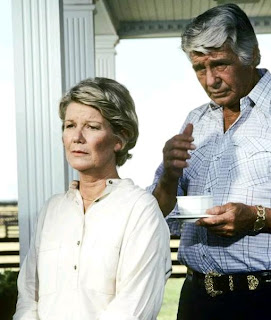 (Patrick Duffy), the show depicted a never-ending struggle for “control of Ewing Oil” along with a multitude of other storylines and scenarios. As the series opened, Jock and his wife sensitive Ellie (Barbara Bel Geddes) were stunned to find that Bobby had married Pamela Barnes (Victoria Principal), the daughter of one of Jock’s biggest rivals and Ellie’s ex-love, thus creating a sort of Romeo & Juliet sensibility. J.R., one of the most manipulative and ruthless (and popular!) villains ever seen on TV to that time, made it his business to rid the family of this new member. In fact, the series was intended to focus on Bobby and Pam, but J.R.’s popularity led to him becoming the character most identified with the show.
Other characters included Pam’s wacky brother Cliff (Ken Kercheval), chief thorn in J.R.’s side despite his battles with alcoholism, and J.R.’s wife Sue El len (Linda Gray), also an alcoholic, first a minor character not even listed in the opening credits, but soon to become a primary figure in the series. In time, these two would wind up as a couple, infuriating J.R. even more, though very few couples stayed together forever on Dallas. There was also Lucy (Charlene Tilton), the daughter of (mostly) unseen third son Gary, who acted out her angst by bedding down the ranch foreman Ray (Steve Kanaly.) In one of TV's looniest ever "twists," Ray was later revealed to be the illegitimate son of Jock, thus rendering these trysts uncle-niece incest, though the writers opted to act as if the liaisons had never happend.
The first episodes played out as a mini-series, with the self-contained stories genera lly having a beginning, a middle and an end. It was more of an adult family drama than a linked-together “soap.” This actually continued for quite some time until the legendary cliffhanger "Who Shot J.R.?" galvanized a trend in this and other similar series of always leaving the plot in mid-air "until next time". The stratospheric ratings for the season opener following his shooting guaranteed that all of the other soaps would try to outdo each other in this way, often featuring multiple cliffhangers with various lives hanging in the balance.
The shooter was eventually revealed to b e Kristin, Sue Ellen’s little sister and J.R.'s secretary (and lover), played by none other than Bing Crosby’s daughter Mary. Her character would eventually wind up dead, too, as many folks did over the years on the series. (Some of them had trouble staying dead, but that’s another matter!)
While there was occasionally a dot of wry humor here and there, the early seasons tended to keep a serious tone, avoiding the camp aspects that were present in other series (and eventually this one.) In fact, Hagman, Gray, Davis and Bel Geddes were all Emmy nominated in those early years, with Bel Geddes taking home a statuette in 1980.
The show also tackled many social issues at a time when there were few outlets for such things on TV apart from The Phil Donahue Show during the daytime. This was the era of The Love Boat, The Dukes of Hazzard, Three’s Company, Mork & Mindy, etc…, though Family and Lou Grant also managed to counter the fluff that prevailed on  television. Miss Ellie was stricken with breast cancer and had to have a mastectomy. Lucy had a boyfriend who turned out to be gay. Ray agonized about having to remove a nephew from life support. Sue Ellen took on a lover two decades her junior (though the social merit of a storyline like that could be debated! Christopher Atkins played Sue Ellen's son's swimming instructor, allowing him the amusing opportunity to parade around in little blue trunks.) This approach became a trend among other soaps as well, especially on the sister show Knots Landing (which, in a bizarre twist, had actually been created prior to Dallas, but shelved until after that show’s success.)
Davis, who stoically battled cancer without discussing it amongst the cast, died in 1981, the first major cast member to leave the series (and obviousl y not of his own choosing!) The writers nevertheless kept “Daddy’s” memory alive always and referred to him, his imposing portrait maintaining a significant place in the house long after his death. Bobby and J.R. (usually) strove to do what he would have approved of, sometimes falling short. Howard Keel as Ellie’s second husband Clayton Farlow then took over the patriarchal role, though J.R. never accepted him.
A far more crushing departure came in the 1984-85 season when Bel Geddes decided her health prevented her from continuing. A dreadful decision was made to replace her with Donna Reed. Reed, a lovely and respected actress (an Oscar-winner, in fact), was completely, utterly WRONG for the role and there wa s hardly a moment's peace during her tenure on the show. Her presence wrecked much of the quality of the scenes, though it was hardly her own fault. She never, ever should have been cast. With her bouffant hair, heavier makeup and showier dresses, Reed couldn’t have been further removed from Bel Geddes, one of the most natural-looking actresses ever. Bel Geddes had long been taken to task in the entertainment press for her frowsy clothes on the series. Perhaps someone thought that the character needed a makeover, but it didn’t work. Eventually, Bel Geddes dragged herself out of sick leave to reclaim the role herself and Reed was fired. Reed sued the producers and received a hefty out of court settlement, but was dead of cancer within a year with many people claiming that the stress of the whole matter hastened her illness.
Then there was the infamous incident in which Duffy decided to depart the show for supposedly greener pastures. At the end of the same season Donna Reed was on, his character Bobby was killed by the insanely jealous sister of his (by now ex-) wif e Pam. The following season, he was buried and Bel Geddes was back as Miss Ellie (though Tilton was now let go.) Sue Ellen allowed Bobby’s death to send her on a significant and hellish alcoholic binge. New relatives Jack and Jamie Ewing were brought in to pick up the slack left by Duffy’s departure and Tilton’s dismissal. Jack was played by Dack Rambo, one of the humpiest stars of the 70s and 80s, whose jeans could only barely contain his (apparently supernatural) genitalia! It was also not uncommon to find him lolling around the Southfork swimming pool in a speedo. A glamorous villainess appeared in the form of Barbara Carrera.
However, ratings dipped a little and Hagman (who had evolved into a producer for the show) missed Duffy, having little or no interest in the gay Rambo and disliking the female-heavy direction the series had taken. So Duffy was wooed back with more money. But what to do? Bobby had very visibly died onscreen and they didn’t want a twin or an imposter. They ultimately decided to turn the entire 1985-86 season into an elaborate dream that Pam had had! So she woke up, heard the shower running and stepped into the bathroom to see Bobby in the shower! Everything that had previously transpired since his murder was written off as a dream. It was a bizarre way to handle things and, though it did help extend the life of the series for a time, ratings never fully rebounded and, in fact, many fans felt cheated and unable to trust what they were viewing any longer and they gave up on watching.
Only a year after that, Principal decided that she’d have enough and Pam was also written out, horribly burned in a car crash and opting to leave her family. Rumors persist that she resented the  way other ladies, particularly Gray, managed to get the meatier storylines when she had been pegged as the primary female lead at the beginning. Incidentally, though I may be in the minority, I preferred the way Principal looked in the beginning – with her brunette hair and no bangs – to the way she looked later with a shaggy cut of pungent auburn. It might be also that the makeover happened just as Pam was becoming an unendurable whiner about pretty much anything happening at Southfork.
Only two actors remained on the series from beginning to end and those were Kerche val and Hagman. Duffy, however, was only out of the loop for one season. (Incidentally, few people ever realized that, though they portrayed brothers reasonably close in age, Hagman was actually 18 years Duffy’s senior, old enough to be his father!) J.R. manipulated endlessly throughout the 13 seasons, but somehow managed to leaven his evildoings with humor and interest so that the character remained an audience favorite, for some an obsession.
When the highly popular imitator Dynasty began to pose a real threat in the ratings, Dallas began to lose its ground in rea lity and also inflicted the worst excesses of 1980s fashion (which came about chiefly through Dynasty) on the ladies. If anyone thought that shoulder pads and sequins looked ridiculous on Joan Collins and Linda Evans, they would be decimated at the sight of some of the concoctions foisted onto Gray, Principal, Susan Howard and others. Only guest star Carrera was able to pull the look off. Nolan Miller had a knack for those clothes (even though he was capable of missteps, too!) and Dallas had no Nolan Miller (though they did hire Travilla for a little while in the mid-80s.)
Though Dynasty had the more opulent opening titles and a classy theme song, nothing can top the opening theme music of this show and the memorable way in which its stars were listed (with three shots of their faces appearing at once, a scheme that has been parodied often.) Click on the link below for one version of the credits, featuring what is probably the cast most identified with the series. http://www.youtube.com/watch?v=ZsVZUJVVaIE&NR=1
As the show wound up (though it had not ye t been decided for certain whether it would return for another season), J.R. took part in a Christmas Carol/It’s a Wonderful Life-type of experience in which he saw what things would have been like had he never been born. He was escorted on the journey by a mystical character played by the (annoyingly, if you ask me) impish Joel Grey. It was implied, but not shown, that he ended the episode by shooting himself, though a later reunion movie (one of two that were both highly rated) explained that he’d shot “the devil” in a mirror.
Though dated now, this was EVENT TELE VISION when it premiered. Fans went mad for the show all over the world (it still holds a record for the show being translated into the most languages and seen in the highest number of countries.) Games, books, bubble gum cards, paper dolls and even a little-known set of action figures were all marketed to tie-in to the show. A Texas company even came up with J.R. Beer!
 The series did overstay its welcome, but such is the way of TV, to milk something until it is completely dry before discarding it. A legion of fans keeps i t alive, first in syndication and now on DVD, and remembers how fun it all was in its day (and today as well, to those inclined.) There are plans for a pilot, even now, for a second-generation version of the series all about J.R. and Bobby’s sons, with Hagman, Duffy and Gray making cameo appearances in it.
 The airborne drama Skyjacked came out in 1972 and, though it isn’t a disaster movie in the sense that the plane isn’t crashing, it still belongs in the same basic family due to its all-star format and in-flight setting. Starring (who else?!) Charlton Heston as the pilot, it concerns a passenger jet, which someone onboard has decided to blow up if the crew doesn’t change its course to the destination desired. (I deliberately passed this film up in the somewhat chronological order I’ve been musing about disaster movies in, lest someone might think this is strictly a Heston blog, he was in so many of these types of movies in the 1970s!)
 with faces of the stars. This one tweaked it a bit by arranging them differently rather than in a row at the bottom. It also strove to project a “whodunit” aspect to the film and, though the movie does indeed take pains to shroud the identity of the hijacker for a fairly significant amount of time, the back of the DVD case gives the mystery away completely! So take care if you wish to be surprised when watching and ignore that until later.
 finally a skirmish with heat-seeking missiles (clearly most of the ideas had run out by that time!) Various TV-films dealt with ghosts, crashes into the Everglades, murderers and even one in which a plane flies into a skyscraper! Then there’s the loopy Starflight: The Plane That Couldn’t Land (released to video as Starflight One) about a state of the art craft that gets flung into outer space! Check out the old VHS cover here. (Click to enlarge.)
 ddenly there are lipstick-written messages (the first one on a mirror in the lavatory!) demanding that the flight plan be rerouted to Anchorage instead or else a bomb will be detonated. Not only does Heston have to contend with a hijacker/bomber, but also he doesn't even know who the culprit is, just that he or she is likely a member of first class. Meanwhile, the camera keeps finding ways to land on various tubes of red lipstick!
 of the film a bit of a mystery. It also makes for some serious tedium, as the script can't allow viewers to know much about the people on board, lest it become obvious who is or is not the passenger with a screw loose. So the various stars have to maintain a certain level of suspicion about them while also striving to deliver facets of themselves that would make the audience give a care about them. For the most part, they aren’t too successful with this, though the script is probably the main culprit.
 ell here, even showing some shades of vulnerability at times. Check out the mushroom cloud of smoke he has coming out of his pipe in the cockpit! Hunky former Tarzan Mike Henry plays his co-pilot and the two are in the midst of a love triangle over attractive chief stewardess Yvette Mimieux. Henry is her current lover, though she used to be with Heston. Their past love affair is displayed in some loony, “arty” flashbacks, the kind Airplane! would later make fun of.
 dge Family) manages to find time to flirt with sweet Nicholas Hammond. We all remember Hammond, of course, from his appearance as Friedrich Von Trapp in The Sound of Music. He’s on board the flight with his U.S. senator father Walter Pidgeon. Pidgeon attempts in vain to inject weight into his paper-thin part.
 t least Mariette Hartley gets a chance to fret some in her clichéd role of the panicky pregnant woman (and orders a Bloody Mary to drink! Take that PC people.) Claude Akins appears in a role George Kennedy would likely have played if he hadn't been stretched so thin in virtually every other disaster film of the decade. Leslie Uggams, in her film debut, plays a confident stewardess whose final line is amusing if a bit unlikely.
 build some mystery about the bomber. Sadly, this just isn't handled well enough to work to the film's advantage. When the hijacker is revealed, things take on a more tense feeling, but there are really very few times when anyone in this movie acts like a real person. The passengers react to the news of a hijacking the way they might react to finding that the plane is out of smokehouse almonds. At least in Airport, the star-studded cast members each got a chance to shine, even if some of the stories were silly. Here, the characters are almost strictly cardboard props.
 uction design and color scheme, its aerial photography, its unusual music score, its generally serious tone and its eclectic cast of familiar faces. I live for those cool, cadet blue stewardess uniforms that once were the norm, though movies always seemed to contain even more sharp ones than real life.
 f particular interest or depth. The editing and continuity on the film is also poor. Chunks of activity seem to have been left out such as Henry bandaging Mimieux's cut. Also, Mimieux's hair goes from loose to pulled-back to loose within moments.
 when busy character actor John Fiedler has his voice hilariously and ludicrously over-dubbed. There's a lack of urgency to the movie, typified by (the still-lovely) Crain when she has a chance to get off the plane and decides to smooth out the suede in her hat instead. It's doubtful that anyone but die-hard buffs will find this anything much beyond tiresome, but at least it isn't an over-the-top mess like so many of today's movies.


