Well, as I noted in an earlier
post, I've been feeding my nostalgic little soul recently with trips to youtube.com in order to watch old made-for-television movies. Pared of their commercials, these delights only run about an hour and fifteen minutes, give or take, and feature many of the stars I grew up loving. It's been so much fun to revisit these (or, in most cases, see them for the very first time!) You may view them yourselves by clicking on the titles of these telefilms.
First up is the 1972 mystery
Haunts of the Very Rich. In it, seven people are on board a well-heeled airliner with room to spare. They are headed for a luxury resort which promises to fulfill their desires in a very individualized way. (This telefilm is very much, at least in scheme, like a precursor to
Fantasy Island right down to the tropical setting and host Moses Gunn's all white clothing and mystique-filled manner.)
Guests include libidinous Lloyd Bridges, exhausted Anne Francis, “Plain Jane” Cloris Leachman, aggressive businessman Ed Asner, clergyman Robert Reed and affectionate newlyweds Tony Bill and Donna Mills. (Interestingly, both Leachman and Asner were appearing on
The Mary Tyler Moore Show at the time.) Upon arrival at the secluded and remote hotel, these folks are appointed rooms which mirror almost exactly what they would like or expect out of a fantasy vacation. Then a storm knocks the power out and they find they are trapped with no electricity and precious little food and water. Believe it or not, this is really the least of their problems!
A solid cast of familiar faces does well with the sometimes difficult storyline, with each one of them (with the possible exception of Bill and Mills) getting a chance to show off his or her acting talent. Mills does at least get one enjoyable realization scene towards the end. It's campy, yet serious, tacky, yet glitzy. Leachman gets an amusing makeover during her stay. The filming locale is an actual estate in Miami called Vizcaya and it's impressive indeed! (See below an old and a more recent view of the place.)
I had been wanting to see 1972's
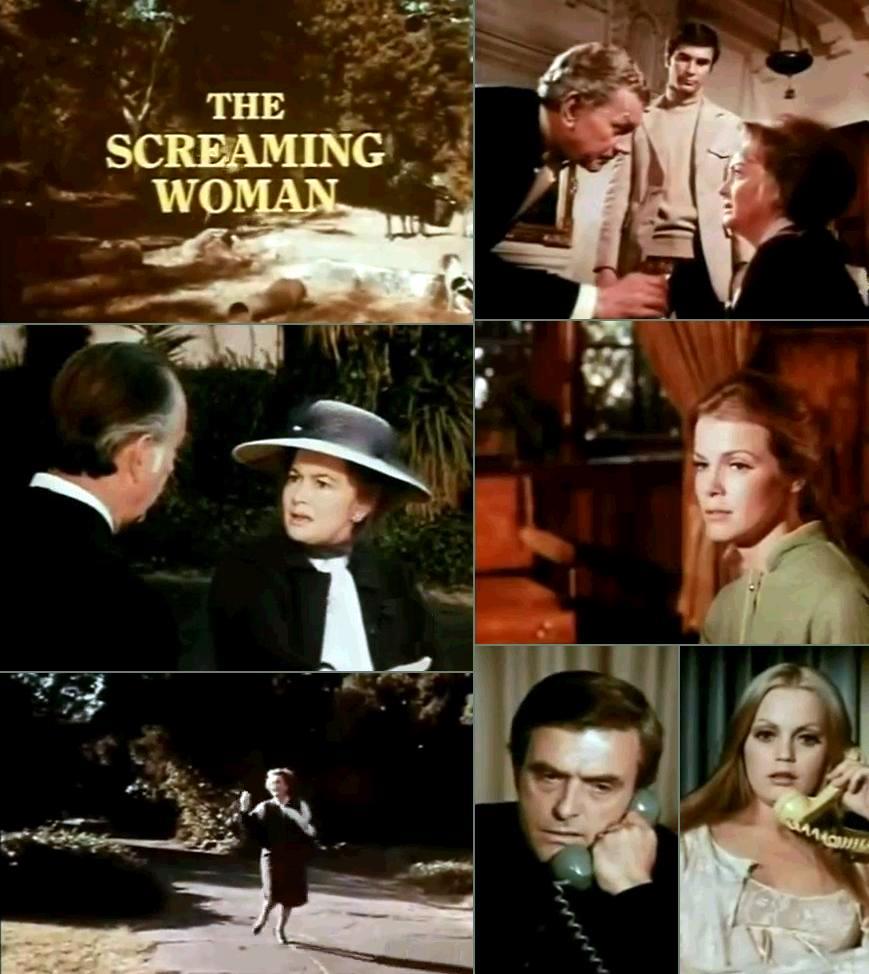
The Screaming Woman for some time and finally got around to it. Here, we have Miss Olivia de Havilland as a wealthy, recently released mental patient who happily goes for a horse-drawn ride in her buggy until stumbling upon a whining, digging dog. When she goes to investigate what's wrong, she hears a woman moaning for help UNDER the ground! This sends her into hysterics and she runs all the way back to her mansion for help.
Unfortunately for her, her sap of a son (Charles Robinson) and her scheming daughter-in-law (Laraine Stephens) don't believe her far-fetched tale and actually would love to see de Havilland sent away for good so that they can sell her property for a hefty profit. Land developers are building family homes in the neighborhood and want a nice chunk of hers. These neighbors are a source of potential help as de Havilland ignores her family's (and her doctor's) warning and strikes out to rescue the trapped woman.
De Havilland is surrounded by a host of familiar TV and movie faces including
Peyton Place's Ed Nelson, cinema veteran Walter Pidgeon, Charles Drake, Lonny Chapman and her old
Hush, Hush... Sweet Charlotte costar Joseph Cotten. Also on hand is late-'60s/early-'70s blonde bimbo Alexandra Hay.
The tight, contrived movie (which easily could have been part of a one-hour suspense anthology, too) is simultaneously terrifying and unintentionally funny. Liv is sort of goofily polite (even though no one in the neighborhood thinks of her that way) and helpless, but there is no denying the severity of the dire situation (which is never hidden from the viewer even at the outset) and you can't say she isn't engaged. (And she still knows how to deliver a close-up.) I enjoyed this quite a bit despite its shortcomings.
I find any kind of '70s disaster movie, whether a feature or made-for-TV, difficult to resist. Thus, I was thrilled to come upon 1974's
Skyway to Death. I was even more excited when I saw that the cast consisted of Stefanie Powers, The Mod Squad's Tige Andrews and former teen idol Bobby Sherman. The project also starred Ross Martin, Nancy Malone, John Astin and amusing little old lady Ruth McDevitt.
Sadly, despite a reasonably promising beginning, in which a disgruntled tram worker deliberately makes the title vehicle become disabled while carrying eight people (with a storm approaching!), this just never came to life. It was never exciting, often stagnant, and I don't believe anyone died, which makes the title of it a lie. Couldn't the tram at least send everyone toppling over at some point? Zzzzzzz...
One thing I thought was sort of interesting was that McDevitt (the doddery pet shop owner from 1963's
The Birds) pilfered a roll from the mountaintop restaurant and told Powers that it was “for the birds.” Another thing that was welcome was the fascinating glimpse into the place where this movie was partially shot, the Palm Springs Aerial Tramway, an attraction that still operates today, but with better, more scenic-friendly people-carriers and a nicer restaurant.
Next we come to 1971's
The Failing of Raymond, in which Oscar-winner Jane Wyman portrays a teacher on the verge of retirement who is confronted by a one-time student harboring an intense hatred for her over a long ago test score. It seems that one day as a substitute, Wyman had just broken up with a married boyfriend and was unduly distracted and out of patience. The student (played in the past and present by Dean Stockwell) misunderstood the test and she didn't allow him to fix it, so he failed.
Now, fully grown and having escaped a mental institution, Stockwell is planning to force her to let him retake the test and has daydreams of killing her as soon as she's passed him! He goes to the school in order to accost her, but upon arriving is mistaken for having responded to her ad for a helpmate in packing up her classroom items!
She's distantly polite to him, never dreaming what he has in store for her. His plans must take a backseat when some of her co-teachers announce that she's going to a party in her honor (one of who is played by Priscilla Pointer, center, and another by Mary Jackson, memorable for her recurring role on
The Waltons.) Stockwell will not be deterred, though, and returns the following day to carry out his plans. Wyman's central performance is supplemented by those of several other veterans including Murray Hamilton, Tim O'Connor and Dana Andrews (who plays her ex-lover.) There are two other actors of note, seen here in the middle and bottom pictures. Recognize them at all? It's not easy!
The older gentleman is Paul Henreid, playing a doctor of psychiatry (trading somewhat on his long ago role in 1942's
Now, Voyager opposite Bette Davis.) The girl, a fellow patient of Stockwell's won the role (her screen debut) thanks to the fact that her father was the director, though she did go on to carve out some acting success on her own. The director of this movie was Boris Sagal and this girl is his daughter Katey Sagal of
Married with Children (1987-1997) and
8 Simple Rules (2002-2005.)
Now it was time to satisfy my appetite for Donna Mills (something that didn't take place with her smallish, rather inconsequential role in
Haunts.) I turned to 1973's
The Bait. In it, someone is ritualistically raping and murdering pretty young women and the police have thus far been impotent in stopping it. Undercover policewoman Mills, who most often works in drug sting operations and surveillance, volunteers to help lure the maniac into coming after her, hence the movie's title. Her superior, Michael Constantine, sets her up with a showy apartment and a job in the district where the attacks have occurred.
A widow with a young son (and a handsome, seemingly patient boyfriend), she relies on her kindly mother-in-law June Lockhart for sitting help. Interestingly, she has a black and a white pair of partners in her scheme to nab the killer, a concept that would also pop up a year later when Angie Dickinson starred in the groundbreaking series
Police Woman. 1973 was a key year for female police officers as Sue Ane Langdon played one on an episode of
Police Story as well.
Mills reports to work (in increasingly shorter skirts and with increasingly flashy hair and make-up, when her initial cries for attention don't work!) and combs the neighborhood trying to get an angle on the case. She befriends a local diner waitress (the eternally chirpy Arlene Golonka) and gets to know the amiable bus driver who takes her to work each day (played by William Devane, who would later costar with her quite memorably on
Knots Landing!) Finally, she does begin to receive phone calls from the nutjob and eventually has to fend him off, but not before endangering her son and his grandma.
Moving on, I chose to view the 1972 thriller
The Victim, starring Elizabeth Montgomery. In the wake of
Bewitched's cancellation that same year, Montgomery was keen to reestablish her reputation as a dramatic actress and began a lengthy string of serious telefilms, the first of which was this one. (Later, she would star in
A Case of Rape in 1974,
The Legend of Lizzie Borden in 1975 and the remake
Dark Victory in 1976, to name just a few.)
Here, she plays a wealthy woman who is concerned about her younger sister (Jess Walton, who later spent many years on
The Young and the Restless as Jill Abbott.) Walton lives in a handsome lodge, practically in the middle of nowhere, and is having serious marital problems. On a whim, Montgomery decides to make the drive to be with her, but unfortunately a major storm is brewing. She arrives at the house, drenched by the torrential rainfall, only to find it empty but for the family cat.
Appearing on the scene is quasi-neighbor and part-time house-keeper Eileen Heckart, who makes little pretense at friendliness or accommodation. She sloughs around (in an amusingly careworn way) with hardly a care in the world as to what might have happened to Walton. As we soon find out (though Montgomery hasn't yet), something HAS happened to Walton because her open-eyed corpse is lying in a large basket on the premises!
Phoning in (literally!) a two-part cameo is bubbly, crazily-expressive actress Sue Ane Langdon as a concerned friend of Walton's who wonders what has become of her. It's unlikely, based on the way these scenes were shot, that Langdon even met up with any of the movie's costars! Anyway, as the storm picks up steam (crazily sending a massive tree limb through one of the house's upstairs windows) and the electricity is lost, Montgomery's fears accelerate. They are partly relieved once Walton's husband George Maharis returns to his house, but the troubles aren't yet over.

Montgomery is very compelling to watch (which is a good thing because she's practically the whole show here!) and kudos to her for being able to leave Samantha Stevens behind (though sometimes we kind of wait for her to wriggle her nose and give herself a hand with the various problems that crop up.) Heckart is also terrific, as usual. Maharis has little to do and arrives to the proceedings quite late. The ending is both muddled and rushed, which is a shame since there is true suspense built up beforehand.
That same year, the TV-movie
The Astronaut was aired. This one concerned a mission to Mars (set in the future, but under ten years so) in which one of the astronauts is felled my a mysterious condition. Due to fear that the space program's budget will be cut as a result, a few NASA execs (Jackie Cooper, Robert Lansing and Richard Anderson, who would soon be part of another top secret mission on
The Six Million Dollar Man) conspire to cover up the man's death.
They, with the dead astronaut's prearranged blessing in the event of his death, hire a man who looks much like him (Monte Markham plays both parts) and put him through both surgery and an intense training program. Thus, when the one living astronaut (James Sikking) comes back to Earth, they can slide the imposter into the rescue helicopter and proceed as if nothing is wrong! The one snag is that the real astronaut has a pregnant wife (Susan Clark) who cannot be upset for fear of losing the baby.

Markham is coerced into returning to Clark and posing as her husband. Unfortunately for the conspirators, it turns out that the imposter is actually nicer and more considerate than the dead man he's replacing and it is this which raises Clark's antennae! Complications ensue which lead to Markham and Clark fighting, but then coming to an understanding. However, Markham by that time is considered a top security risk... The undeniably far-fetched story is given a great try by the cast and director, with Clark turning in a great performance in what is the project's meatiest role.
My never-ending thirst for 1970s disaster led me next to the 1974 flick
Heatwave! In it, the city of Los Angeles begins to experience a series of record-setting high temperatures, rendering its citizens into sweaty, faint, agitated, powerless people who have little to no way of escaping the broiling conditions. Young married couple Ben Murphy and Bonnie Bedelia wake to find their air conditioner on the fritz and the tap water brown with muck. (Even though he isn't naked in this short to the right, I like to pretend he is!) For a while, his stock brokerage office remains open, but eventually can no longer operate. Meanwhile, she, pregnant with their first child, collapses at an overcrowded laundromat.

In a bid to escape the brutal, suffocating conditions of the city, they opt to visit her parents' cabin up in the mountains, but getting there becomes a trial in itself. First, they visit a diner with no electricity at which they are limited to one small glass of lukewarm water apiece. Then, they are stopped by a frantic, stranded man who proceeds to steal their car! They have to proceed on foot for several miles through rugged terrain with no provisions and only the hope of a stream for hydration.
Once they've finally reached the cabin, they discover a couple of teenagers have already taken up residence there (!), but they come to an understanding about that. Still, with Bedelia suddenly forced into premature labor, things get quite dicey, though there is a kindly doctor (Lew Ayres) nearby who may be able to help. What really creates a problem, though, is that Murphy and Bedelia's premature baby is in dire need of an incubator, but not only isn't there one around, but there isn't electricity or fuel to run it anyway!

While this was a reasonably captivating TV-movie, it seems a shame to me that anyone would cast Ben Murphy in a project about a heat wave and then allow him to wear any clothes. Ha! He does start out the movie in a pair of shorts, but otherwise is almost always covered up (in, oddly, yellow in virtually every case!) He should have been naked or in a loin cloth. He also is given some unappealing glasses to wear (and, in fact, is pretty whiny and annoying throughout.) One of the chief surprises is a scene in which the visibly pregnant Bedelia is offered a cold beer and takes it without anyone including herself blinking! You'd be luckier in finding a Hollywood actress without Botox than such a scene in a movie today!
Probably the most disappointing of all the 1970s TV-movies I've watched in the two recent marathons I've done is this next one, 1975's
The Missing Are Deadly. (A better copy, but annoyingly broken into parts begins
here.) In it,
Peyton Place's Ed Nelson and
Star Trek's Leonard Nimoy are dueling scientists, attempting to combat a deadly bacterial plague, but going about it in different ways. Nimoy, against Nelson's advice, proceeds to work on fighting it with a virus injected into laboratory mice and things get out of hand when Nelson's sons (George O'Hanlon Jr & Gary Morgan) come to the lab and one of them (Morgan, who is mentally challenged) steals one of the infected mice! The caretaker for the boys, by the way, is Irene Tedrow, known to millions as cat-owning Mrs. Elkins of
Dennis the Menace from 1959 - 1963.
The boys go off on a camping trip with O'Hanlon's girlfriend (played by Kathleen Quinlan), infecting people all the way. One of the infected is Quinlan's fixy mom, Marjorie Lord, and she, like anyone else who has come into contact with the mice-wielding teens, soon becomes ill and has to be quarantined until a cure can be implemented. Her hair doesn't seem to suffer too much in the process, though. Also on board is slumming Oscar-winner Jose Ferrar as another doctor working on the situation. The premise sounds somewhat exciting, like a pre-
Outbreak (1995), but the execution is pedestrian, the writing uninvolving and pat and the characters cardboard, so that they finished project comes off as little better than an expanded episode of
Shazam! or
Isis... Incidentally, were you aware that Lord (of
Make Room for Daddy) is the mother of Anne Archer?
Still thirsty for disaster, I next and finally (for now) checked out the 1974 telefilm
The Day the Earth Moved. The title graphics on this one are amusing because after the name of the movie comes up, the letters crack and then fall apart! This one concerns Jackie Cooper as a pilot who co-owns an aerial photography business with Cleavon Little of Blazing Saddles, released this same year! The two, along with Cooper's dog (“Dog is My Co-Pilot??”) are surveying a stretch of desert for plans to build a retirement community and they fly over a rickety, one horse town. Later, Cooper is driving back home on his own and is ticketed for speeding through that town. He has $20 on him, but the fine is over $100! So he is forced (like something out of an old western!) to work the fine off by clearing rocks, garbage and other debris out of a run-down, immensely-dilapidated former tourist attraction with a Christmas theme.

He is given a rake and must work in sweltering heat in order to work long enough to get his impounded car back. The townspeople aren't exactly evil; more desperate, since the shithole of a place has less than nothing going for it. Cooper even has a secret good Samaritan who keeps giving him luxuries like a beer, an apple and a radio. (Cooper was fifty-three at the time and in admirable shape, with full and partial shirtless scenes. ) Meanwhile, back home at the office, Little and Cooper's wife Stella Stevens are starting to worry about what's become of him. Cooper continues to work off his fine, though he also has a eye towards escaping. He finally gets his chance, but leaves his dog with a helpful little girl he's befriended, promising to come back some day.
Once home, he is informed that there is something wrong with the film he'd been using on that initial flight. Eventually, it is discovered that the “defective” film is actually startlingly accurate at predicting earthquakes and, based on the data, the burg he was just held prisoner in is due for a big shake-up! Trouble is, his plane has been impounded due to lack of funds. Cooper, Little and Stevens steal back the plane in order to go and save the townspeople (who consist of the always welcome Lucille Benson, William Windom, Beverly Garland (in a hideous, cheap wig), little Tammy Harrington and a few others. Unbelievably, they all stand around debating while the earth rattles serious warnings at them! Finally, the ground starts really quaking and it's time to go, but several folks have ignorantly wandered back to their homes or other places to retrieve things.

The climax of the film (in the final dozen minutes or so) contains some surprisingly decent special effects work. It certainly didn't take much to trash the flimsy, hapless buildings, but there are also water and fire effects and, considering the time and the budget, it comes off pretty well. It's also unintentionally hilarious to watch the goofy citizens of the town being rounded up as the bewigged Garland watches in horror from the plane. Stevens has one true LOL moment when she has to keep an old geezer from trying to bring along a bunch of dusty, ragged tools and finally screams, “Come on!” in her best
Poseidon Adventure voice.
The most fascinating credit for me was that this movie of the week was produced by Bobby Sherman, his only attempt at doing so, and the music for the film was also provided by him. When watching the film, I couldn't help noticing how unusual and unconventional the music was for a project of this time and type, not that I'd say it's amazing. Just different. So, it was interesting to see that Sherman was behind it. These are the only credits he has for producing and composing, though it seems to me that he did fairly well on both counts.


I doubt that I'm through wading through these nearly forgotten products of an earlier time. Bless the uploaders at youtube.com for making these available to those of us who enjoy glimpsing them again (or for the first time.) As you can see from this sampling, the stars overlap sometimes, as this was a nice opportunity for people to continue working once their series was on hiatus or cancelled (or their film career had petered out.) It's fun, in most cases, to see these people in action in a different light than we may be used to.