 Before that, however, she was a heroine in many motion pictures, the most notable one a science fiction classic.
Born Dagmar Winter on June 8th, 1931 in Berlin, Germany, her father was a surgeon married to his Hungarian-born wife. She was raised for the most part in England, but at the age of sixteen, her father (and his second wife) moved the family to Southern Rhodesia, a place he had visited during one of his cases and had fallen in love with. The young girl sought to follow in her father's footsteps and enrolled in the medical program at Rhodes University, the solitary female out of 150 students. While there, she took part in some theatre and was soon bitten by the acting bug.
 By the time she was nearing twenty, she returned to England and began to pursue roles on the stage. Before long, in 1951, she started landing small, uncredited parts in British films such as Lady Godiva Rides Again (actually about a beauty contest, not the legendary streaker.) Fellow fledgling actress Joan Collins was among the film's contestants. She was mostly used in parts that took advantage of her sleek figure and dark good looks. The Crimson Pirate and Knights of the Round Table were big, Hollywood studio films that were filmed in England and she had decorative roles in each. Knights' leading man was Robert Taylor. Little did she know, as she played a handmaiden in this movie, that a scant three years later, she would be his leading lady!
 An American agent spotted her in a play and convinced her to come to the U.S. where he would represent her. She left for America in 1953, unsure of her future, but hopeful nonetheless. She changed her name to Dana (which rhymes with Donna, taken as inspiration from Lana Turner) and replaced the i in her last name with a y, making her Dana Wynter. Obviously making an impression when shown to the studio representatives, she fielded several offers before eventually signing with 20th Century Fox.
 Before this, she had been put to work in some California-based television to get her feet wet. She also had the good fortune (in hindsight) to be new enough to Hollywood to not be able to command a star salary, for it was this element that led her to be used in a low-budget science-fiction film that would forever assure her a place in sci-fi/horror film history.
 Walter Wanger was making a movie for Allied Artists that would finally come to be known as Invasion of the Body Snatchers. He wanted to cast either Gig Young, Dick Powell or Joseph Cotten as the male lead and Anne Bancroft, Donna Reed, Kim Hunter or Vera Miles as the female lead. However, when the studio insisted on a reduced budget, he was forced to go with unknowns or TV actors in these parts. His “bad luck” was great fortune for not only the actors chosen, but also for audiences of the film as well. He wound up with Kevin McCarthy and Dana Wynter.
 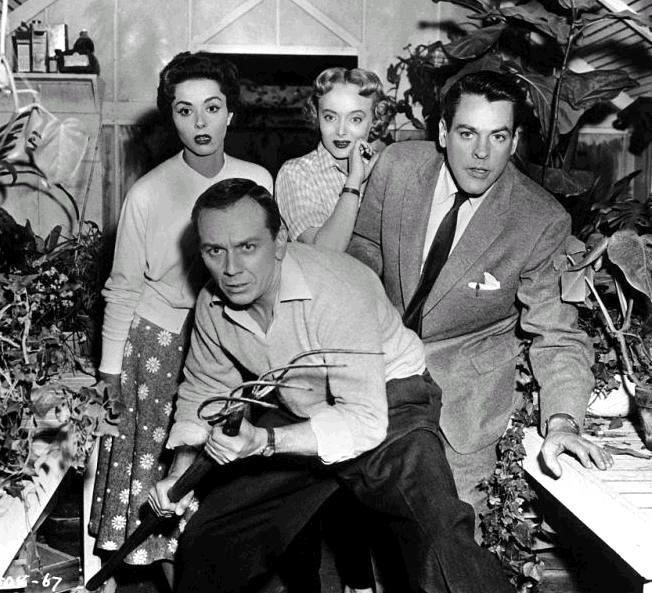 The tight (eighty-minute), taut, black and white thriller is about a small town whose inhabitants begin acting emotionless, sullen and drone-like for no apparent reason. It is discovered that alien life forms have come to rest on Earth and form pods, large vegetation-like objects, that morph into replicas of nearby humans, finally taking their places when the victims are asleep. McCarthy and his elegant girlfriend Wynter are among the few people unaffected, at least at first, and they – along with pals King Donovan and Carolyn Jones – strive to stay alive in the face of overwhelming odds against doing so.
  The story is creepy, fast-moving and ultimately unforgettable (it has also been remade or reworked over and over again and rarely with the same level of effectiveness as the original.) McCarthy, who had a screen career that lasted nearly seventy years!) was, perhaps, never better and at times looked strikingly handsome, especially when disheveled. (Check him out in a couple of these photos and see if you don't agree.) Wynter was positively worshipped by the black and white celluloid and comes across breathtakingly lovely in the film.
  The movie was made in less than four weeks for under $400,000 and made back more than double its cost in the first month of release. It eventually made over two and a half million dollars and is considered a hallmark of the genre. Fans have examined it, applying political subtext to its plotline, though everyone associated with the making of it denied that there was any such deliberate agenda. They just wanted to scare the bejesus out of people and they did.
 Due to the protracted post-production and release of Invasion, U.S. audiences would actually first see Wynter in the second film she made (her first at her new home of 20th Century Fox.) The movie, The View from Pompey's Head,
 was based on a best-selling novel from the prior year. Starring Richard Egan, it concerned a New York lawyer who goes to Pompey's Head, South Carolina to search for the author who is due royalties from a publication. Once there, he is confronted with various class prejudices and the presence of racism that had led him to flee the south years before. However, he comes upon his old girlfriend (Wynter), who is now married to high-strung businessman Cameron Mitchell, and can't quite escape as quickly this time. The film is all but forgotten now and has never been released on VHS or DVD, though there are plenty of folks interested in seeing it after all these years. Still, she made enough of an impact to win The Golden Globe award for Most Promising Newcomer in 1956.
  Still fairly new to Hollywood, she was swept off her feet by one of the town's all-time celebrated lawyers and ladykillers, Greg Bautzer. Bautzer had been involved with Lana Turner, Dorothy Lamour, Joan Crawford, Ginger Rogers, Barbara Payton, Terry Moore and heaven knows who else. (He was later portrayed, in first name only, by Steve Forrest in Mommie Dearest.) Married in June of 1956, they honeymooned in Honolulu, Hawaii.
 Next for her was D-Day the Sixth of June, a three-cornered romance set against the onslaught of WWII. Taking place in England, it tells the story of a Red Cross worker (Wynter) whose boyfriend Richard Todd is off fighting the war until he goes missing. She finds herself falling for an American officer (Robert Taylor)
 who is married, himself. They slip into a clandestine affair, fed by their fear of the future, until – uh, oh! -- Todd returns home alive! Just as many films, before and since, have depicted a love triangle interrupted by battle, the finale is dictated by the world-shaking events around them. Wynter, who had to be in shock playing the lover of an actor who only three years before was the star of one of her earliest movies, counted this as the favorite of all her pictures. For a lot of viewers, though, the title promised more action than romance. Perhaps if they'd kept the original title of the source novel, simply The Sixth of June, it wouldn't have been so misleading. Jean Simmons was initially meant to play Wynter's role, but was reassigned for some reason.
 She was lent to MGM for her next picture, a project for which she couldn't have been better prepared, having spent several years in Africa. Something of Value was a drama examining the racial tensions of the whites in Africa and the native citizens who are on the verge of uprising against their unwelcome governors. She played the wife of Rock Hudson (also being loaned to MGM by Universal Studios) who is forced to confront his childhood friend Sidney Poitier when their political affiliations become divergent. Location filming in Nairobi, Kenya could probably have been better showcased had the film been in color and not black and white and that may be part of the reason that the film is not as enduring as it is (that and maybe the utter lack of an accent in Hudson's “British” character!)
 1958 marked the first time that Wynter was cast as the primary character of a movie. Instead of being just the glamorous wife or girlfriend of the male star, she was top-billed and featured as the primary focus of Fraulein. Fraulein told the story of a demure German girl who, through the devastating circumstances of WWII, is forced to hide, nearly starve to death, do hard labor and is nearly raped and almost coerced into prostitution! These are only a few of the events that befall her character in this dramatic saga. Filmed amid authentic Eastern European locations, Wynter shines in the demanding role. Her customary dark locks are lightened a bit here (to make her seem more German or to soften her potentially hard looks?)
  She is put through the mill and eventually shown kindness by an American soldier (Mel Ferrer) who she once begrudgingly helped to hide from her country's military.
 As always, she looked sleek and attractive throughout and was able to rise to the occasion of the very eventful story, but for whatever reason the movie didn't live up to the expectations the studio had for it. She would not be a headliner again, at least not during her days at Fox.
 Later that year, she was part of the ensemble in In Love and War, yet another WWII movie about three U.S. Marines who, you guessed it, take part in love and war! Robert Wagner was paired with Sheree North, Jeffrey Hunter with Hope Lange and Bradford Dillman with Wynter, cast as a high-living, promiscuous socialite. This ultimately leads Dillman to set his eyes on island girl France Nuyen. Of the female roles in the film, it was the meatiest and she handled it well.
  1959 brought another movie that took place outside the U.S. Shake Hands with the Devil starred James Cagney and Don Murray and examined the 1921 conflict between Ireland's IRA and the British forces sent to thwart them. Wynter played an English girl held hostage in the crisis who attracts the attention of young medical student Murray. She also appeared during that year's Oscar ceremony, singing in the unlikely trio of herself, Joan Collins and Angela Lansbury, an English-tinged number called “It's Bully Not to Be Nominated.” (Incidentally, that broadcast is the Academy's shortest ever, due to extreme streamlining by producer Jerry Wald. It clocked in at an hour and forty minutes! It's a shame Wald is no longer with us!)
 In January of 1960, Wynter gave birth to her son Mark, by husband Greg Bautzer.
 She had been pregnant during the filming of her next released movie, though it certainly didn't show in her crisp, sleek uniform. (However, in the shot to the right of the two here, there seems to be a hint of fullness in her torso, perhaps taken towards the end of the shooting schedule?) Sink the Bismarck! was still another WWII-era film concerning the British Navy's attempts to stop a powerful, new German battleship called The Bismarck. Wynter played the cool, skillful assistant to Kenneth More, the Captain in charge of the operation.
  For Dana Wynter, there seemed hardly any way to make a movie that didn't concern WWII and that fact remained so in 1961 when she was cast opposite Danny Kaye in On the Double. Though she was at least in a comedy this time, the storyline still took place in 1944, just prior to the D-Day invasion!
 She played the wife of a British General
 who is replaced with an American lookalike (both roles played by Kaye) as part of a plan to flush out attempted assassins and German spies. Kaye fools many people (including the General's heavy-tippling sister Margaret Rutherford), but isn't able to get anything past Wynter. Eventually, the real General (who was no longer in love with Wynter anyway) is disposed of and the imposter and Wynter fall in love themselves.
 Wynter dabbled a bit on TV (appearing on The Dick Powell Theatre, Wagon Train and The Virginian)
 until her next movie in 1963. This was the gimmicky mystery The List of Adrian Messenger, starring George C. Scott as a man trying to unravel the reason why men on a list of names have all died under mysterious circumstances. The film's conceit was that several supporting characters were played by major stars such as Kirk Douglas, Tony Curtis, Burt Lancaster, Robert Mitchum and Frank Sinatra in heavy prosthetic makeup. (It was later revealed that actor Jan Merlin actually played some of these parts and that a few of the actors only showed up for a “reveal” segment at the end. Nice...)
  Little did Wynter know that this would mark the last time she appeared in a feature film for five years. The end of her contract and the end of the studio system as it had existed in general meant that many performers were left floundering on their own for work. She remained busy, but in television now, guest-starring on The Alfred Hitchcock Hour, Twelve O'Clock High, Run for Your Life and even, surprisingly enough, My Three Sons as a brief love interest to that show's star Fred MacMurray. Her marriage hit a snag around 1964, but she and Greg were able to work through it and reunite before too long.
 In 1966, she took part in a regular series role on The Man Who Never Was. A bit of a riff on her earlier role in On the Double,
 she played the wife of a millionaire playboy who is mistaken for a spy and killed. When the spy takes his place, she decides to go along with the ruse rather than reveal him and, just like she did with Danny Kaye, in time falls in love with the imposter! The glamorous show only lasted for 18 episodes, though a couple of them were re-edited together and made into a theatrically released movie called Danger Has Two Faces (this patching together of TV shows into feature films was a fairly common practice at that time amongst studios that made both types of entertainment. Anything to wrong another dollar out of something.)
  Her next movie (that was actually intended to be a movie all along) was the provocative 1968 flick If He Hollers, Let Him Go! The story involved a black prison escapee (Raymond St. Jacques) who is coerced into trying to kill Wynter by her deceptive husband. He was already innocent of the crime he went to prison for and, thus, is reluctant to take part in this one. The film is notable for Wynter for two reasons. One is that she has a fleeting nude scene, the only one in her career and the other is that her husband is played by her old Body Snatchers costar Kevin McCarthy.
 Now a go-to girl for any TV series that needed a dose of elegance and refinement,
 she was a guest on several shows from The Name of the Game to Robert Wagner's It Takes a Thief. Her always slim figure showed off those sleek '60s clothes beautifully while her hair was done in various fancy ways. She found she was able to aptly convey villainy and took pleasure in playing parts different from the worried, stalwart heroines she was known for. She also could occasionally dip into comedy, as when she worked on Get Smart, the spoofy spy series that starred Don Adams. The creatively title episode Widow Often Annie had her playing a tennis-playing woman named Ann who weds and then kills various agents from Adams' team.
 She also made television movies, including Any Second Now, a yarn about photographer Stewart Granger who tries to kill his heiress wife Lois Nettleton when she finds out he's been cheating on her and threatens to leave him with no money. Nettleton lives, but has amnesia, so he then tries to find ways to have her die in an accident before her memory comes back and she can recall his deceipt.
 1970 brought the film Triangle. Despite her billing as the star, she really only had a supporting role in a film about bad girl college student Tiffany Bolling and her various adventures. Wynter played the headmistress of Bolling's school who struggles
 with the dent that an illicit affair might have on her reputation. That same year, however, she had a supporting role in the biggest hit of the season, Airport. I have a post here devoted to Airport and her character of Cindy Bakersfeld (Burt Lancaster's shrewy, social-climbing wife), so I won't go on about it again, but she was deliciously nasty and commandeering while somehow adding a layer of compassion and humanity to the one-dimensional role.
 Airport, a monster hit that enjoyed ten Oscar nominations including Best Picture, didn't lead to any immediate movie roles for Wynter, however.
 She kept busy on the hot TV series of the day: Marcus Welby, M.D., The F.B.I., Hawaii 5-O, Ironside and Owen Marshall: Counselor at Law. In 1973, she made the movie Santee, a western starring Glenn Ford and an early experiment in the use of videotape versus film. In it, she played his loving, compassionate wife, who is there when he brings home a boy whose gunslinging father Ford has just killed. The boy (Michael Burns) has plainly stated
 that he will exact his revenge on Ford at the first opportunity, but Ford, Wynter and their ranch hand Jay Silverheels hope to sway him to staying and becoming part of their family.
 In 1975, she made Call Me Savage, a French film that starred Yves Montand and Catherine Deneuve as lovers. Wynter played Montand's American wife, the owner of a cosmetics firm that cannot operate properly without Montand as he was the one who developed the comapny's perfume formulas and is the only one who still knows them. This would turn out to be Dana Wynter's final feature film.
Nevertheless, there was still plenty of work ahead of her. She did the rounds on The Love Boat and Fantasy Island and appeared on The Rockford Files and Hart to Hart. In 1981, she and Greg Bautzer finally divorced. She never remarried.
 She began to divide her time between California and Ireland, a place she absolutely adored and eventually purchased property in. She started to develop a writing career reflecting on her life in both of these places through articles in a column. She made several appearances on the Irish television program Bracken, a show that starred a pre-fame Gabriel Byrne. She also traveled to Hawaii twice to perform as a guest star on Magnum, P.I.
 In 1982, Wynter, who had been referred to at times in her career as regal, was cast as Queen Elizabeth II in the telefilm The Royal Romance of Charles and Diana. Stewart Granger, her old costar from Any Second Now portrayed Prince Philip and her mother, The Queen Mother, was enacted by Miss Olivia de Havilland! She didn't work on the screen again for eleven years when she played Raymond Burr's wife in The Return of Ironside.
 (She had guest-starred on the show twice as different characters and this time was still another character.) She was only sixty-one, but she was done with acting.
 Far from idle, she continued to pen articles and in 2005, the truly international actress authored a book called Other People, Other Places: Memories of Four Continents. For the last decade, she had spent the bulk of her time in Ojai, California and was a favorite citizen among local residents, charming them with her still-evident grace and class. She died on May 5th of congestive heart failure at the age of seventy-nine (almost one month shy of eighty), leaving her son Mark as her only heir.
 We love Dana Wynter for her impeccably chic sense of style and taste. She's a hero in The Underworld for her brief, but ball-breaking, role in Airport and for her work in the classic Body Snatchers, but we always love to see her in whatever happens to be on. A class act from start to finish, it's a shame she wasn't able to eke out a more prominent career in the movies than she did. At least she will always be remembered by sci-fi fans for her appearance in that legendary movie.


 When Ross Hunter produced the blockbuster film Airport,


 Chief stewardess Jacqueline Bisset’s
 Other gals on board show off different looks. Strangely, when the stewardesses board the plane, they are shown in slacks and turtlenecks (and coordinating outerwear, luggage, etc…), yet

 Still another look is shown off by the fourth stewardess. She wears a gray mini that also has a tie down the front, but it is slimmer and less pronounced


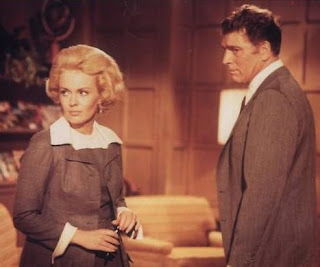 For those occasions when Seberg had to venture out into the frigid Lincoln, Nebraska winter, Head designed a white, hooded coat with fur trim and a pair of white boots.


 Wynter has a small role, but manages to appear in about five or six different outfits thanks to a sequence of flashbacks. She also demonstrates


 Thus, The Airport Look clothing collection is aimed at a clientele that really isn’t even represented in the movie! One look at the sketches and the photographs of the finished pieces and one has to really scratch


