 in theaters in 1974 with the new sensation Sensurround (in which large speakers were installed that caused vibrations and enhanced audio, making the viewer feel that he was in the midst of the big shakedown), the creators looked for new opportunities to utilize the system, eventually presenting the 1976 WWII drama Midway with it. Next was 1977’s Rollercoaster, the Sensurround
 offering enhanced ride noises and vibrations. (The process would only be used once more, when the TV pilot for the original Battlestar Galactica was released to theaters as a feature film, before quietly fading away forever.)
Rollercoaster concerned a mad bomber who has an axe to grind with the owners of amusement parks in the U.S. (this fact is not actually spelled out in the movie, but, rather, is explored in the tie-in novel and in a scene that was cut from the final print in which the bomber discusses with his mother the way the big parks drove her and the bomber’s father into bankruptcy.) Playing the young man with a detonator is Timothy Bottoms.
After causing a violent and deadly accident on one of the coasters, he makes it known that he wants
 $1 million from the cartel of amusement park owners or he will continue to blow up their chief attractions. The clean-cut, demurely dressed guy couldn’t be any more docile or non-threatening looking, but that’s the point. Many 70s thrillers wanted to emphasize that killers could come in many shapes, sizes and types. For that matter, Alfred Hitchcock went that route in Psycho.
Speaking of Hitchcock, some of the posters for Rollercoaster contained the following blurb in large print: “ROLLERCOASTER
 is a suspense melodrama of the sort that Alfred Hitchcock does best.” Think about that. On their own posters, they are promoting the fact that the “suspense melodrama” they have crafted is one that someone other than themselves does best?? Ha! I’m guessing that this little gem caused people to go and watch something that was actually done well instead.
Anyway, taking an extreme interest in the extortion gambit is a ride inspector
 who had only recently checked out the coaster that derailed. Played by George Segal, he’s a divorced dad trying to quit smoking and who seems to catch hell from everyone from his superiors (one of whom is played by Henry Fonda, in a cameo appearance) on down. He draws attention to himself as the drama surrounding the incident swells and before long, Bottoms has decided to deal one on one with him, forcing him to deliver the money.
What follows is a cat and mouse game between Segal and Bottoms as Bottoms makes Segal go through a number of elaborate and seemingly
 pointless moves throughout a major theme park. He has to buy cotton candy (and I don’t even want to know what Segal’s moustache looked like after this chomp of the stuff!), ride rides that are dizzying and/or otherwise uncomfortable, purchase a goofy hat, have his weight guessed and just generally be run ragged all through the park as Bottoms watches amusedly through binoculars. He is then informed that he is actually carrying a bomb and isn’t allowed to let it go!
 Complicating things for Segal is a belligerent FBI agent (Richard Widmark) who is used to calling the shots and is none too fond
  of having a civilian placed in the middle of the situation. He and Segal clash over the best way to handle things, though they also establish a begrudging respect for one another.
Segal’s current girlfriend Susan Strasberg has unwittingly chosen the same day, of all days, to bring his daughter Helen Hunt (!) to the amusement park, further complicating things and adding another layer of worry to Segal’s already crowded pile of them.
 Rollercoaster is often placed into the disaster movie genre because of its sequence depicting the destruction of part of a coaster
  and the decimation that happens when the runaway car projects itself into a set of carnival booths. Unfortunately, that is practically the only sequence of its kind and, thus, the movie is action-heavy at the start and close to nonexistent as it proceeds. The film really has to be categorized more as a suspense drama, though opinions vary greatly on how much suspense there really is.
That crash, however, is pretty eye-opening. Yes, there are clearly mannequins riding in at least one of the coaster cars, but it’s still
 pretty neat to see it careening off its track and into the activity below. Allegedly, this sequence was initially far more graphic and visceral, but was pared down for a PG rating. If the script had allowed Bottoms just one more incident of destruction, it might have made the difference in the success of the picture. As it stands, the lack of pyrotechnics in the latter 7/8th of the movie gives the viewer a feeling of being let down. Universal tried to blame Star Wars, which came out around the same time, for the film’s poor performance, but they really needed to look at just how pedestrian a film they had on their hands!
What appeals to me about the movie is the kitschy, frozen-in-time aspect of the park in which most of the action takes place. Kings Dominion in Richmond, VA is very, very much like Kings Island in Mason, Ohio and I went there
 as a child. (So did The Brady Bunch, if you ever caught that episode.) The rides, characters, décor, the simplicity of it all, it is all gone forever. When I watch Rollercoaster, which isn’t that often because it’s a middling movie really, I find myself paying closer attention to the background action and the people rather than the stars! The sign for the singing mushrooms above notes that they have to rest every fifteen minutes or their throats will get "spore!"
As for the stars, Segal gives one
 of his quirky sort of portrayals with his patented brand of tormented haplessness. He’s a matter of taste. If you like him, it’s well worth watching this. If you don’t, it could become pretty tiresome rather quickly. I find that I don’t usually mind George Segal movies much, occasionally even like them, but always need a buffer of other ones in between them. In other words, there will be no George Segal Film Festivals in The Underworld! Note that he is wearing an Izod polo shirt with the requisite alligator on the chest. Within a couple of years, these would be the hottest shirt possible to own.
Timothy Bottoms (for whom, you ask? LOL) He is a peculiar presence
 to me. There was a time when he seemed like he was going to be a really major film actor. He had significant roles in several notable movies such as his debut in the disturbing Johnny Got His Gun and then The Last Picture Show and The Paper Chase. It never quite happened for him, though. He is unforgettable to me because, as a child (isn’t everything here about my childhood?! How annoying!) I watched him in the 1976 miniseries Arthur Hailey’s The Moneychangers. He played a thieving bank teller who was sent to prison and immediately raped by a sadistic fellow inmate. So I guess that answers the question at the beginning of this paragraph.
 I never paid much attention to Richard Widmark until a while back when I realized how dependable he was as an actor and how undervalued
  he is as an antagonist. He was very adept at playing hard-assed authority figures who are still either sympathetic (usually thanks to a level of sarcasm) or multidimensional. I love his work in Coma, of course, and he is one of the few people in The Swarm to have some life in him. He made a huge impact in his first film Kiss of Death (in which he laughed as he sent a wheelchair-bound woman hurtling down a flight of stairs) and it gleaned him a Golden Globe and an Oscar nomination. He worked steadily thereafter in many films, but remains strangely unappreciated.
At this stage in his career, Fonda was working
 in crap, crap, crap. Just look at some of the gems he did from ‘77 –’79: Tentacles, The Great Smokey Roadblock, The Swarm, City on Fire and Meteor. Even Dionne Warwick and her Psychic Friends Network could not have predicted that in 1981 he would finally win the coveted Academy Award for his role in On Golden Pond. Apart from a TV movie that same year with Myrna Loy, it was the final thing he did before his death. I always say go out in a winner and avoid “The ‘Trog’ Trap.”
This was really a nothing role for Strasberg, too. Perhaps the makers thought it might be too clichéd to have her or her young charge
 Helen Hunt be on the threatened rollercoaster, but in just having them present in the park, there’s nothing much at stake and they are merely uninvolved bystanders bordering on filler. (By the way, look at the ignorant lady in the tan hat next to Helen who has no clue where to focus her attention!) The year after this, Strasberg would appear in the camp howler The Manitou as a woman with an Indian shaman growing out of her neck!
This was Hunt’s first film
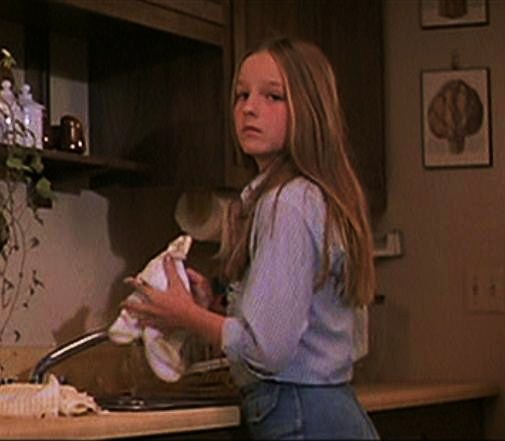 role and it would be 1985 before she did another one, so busy was she in TV movies and series. Again, only a mind reader could know that she would also one day have an Oscar to call her own, though she was a significantly successful child actress. Like Strasberg, her role here is insubstantial.
Busy character actor Harry
 Guardino, who often played cops, has a role (and decent billing) in the film as a police detective. What’s interesting about him is that in some of the movie posters, his photo appears alongside everyone else’s, but in some (like the one at the top of this post), he was taken out!
There are several notable names among the rest of the cast, most of whom appear only briefly. Craig Wasson, who would later star in Body Double and Ghost Story, plays a hippie.
 The trashy looking chick next to him was used again by this director (and to no good effect - it was her last screen credit) when he made When Time Ran Out. She bagged way too much screen time in that one. Jean Rasey, who was in The Hindenberg and later played Pamela Sue Martin’s sidekick for one season on The Hardy Boys/Nancy Drew Mysteries, has a bit as a girl in line to ride a coaster. There’s also a messenger played by the then-unknown Steve Guttenberg, making his film debut
Then we have Miss Monica Lewis.
 I’ve spoken of her here in The Underworld before because of her tendency to pop up in the film projects of her producer husband Jennings Lang. She had substantial roles in Earthquake, Airport ’77 and The Concorde: Airport ’79, but here she was relegated to one quick scene as a tourist who interacts briefly with Bottoms. Lang probably got cold cereal for breakfast for a month after that slight!
Pre-production plans called for The Bay
 City Rollers to perform in the film, but this never happened. Instead, a group called Sparks was used. Sparks had (and still has) a considerable career in the music industry, but they considered their appearance here to be one of their biggest regrets! It must be said that they don’t come off particularly well here. They are part of a show emceed by the famous L.A. disc jockey Charlie Tuna.
Also with regards to music, prolific composer
 Lalo Schifrin (the man behind the themes for The Man from U.N.C.L.E., Mission: Impossible and Starsky and Hutch along with many film scores) created a waltz for the score called Magic Carousel that is pretty hard to shake off once you’ve heard it. Though his score for the film is repetitive, some of it does help build suspense where the director James Goldstone sort of failed to provide it.
 I never got to experience
  Sensurround, its chief years being when I was 7 through 11 years of age and it being used on only four films. If anyone reading this went to see a movie with it, I’d love to hear your thoughts. I understand that some theaters experienced cracked plaster and that, generally, the public didn’t care for the notion.


 Though the big set piece is a visit to the austere and forbidding Jefferson Institute, the


