Though many times I don't, today I do know where I'm going to. I'm headed into the whirling, exotic, camptastic, chiffon-laden world of Tracy Chambers. WHO? You might know her best (and if you don't, you really ought to!) as the world-famous super-model Mahogany, as portrayed by Miss Diana Ross in the 1975 film called (what else?),
Mahogany.
By 1985, Ross had already achieved considerable fame as the lead singer for the sensational songbirds, The Supremes, being groomed to “work a dress” in the process, and had proceeded to carry on a successful solo career after leaving that group in 1970.
In 1972, she starred in the Billie Holiday biopic
Lady Sings the Blues with Billy Dee Williams and Richard Pryor, gleaning an Oscar nomination as Best Actress. (The award went to another singing actress, Liza Minnelli, for
Cabaret.) Thus, she was primed for another cinematic showcase, this time to be directed by her often Svengali-like musical producer Berry Gordy.
The project of choice was
Mahogany, the tale of a girl from the decaying projects of Chicago who attends design school with the dream of becoming a fashion designer, but whose life takes a major turn when she is instead thrust into the heady world of high-priced modeling. This was an interesting subject because in 1974 Vogue magazine had broken with longstanding tradition and placed a black model, Beverly Johnson, on its cover for the first time in its history. Johnson would appear on Elle the next year as well.


While it can't be said that Beverly Johnson was the basis for this story, her notability and trailblazing within her given arena did lend the movie a sort of timeliness that is forgotten now for those who have long become used to super-models of all ethnicities. Miss Johnson also had a lean, flat-chested physique that Miss Ross' mirrors in the movie. Take note, too, of this particular dress that Johnson is sporting, for a similar one takes center stage near the beginning of the movie. On that note, let's head there ourselves...
Mahogany opens with a crowded, ornately detailed fashion show (part of which glows in the dark!), chock full of unusual Asian-flavored get-ups (billed by an announcer as the “Kabuki finale!”) We watch as the garishly made-up and garbed models show off their wares and then meet the designer herself, Ross, as she comes out to accept all the accolades, which are plentiful. She retreats backstage for a moment where she is stopped cold by mention of the word “success” and the movie then skips back in time to a few years prior.
Now the theme song, one which went on to become a smash hit for Ross - “Do You Know Where You're Going To” - and which permeates the movie, begins to play as we meet her in her younger days. (In this scene and a later one in Rome, one really can't escape the feeling of Barbara Parkins riding a train in
Valley of the Dolls while that movie's theme song plays on and on...) She's a Chicago-bred design student, working at a major department store in order to pay her way through school.
Her instructors chide her for daring to show imagination and over-embellishment in her assignments when all they are asking for is simplicity. Stubborn and stuck on her vision of what is fashionable, she resists their pressure to follow the rules.
She is inspired by juvenile vandals who she spies spray-painting one of the city's walls as she commutes to work and begins to add some of their colors to the gown she's sketching. The draped, yellow chiffon dress is given a rainbow of stripes to add punch to its otherwise simple design. She coerces her devoted seamstress aunt Beah Richards to whip up the creation in the precious little time she gets away from her job at a sweatshop-like clothing factory.
Her boss at the department store (Marshall Field's?) is the commanding and effortlessly chic Nina Foch, whose every moment on screen is a gift for those familiar with her. Somehow she is able to completely deliver a character, warts and all, that is quite captivating with only a modicum of dialogue. She is on the verge of losing patience with Ross, whose focus is on designing instead of the promotional and window display work she's been hired to do.

One day, noted fashion photographer Anthony Perkins is set to arrive at the store in order to photograph a set of clothing (and a rather phallic telescope.) After clicking frame after frame of some of the most unlikely models anyone has ever come upon, he turns to notice Ross, who is there simply to accompany her boss Foch and assist with whatever needs there might be. As it turns out, Perkins feels that he needs Ross to model the clothes. (And why not when he's otherwise stuck with the playpen of "models" that the casting director has chosen, probably in a bid to make Ross look even better by comparison!)
Foch puts a quash on that, but before long, Ross is showing off the gown that her aunt has sewn for her and Perkins is having a grand time snapping pictures of her as she swirls and twirls around a storage room. Foch is less than pleased by this development.
She's even less pleased when Ross begins to miss work in order to shop her various designs around to several of the local fashion houses and manufacturers. Ever confident of her talent, she loses patience after a while with the men who take little or no interest in her sketches. (One of these is comic writer Bruce Vilanch in his on-screen acting debut!) This hooky from work ends up costing Ross her job.
Meanwhile during all of this, Ross has caught the attention of a local activist, Billy Dee Williams, who is in the process of running for a local alderman's position and who spends most of his free time bellowing out platitudes about poverty and social change from a bullhorn. On a whim, she pours some of the milk from her recently purchased groceries into the horn and when he goes to use it, he is doused. Unaware that she has anything to do with it, he blames some local toughs who'd been baiting him and a fight breaks out.


Feeling guilty, she arranges his bail, but has to rely on him to pay her back since the check she wrote was rubber! Having bumped into each other once more at the unemployment office, she kiddingly employs a routine in which she paints herself as a widow with hungry children who “needs her ol' man back.” They embark on a tentative relationship, though he is clearly focused on his career in politics, while she still hasn't given up on her dreams of becoming a top fashion designer.
Conflict arises when she can't devote the time to his career that he wants and he considers her own pursuits frivolous and meaningless. This is brought home in an argument as she is assisting Perkins on a photo shoot that uses a variety of poor black people as nothing more than props for glamorous fashions being modeled by white girls. Later, just as Williams is counting on her for support, Perkins offers Ross a job in Rome, Italy, a fashion cornerstone of the world!
Unable to resist this opportunity, Ross takes off for Rome, getting a scenic tour of the place from her cab driver (as the strains of “Do You Know Where You're Going To,” orchestrated in an achingly beautiful style by Lee Holdridge, play once more.) Perkins wants her solely as a model, but she feels that it is nevertheless a great launching pad for her.
Perkins reveals himself to be quite the obsessive personality, his apartment adorned with all sorts of pictures of a prior fixation of his, “Crystal.” The blonde model is splattered everywhere in all sorts of poses, including topless pictures, but with one viciously scratched at and scuffed and used as a dartboard, a clue that he could be someone not to cross without suffering consequences.
Declaring that he renames all of his lucky protegees after inanimate objects, she is dubbed “Mahogany.” (During a recent viewing, my friend Joe and I had fun cackling over the possible runner-up names such as “Walnut,” “Tigerwood,” “Birch” or “Old Hickory!”)
Perkins gussies her up in a tre chic honey-taupe ensemble and, in a scene that presages 1983's
Flashdance in its “new meat inspected by a row of judges” flavor, has her present herself to the directors of Gavina, an Italian fashion house. She poses and contorts while a couple of crass old men dispute her attributes.
In a moment I worship, she turns “street” on them and curtly gives them what for, tossing one final insult onto the sole woman in the room who's remained quiet throughout. As it turns out, the woman (Marisa Mell), quite agrees with Ross' point of view and, fortunately, happens to be THE Gavina! She's hired.
Herein begins a parade of playful, exotic, dramatic, fantastic, fantastically lunatic fashion shoots with Miss Ross decked out in a large number of hairdos, gowns, bodysuits, furs and other items all set to, yes, WE DO KNOW, “Do You Know Where You're Going To!”
And you know what? I don't care how many times I see this movie (and it's been plenty over the years), I still love that song and the alternately gentle and dramatic, haunting arrangement of it that appears over (and over) the arresting visuals, only a smattering of which are shown here.
Ever a sucker for the treacly, melodramatic and sentimental, I couldn't understand it in 1976 (when I was nine - LOL!!) and I can't understand now how the Academy of Motion Picture Arts and Sciences gave the Best Song Oscar to Keith Carradine's “I'm Easy” from
Nashville instead of to this!
Perkins can barely contain his obsessive lust for Ross, though she isn't quite sure he's even straight! He takes umbrage at the mere notion that he's anything but, yet when push comes to pump, the votes are tallied and he still hasn't been able to win her over.
Things go along swimmingly (as in Perkins pushing her, fully garbed, into one of Rome's many fountains) until a couple of things chip away at the glee of their newfound partnership.
At one of their shoots, she emerges from her trailer bedecked in one of her Mahogany originals and learns the hard way that Perkins dislikes it. (Or at least, pretends to dislike it as a method of acting out his frustration over his bubbling repression and unfulfilled desire for her.)
Then, at a major league fashion event for charity, Ross agrees to model one of the designer's signature gowns, but, still not having learned her lesson, surreptitiously substitutes one of her own creations just before entering the runway. Before a packed, stunned audience, she contorts down the runway dramatically, attempting to show the world her satin dragon get-up. Perkins, in the mood to humiliate her even further, makes a preposterously low bid, inciting laughter amongst the crowd.
Finally, just as she is almost completely crushed, a kindly, empathetic savior (Jean-Pierre Aumont) comes to her rescue and enthusiastically bids nearly seven times more than any of the other dresses have sold for. After the show (sporting a wig and dress that are very iconically DIANA ROSS of that era), she thanks him profusely for his generosity.
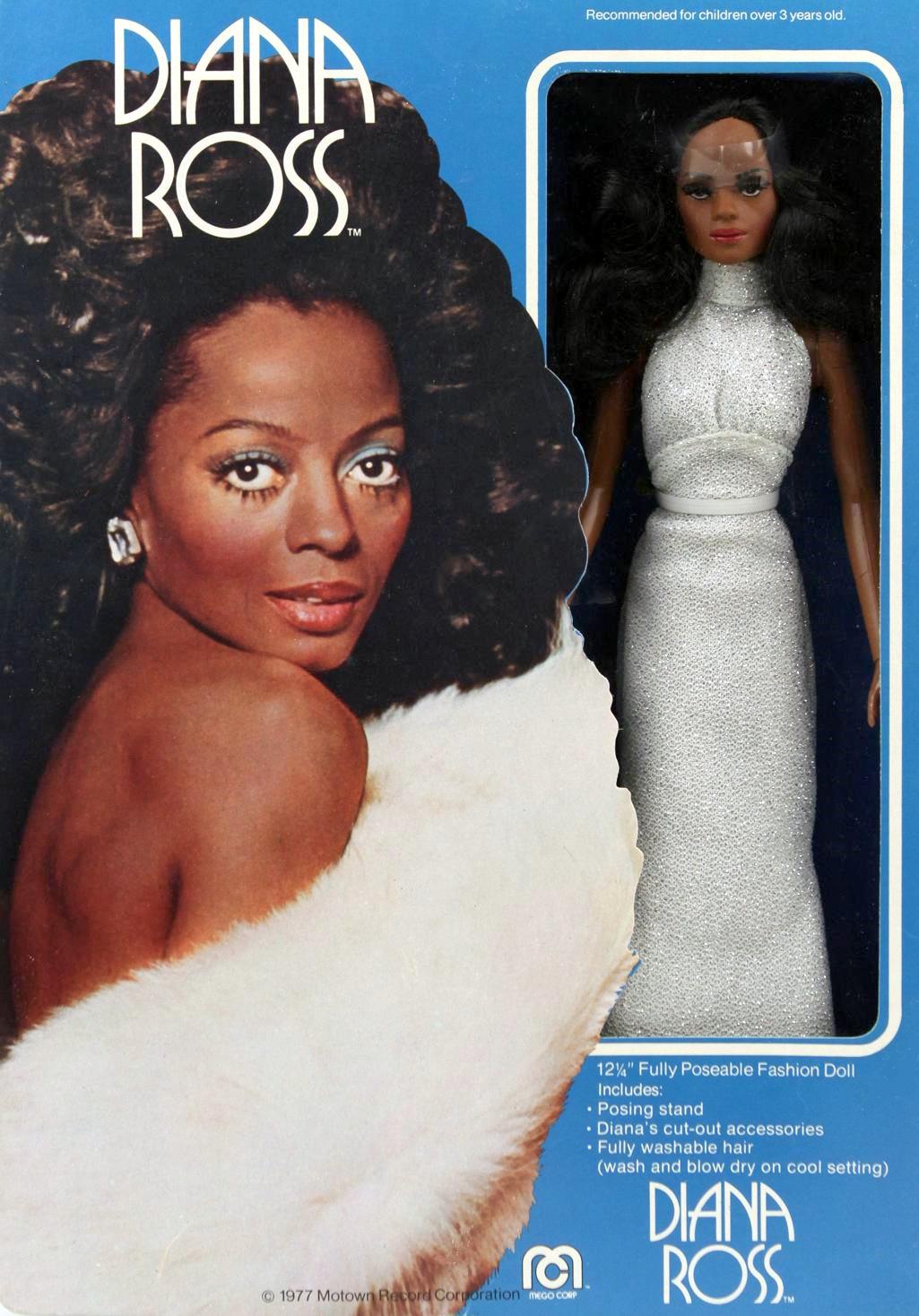
This look, in fact, was pretty close in scheme to what was used for her Mego Barbie-like doll that came out within two years of
Mahogany; the doll, not the photo on the box. Little fruits of the world (one of whom who will certainly remain nameless) could play the soundtrack album over and over while spinning the 12-1/2” Diana Ross doll around and around, maybe even changing her hair and clothes to create different looks.
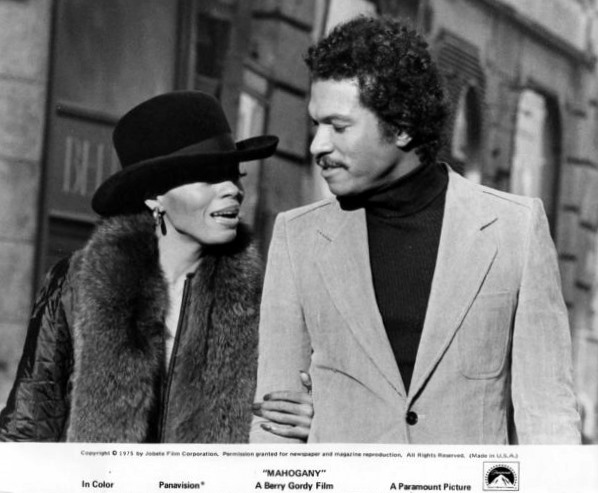
Suddenly, Williams appears in Rome and Ross is delighted to see him. He has lost his campaign as alderman and thus has come to see her to give her another shot. She takes him to a tailor who fits him with a new sport coat (too snugly, in my own unprofessional opinion, though it could be because Williams wears a thick turtleneck no matter which continent he's on or which hemisphere he's in!) and they romantically do the town.
Then it's time for one of Perkins' parties and things start to take a nosedive again. Williams, a macho man who doesn't even like being seen carrying shopping bags, finds himself immersed in the outre world of designers, models, performers and other unusual folks. Perkins wants him out of the way and decides to push him to the limit. He invites him to a private room of his which is filled with gruesome photos of people in death (along with a portrait of author Ernest Hemingway, who shot himself) and racks of guns.
The two have a testy tete a tete with a handgun as the prize and in the end Williams is so disgusted by Perkins' demeanor and behavior he storms out of the party. This causes the beleaguered and desperate Ross to engage in a sultry dance in which she partially disrobes and begins to symbolically immolate herself with scalding dripping candle wax!

Williams and Ross cannot come to any sort of stable arrangement, so he leaves, but not without first telling her emphatically that,”Success is NOTHING without someone you love to share it with.” She dutifully reports to another photo shoot for Perkins, but he still has it in for her for not loving him (or turning him into a “man?”) By now consumed with his array of perverse obsessions surrounding death, he and Ross become involved in a hair-raising (literally!) automobile accident.
The result is that she is facially damaged and darn near killed. Just when she is at her lowest, rescue comes in the form of Aumont, who has not forgotten her from the charity auction. He houses her in his exquisite estate and helps to nurse her back to health. Once better, he arranges for her true dream, that of a fashion designer, to come to fruition.
It doesn't take long for Ross to assume the haughty, overbearing, demanding attitude that has long been associated with people possessing a strong ego. Not to say she's playing herself here, but you can bet your ass that more than one hotel maid has gotten this facial reaction from Miss Ross at one time or another along with the remarkably shrill tone she affects during this sequence!
Since the movie opened with the big runway collection debut, there never was any question that Ross would become a designer, but I guess there was some degree of suspense as to how she'd get there. However, having reached the goal she has wanted all her life, she seems spent, despondent and, true to Williams' prediction, totally alone. But will she stay that way?
Critics seemed to delight in handscraping
Mahogany for its roll call of soap opera cliches. Though contemporary at the time, the movie calls to mind a host of other, venerable movies from the rags to riches films Joan Crawford starred in at MGM (and, like Joan, Ross lives in a squalid neighborhood, but her apartment is pristine!) to later gems. Certain scenes call to mind 1960's
BUtterfield 8 (the red sports car flying into a construction site), 1961's
Back Street (the fashion milieu and the struggle over the steering wheel) and 1966's
Madame X (the recuperation period at the hands of a wealthy benefactor), whether deliberate or not. Anyone complaining about this is simply missing the fun of it all!
Of course, the movie was intended to be taken seriously. Esteemed, Oscar-winning director Tony Richardson (for
Tom Jones in 1963) was initially at the helm, but was fired part way through with Berry Gordy taking over the reins. It was Berry's first and only time in that capacity (and I must say that, whatever flaws the movie may have, the finished product skillfully manipulates a willing audience and features a fashion montage that was memorable enough to be aped in 2006's
Dreamgirls.)
Probably the biggest issue it has, to my mind anyway, is it's message that a woman can only be happy if she has a man in her life and that her dreams, realized or not, can take a back seat so long as she has one! The way Ross is exploited and mistreated by this man and that one, she may as well have been dubbed “Misogyny.” The tie-in book, perhaps trading more on Ross' own reputation rather than the rather tread-upon character of the movie, describes Mahogany as "tempestuous."
Mahogany was a hit film in spite of its detractors. Ross (sixty-eight at present), whose only previous movie role had bagged her an Oscar nomination, seemed poised for a legitimate career in the cinema, but
The Wiz, released in 1978, put a stop to that. She has never since acted in a feature film. In
Mahogany, there is no denying her camera-ready charisma. It's a meaty part and she handles it well. She also establishes considerable chemistry with her love interest, the same one from
Lady Sings the Blues (!), Williams. Astonishingly, she receives the movie's SOLE costume design credit, though there is no conceivable way they she did anything more than consult and suggest ideas for a portion of the film's clothing.
Williams had been around on TV and in the movies since the late 1950s, a high point being the 1971 TV-movie
Brian's Song, which earned him an Emmy nomination. (The award went to Keith Michell in
The Six Wives of Henry VIII.) He went into a brief decline after
Mahogany and didn't make another feature for five years, but when he did it was a big one. He landed the role of Lando Calrissian in
The Empire Strikes Back in 1980! He then did
Return of the Jedi in 1983 and proceeded on to a very steady, but unremarkable career. He is seventy-five today.
Perkins started out in films in 1953 and got an Oscar nomination for 1957's
Friendly Persuasion, though the award went to Anthony Quinn in
Lust for Life. (Can you imagine him sitting there, waiting for the envelope to be opened, only to hear, “And the winner is, Anthony... Quinn”??!!) His iconic (and tremendously typecasting) role was in 1960's
Psycho. Looking back, it is astonishing that his unforgettable work in that netted him no award consideration to speak of. Here, he's traded in his stuffed wildlife for guns and his knife for a camera. No one else could have brought the same level of creepy, detached derangement to the role, though. Perkins died in 1992 at only age sixty from the complications of AIDS.
French actor Aumont had screen credits going back to the earliest part of the 1930s and worked steadily in a wide variety of projects until the mid-1990s when he retired. Prior to
Mahogany, he'd worked for Francois Truffaut in the acclaimed 1973 film
Day for Night. Interestingly, his second wife was Maria Montez and his third (and final one, from 1953 on) was Marisa Pavan, the actress sister of Pier Angeli, who became his widow in 2001 when he died of a heart attack at age ninety.
Richards is one of those character actors we always enjoy seeing, either in hooty camp like
Hurry Sundown (1967) or more celebrated fare like
In the Heat of the Night and
Guess Who's Coming to Dinner (both also 1967.) She was both Oscar and Golden Globe nominated for
Dinner, but lost to Estelle Parsons in
Bonnie and Clyde and Carol Channing in
Thoroughly Modern Millie respectively. She acted on screen from the late-1950s until her death in 2000 from emphysema at age eighty. Her final movie was Oprah Winfrey's
Beloved in 1998.
Foch (whose last name rhymes with “gosh,” though Robert Osborne has also pronounced it like “gauche”) is another actress whose presence is always a treat. A rare starring role occurred for her in 1945's
My Name is Julia Ross (later remade in 1987 as
Dead of Winter with Mary Steenbergen), but more often she was a supporting player. Whether as Moses' adoptive mother in
The Ten Commandments (1956), a Roman noblewoman in
Spartacus (1960) or Sharon Stone's leasing agent in
Sliver (1993), she always brought a special glint to her roles. Her sole Oscar nomination came with 1954's
Executive Suite, which she lost to Eva Marie Saint in
On the Waterfront (a leading role nestled into the Supporting category.) An acclaimed acting teacher, Miss Foch died in 2008 at eighty-four of a blood disorder, having taught the previous day.
Austrian actress Mell had a busy career in French and other European films from the early-1960s on with Mario Bava's psychedelic 1968 spy flick
Danger: Diabolik one of the best known. Already by that time she had survived a serious car accident of her own in 1963 which required plastic surgery. A strange blip in 1968 had her performing the title role in a David Merrick-produced/Vincente Minnelli-directed stage musical called Mata Hari, opposite Pernell Roberts, but the show flopped badly. Sadly, she died in 1992 of cancer at only age fifty-three, reportedly in dire financial straits.
The designer who has her charity fashion show momentarily hijacked by Ross was a real and true person by the name of Princess Irene Galitzine. (You can hear her referred to on screen as "Princess.") Her parents, a prince and princess, had to flee Russia during the revolution and wound up in Italy. A salon owner and designer from 1946 on, she was innovative enough to spearhead the "palazzo pyjama" look in 1960. Her company is still in operation today, though she died in 2006 at age ninety.
This is the type of movie that one either enjoys or loathes, depending on his point of view. My aforementioned friend Joe recently bemoaned the fact that he has trouble coming up with movies to watch together that I have never seen. I told him to try showing me something that's allegedly good! LOL (I've seen
Mahogany at least six or seven times.) Whether he meant to do it or not, Berry Gordy fashioned a tale that caters to many of my favorite cinematic fascinations, from lush music to chiffon to makeovers to camp. I love it!




 Labels:
camp,
Carol Channing,
Diana Ross,
Liza Minnelli,
odd pairings
Labels:
camp,
Carol Channing,
Diana Ross,
Liza Minnelli,
odd pairings




 Williams and Ross cannot come to any sort of stable arrangement, so he leaves, but not without first telling her emphatically that,”Success is NOTHING without someone you love to share it with.” She dutifully reports to another photo shoot for Perkins, but he still has it in for her for not loving him (or turning him into a “man?”) By now consumed with his array of perverse obsessions surrounding death, he and Ross become involved in a hair-raising (literally!) automobile accident.


