The (almost) complete demise of GSN – The Game Show Network – as a place at which to view classic game shows has been a real pain for me. When the channel started, they showed almost round the clock broadcasts of classic episodes of such shows as Match Game, The Price is Right  (the old ones – with a dark-haired Bob Barker!), Hollywood Squares (with Paul Lynde), Tattletales, $25,000 Pyramid, To Tell the Truth and many, many more. Sadly for me, I didn’t have the station at that time! I was a cable subscriber and didn’t get the channel until I moved to my house and ordered satellite.
Almost simultaneously, GSN began introducing new game shows of their own and started phasing out all the classic shows. You might still catch Let’s Make a Deal, Blockbusters, Match Game or Family Feud on a weekend morning, but in order to see To Tell the Truth, What’s My Line?, I’ve Got a Secret, Password or a number of other old shows, you would have to record them because they were shown  either during weekdays or, in most cases, broadcast overnight at some ungodly hour.
Now, the station is almost completely devoid of classic shows and is a wasteland of shitty original programming and rebroadcasts of recent game shows (some of which were successful like Deal or No Deal and some of which that didn’t make it such as 1 vs 100.) Having already watched TVLand enact a long, slow slide into oblivion, it has been hard for me to watch GSN do the same thing. I guess either there is no market for old game shows (which, to me, are almost always endlessly amusing, enthralling and interesting) or else they just believe that there isn’t one.
I like just about any old show (and there have been some real oddballs along the way),  but my favorites are always the ones with celebrity panelists. The old classics like What’s My Line? and To Tell the Truth were, especially in the case of the former, so classy and elegant. However, even later fare such as Liar’s Club (which had a panel of four stars trying to convince contestants of the true purpose of some unusual item, only one of whom had the real answer) retained a tacky charm. Club used to give me access to one of my guilty pleasures, the smarmy, ultra-slick, tan comic actor Dick Gautier. (Look... You either like him or you don't!)
The long-running What's My Line? has devout following to this day. One reason is because each episode had a special feature at the end in which the panel would be blindfolded and were made to quiz a major star personality in order to obtain his or her identity. Often, the stars would disguise their voices to try to stump the panel. Practically anybody who was anybody appeared in this segment including some of the top stars EVER. Miss Joan Crawford appeared several times, but so did many major celebrities. Even an up and coming singer/actress named Barbra Streisand was selected to be a mystery guest. (Come to think of it, there probably aren't a great deal of living celebs who can say they were a mystery guest on WML. Most of them are dead now!)

Another aspect of the show that charmed (and continues to charm) a lot of fans was the friendly, slightly sassy, elegant and, above all, charming presence of regular panelist Arlene Francis. Miss Francis was with the show for practically all of its considerable run and could always be counted upon for winking good humor. She wore a distinctive heart-shaped diamond necklace (a first anniversary present from her husband Martin Gabel) that became legendary and took on a life of its own. Rare was the day that she didn't have it on on the air. She even wore it many years later when she was a panelist on the far more racy and loose Match Game. In 1988, a street thug
  snatched it from her neck, thus robbing her (and the world) of one of TV's most recognizable pieces of jewelry.
Seeing stars on game shows allows the viewer to witness someone they may only know from the movies or TV act solely as themselves (or at least as close as possible given the fact that even in this format a performer is likely to be putting on some sort of face.) The candid, unabashed moments that spring up can really endear a celebrity to the public (or occasionally turn the viewer off.)
I especially like to see stars I am only familiar with from their screen work on a show fighting to win money for their contestant. Someone like Barbara Rush or Joan Fontaine (both on Password) would genuinely strive to do her best and would be disappointed in herself if she failed.  Mary Ann Mobley, on To Tell the Truth (both the 1980 edition and particularly the 1990 edition hosted by Gordon Elliott and Alex Trebek) was drop-dead glamorous, but when it came to getting to the bottom of who was the real person out of the three choices, she was like a prosecuting attorney (in a way that I nonetheless found captivating, I must say.) That 1990 version of Truth, by the way, featured a steep staircase that panelists had to descend. The always regal Miss Kitty Carlisle (who appeared on every incarnation of the show) had to navigate it in high heels and long gowns, usually with the help of a fellow panelist (in this shot, Chris Lemmon, Jack's son.)
 Hollywood Squares was another outlet
  for seeing stars off the cuff. I adored Paul Lynde and his zingers were funny, but unexpected hilarity also came from people like the young Burt Reynolds, freed from the shackles of his action hero TV and movie persona. Vincent Price, known in later years for his campy horror films, also proved to be quite a witty person, his totally unique voice offering great spins on the one-liners. The series also allowed viewers to glimpse some of H-Town's most beautiful and glamorous women such as Zsa Zsa Gabor, Elke Sommer and Barbara Bain, among many others.
  Match Game, especially in its earliest seasons when regulars Brett Somers, Charles Nelson Reilly and Richard Dawson were
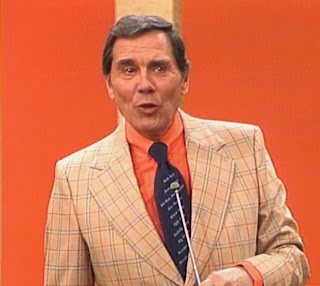 in place and trading barbs with each other, was a terrific show, rife with double entendre and suggestiveness. When the format was revived years later, it suffered from the lack of social restraint. Since you could now write “Penis,” “Vagina” “Balls” and God knows what else on your card, there wasn’t a lot of room left for cleverness! Host Gene Rayburn was, to my child's eyes and ears, the king of lasciviousness, though watching him now he was actually quite erudite,
  well-read and tasteful. Match Game P.M. was a particular favorite of mine because the half hour was a self-contained game (unlike the daytime version in which games would stretch from episode to episode) and the caliber of stars tended to be a little brighter or at least a bit more unusual. Brett and Charles (who tended to wear some bizarre, deliberately ugly concoction) always sat next to one another, nit-picking each other endlessly and hysterically while Richard leaned on a Paul Lynde imitation for many of his laughs.
 Regular readers of this blog
  (both of them! lol) know of my fascination with opening credits that show the stars’ faces and either display or announce their names. Match Game had one of the best methods for introducing the panel. A spinning, mod-looking square would spin around and reveal, in turn, the six celebrities as none other than the great Johnny Olson said their name aloud. You can imagine my delight in watching these old shows when the spinning frame would reveal Michael Landon, Joan Collins, Tab Hunter, Mary Wickes, Ethel Merman(!)
  and occasionally a new performer who would later become far more famous, such as Jamie Lee Curtis. One of my earliest "daddy" type crushes, CHiPs' Robert Pine, also appeared on the show occasionally in its later years. If his charming grin looks familiar, it may be because his cute son Chris Pine is now a popular actor thanks to the recent Star Trek redux.
 As a kid, I used to daydream about my family being on Family Feud and would work out which five of us would be on it and in which order. Now that I’m older
 and my old time celebrity obsession is in full swing, I love to watch Feud eps that feature TV and movie stars playing for charity. The combinations of stars who are brought together can be quite staggering. It can also be eye-opening to see some folks who have been away from the limelight for a time and who may not have held up particularly well!
All-Star editions of Family Feud would bring together casts of shows that were either cult favorites (like The Brady Bunch) or then hits (like Eight is Enough.) There would also be groupings from Dallas, The Love Boat and other popular series. Stars enjoyed posing in offbeat ways while being revealed in the customary inset room filled with "antique" furniture and lamps.  The Dallas gang lifted Larry Hagman into the air while The Love Boat men all pretended that they were flashing lone female Lauren Tewes. There would also be theme programs that bordered on the surreal (to hell with that. They WERE surreal!) Take, for example, the Heroes vs Villains episodes that put together combinations like Leonard Frey, Joan Collins, Beatrice Straight, Susan Lucci and Norman Fell as a team of villains! Some of the heroes included Marla Gibbs, Lynn Redgrave and Olympic gymnast Kurt Thomas(!)
Then there was the week that 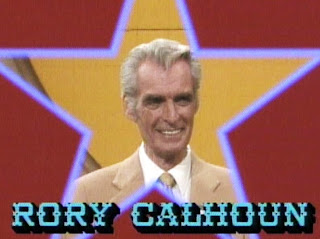 brought performers who had been honored with a star on the Hollywood Walk of Fame. This concept gave us teams that included a shockingly weathered, rail-thin Rory Calhoun and a less-than sturdy looking Dorothy Lamour! These veterans were playing alongside other folks such as Keenan Wynn, Cesar Romero, Gloria de Haven, Jayne Meadows and a still-lovely and elegant Arlene Dahl.
 Tattletales was barely even a game, really. More a chance for three showbiz couples to answer questions about one another in order to win a little money for their respective sections of the studio audience. This show was unique in that it offered the public a chance to meet the spouses of the celebrities. Yes, there were quite a few celebrity couples, but often there were comedians or actors who brought their non-celeb
 wives to play. In the whirlwind, anything goes world of Hollywood, reruns of this show could probably be quite cringe inducing since marriages tend to have a brief shelf life there. (Take once happy, then not, Chuck Woolery and Jo Ann Pflug. I worshipped him, by the way and thought he was beautiful.) It wasn’t a requirement for the guests to be married. One infamous pairing had Dick Sergeant and “his lady” Fannie Flagg! Other times, closely connected costars from a series would appear, sometimes from daytime soaps. Due to the nature of the questions, though, it usually paid for the pair to be pretty familiar with one another.
The show was hosted by Bert Convy,  he of the unbelievably thick Chia-Hair. I always enjoyed Bert and thought he was charming, attractive and good at being a host (certainly better than when he was an actor!) He hosted Tattletales, Super Password and Win, Lose or Draw among others. The odd thing is, in Peter Marshall’s autobiography (he being the longtime host of Hollywood Squares), he stated that there were only two people in the game show community that he didn’t like: Dan Rowan (of Rowan & Martin) and Bert Convy. He didn’t feel the need to state why although both men are deceased now. That remark has always confounded me and made me wonder what in the hell was up. GSN used to sometimes
  run obscure shows like Double Dare, Body Language and the oddity Now You See It, which lined six (always horrifyingly dressed) contestants on a set of stairs as a wacky theme played. Half the fun is in seeing what people wore then and how they wore their hair! I just love taking in these vintage programs and always hope that someday they will dig them all back out or that a new channel will start to run them. (GSN II??)
It’s really quite startling that, after 125 posts and close to a year of rambling, I have yet to do a profile on one of my favorite characters (and that’s just what he was) of all time, Mr. Paul Lynde! His delivery of lines and jokes is something I’ve drawn inspiration from, not necessarily onstage, but just in general conversation! Things would end quite badly for Paul, but, for a certain period of time, he reigned as one of film and television’s most hilarious and useful smart mouths.
Born in Mount Vernon, Ohio in 1926, Paul was the son of the local police chief and one of six children. Inspired at the tender age of five by the silent film Ben Hur, he knew in his heart from then on that he wanted to be an actor. (It’s also possible that he was fixated on the often scantily clad Ramon Novarro in said picture as well!) Sadly, for Paul, he emerged as a pudgy child, eventually becoming quite fat as he entered his teen years. Being both overweight and (secretly) gay, he developed a sense of humor to help overcome his unease.
When he announced to his parents that he was going to pursue a career in acting, it didn’t go over well at all, but off he went to The Big Apple. By 1952, he had developed his skills as a comic storyteller and writer enough to land a spot in a Broadway revue called New Faces of 1952. This very successful program also contained such future stars as Robert Clary,  Carol Lawrence, Alice Ghostley (who had a significant impact on him and his vocal delivery) and Miss Eartha Kitt! Incidentally, I’m thinking that few people were looking at the FACE of the chick to the right, below Paul!
In 1954, this revue, with a few tweaks here and there, was made into a film version called New Faces and Lynde repeated his work in it, including his highly popular sketch on a bandaged man just back from an African safari. Following this, Lynde guested on The Red Buttons Show as well as other variety and anthology series and lent his voice (of a commandeering hotel owner) to the Buddy Hackett sitcom Stanley.
In 1960, Lynde made his return to Broadway in the successful musical Bye Bye Birdie. All about the hullabaloo caused when a singing teen idol is called into U.S. Army service, Lynde played the cranky, harried father of a flighty young daughter.  It was a supporting role, but a terrific one, with two amusing numbers and several snarky lines. Originally starring Dick Van Dyke and Chita Rivera (changed to a Latina when both Carol Haney and Edyie Gorme passed on it), the show celebrated its one-year anniversary with replacement cast members Gene Rayburn and Gretchen Wyler.
At thirty-four, Lynde was perhaps a mite young to be cast as the cantankerous old coot, but his moderately heavy weight (and a little fake grey at the temples) helped him to convince. A film version in 1963 saw him reprising his role, though it was a less than thrilling experience for him. The director, George Sidney, was practically obsessed with the actress playing Lynde’s daughter, Ann-Margret, and shifted the focus to her. A title number was written for her and some of Lynde’s material was cut in order to make room. His quote about Bye Bye Birdie was that “they should have re-titled it ‘Hello, Ann-Margret!’”
The year brought him a variety of film roles, though. He played a TV reporter in Disney’s Son of Flubber, the sequel to The Absent-Minded Professor and played a nosy landlord in Under the Yum Yum Tree. His wife in that one was portrayed by Imogene Coca who, at eighteen years his senior, demonstrates again the way he was being pigeonholed as characters older than himself. For audiences, Lynde was aging in reverse, since he would soon be losing weight and dressing more youthfully as time wore on!
The following year brought him one of his most oddball films, basically an extended Pepsi-Cola commercial called For Those Who Think Young (a more apt title might have been For Those Who Don’t Think!) With a cast no one could make up off the top of his head and be taken seriously, the names included: James Darren, Pamela Tiffin, Tina Louise, Bob Denver, Anna Lee, Nancy Sinatra, Claudia Martin (Dean’s daughter), George Raft and Ellen Burstyn! Then there’s Woody Woodbury, a “comic” who shares most of Lynde’s scenes.
The two men portray the uncles of Tiffin and, whether by design or not, come off like two old queens. They sit on the beach together, fussily. They sleep in the same bed at one point. Then there’s the moment when Louise hands them two phallic looking hotdogs and Woodbury hands his to Lynde, saying, “Here…Keep this warm.” Lynde was sorely, sorely wasted in this dire film, which really could have used more of his contribution.
Happily, that same year he was handed an amusing cameo in the Rock Hudson-Doris Day comedy Send Me No Flowers. He played a gregarious, overenthusiastic cemetery plot salesman who delights in arranging the final resting places of his clients. (In the film, Rock thinks he’s about to croak.) The role had been originated on Broadway by famed sportscaster Heywood Hale Broun, but Lynde put his unmistakable spin on it. Already, moments in a TV show or movie that involved Paul Lynde were becoming the chief highlights of the piece in question.
He appeared three times on The Munsters as doctors who  got a real eyeful when the amusingly horrific family members required his services. In 1965, he played a smarmy agent to singer Linda Evans (!) in Beach Blanket Bingo. (Evans' character was abducted in the movie and that aspect is what led Nancy Sinatra, whose brother Frank Jr had been kidnapped, to turn down the part.) His unbelievably distinctive voice paired with his deliberately extreme facial expressions compensate (as they did in so many projects) somewhat for the substandard material. With Frankie Avalon and Annette Funicello and the whole gang on board, there wasn’t a great deal of room for him anyway.
 1966 reunited him with Doris Day in the film The Glass Bottom Boat. He played the security chief at a research facility in which hunky Rod Taylor works. When Taylor and Day meet cute, a series of misunderstandings
 lead Lynde to believe that Day is a Russian spy. Eventually, the only way Lynde can get close enough to really observe her is for him to dress up in (eye-popping) drag and follow her into the ladies room! Doris’s real life remark upon seeing Paul in his arresting get-up was “Oh, I’d never wear anything that feminine.” Here, you can see costar Dom DeLuise’s visual response to his character’s realization of who he’s hovering over the buffet table next to!
 Incidentally, this film contains a
  married couple played by George Tobias and Alice Pearce (whose last film this was.) They were far better known for playing Abner and Gladys Kravitz, the squabbling neighbors on Bewitched. (Pearce would be replaced on the series, following her death, by Sandra Gould.)
During the period from 1965 to 1971, Lynde would also make highly memorable appearances on Bewitched as Elizabeth Montgomery’s favorite uncle, Arthur.  His very first guest spot on the show had him as a nervous, exasperated driving instructor, but he would come back ten more times as Uncle Arthur. His unforgettably sarcastic and silly appearances on the series led many a viewer to believe that he’d been on the show more times than that. His snappy references to Montgomery’s character of Samantha as “Sammy,” along with his patented sneers and cackles, made for plenty of fun whenever he was around. Montgomery was always pleased to have him on the show and her husband, the producer, liked what it did for the ratings!
 Paul’s most memorable project of all came when he worked on the game show Hollywood Squares. A simple game of tic tac toe, with a giant grid containing a celebrity within each square, became a runaway hit. Hosted by Peter Marshall, contestants had to win their X or O on the grid by listening
 to a trivia question posed by him and then deciding whether to agree or disagree with whatever answer the celeb gave him in return. Before the stars would even answer the question, they tossed out a joke answer (almost always provided by the show’s writers.) What kept this scripted aspect of the show funny and fresh was that, yes, the stars were given witty answers to spout, but neither they, nor Marshall, had ever previously heard the question! Thus, it was not unusual for the stars to start cackling at just the thought of what they were about to say because they’d only just gotten the joke themselves.
Each star was given questions (and joke answers) that would appeal to his or her persona. For example, Charlie Weaver had things about old people, Rose Marie got a lot of dating questions that allowed her to bemoan her arid sex life and Paul was handed questions that lent themselves to hysterically kinky answers or ones that lightly alluded to his sexuality. He was utterly game to this, especially when his popularity skyrocketed through the stratosphere as a result of his work in “the center square” of the show. He was also nominated five times for an Emmy for his performance on it.
Although much social change had occurred just prior to the show’s debut in 1966 (and would continue as the show ran through to 1981), there were still many things one just didn’t say or do on television. Lynde’s material was just suggestive enough to invoke a laugh (or maybe even a gasp) from viewers across the nation who gobbled up his hilarious “zingers.” And now for a small selection of some of my favorites!
Peter: Will a goose help warn you if there’s an intruder on your property?
Paul: There’s no better way!
Peter: Diamonds should not be kept with your family jewels, why?
Paul: They’re so cold!
Peter: True or false? Research indicates that Columbus liked to wear bloomers and long stockings.
Paul: It’s not easy to sign up a crew for six months…

Peter: It is considered in bad taste to discuss two things at nudist camps. One is politics. What is the other?
Paul: Tape measures.
Peter: Burt Reynolds is quoted as saying, “Dinah (Shore)’s in top form. I’ve never known anyone to be so completely able to throw herself into a…” a what?
Paul: A headboard.
Peter: What’s that thing to the east of Sweden?
Paul: Have you seen Anita Ekberg lately?
Peter: According to legend, who looks better, a pixie or a fairy?
Paul: Well looks aren’t everything! Well, I guess I would say…I would have to go with the fairy.
Peter: Is there such a thing as a female rooster?
Paul: Yeah, they’re the ones that just go “a doodle do.”

Peter: Nathan Hale, one of the heroes of the American Revolution was hung. Why?
Paul: Heredity!
Peter: Eddie Fisher recently stated, “I’m sorry. I’m sorry for them both.” Who or what was he referring to?
Paul: His fans.
Peter: Who are more likely to be romantically responsive. Women under thirty or women over thirty?
Paul: I don’t have a third choice…?
You get the idea. None of these quotes are even half as funny without hearing Paul’s peculiar voice reading them back, but to those of us who are familiar with him, we can picture it in our minds. One of Paul’s favorite costars on the game show was Karen Valentine. He appeared in her TV movie Gidget Grows Up in 1969,  playing her narcissistic landlord (who also has a fixation on old time movie actress Helen Twelvetrees!) He returned to the role in 1972 for Gidget Gets Married, but Valentine wasn’t Gidge that time out.
When Paul began appearing on the Squares in 1966, he had just come off a crippling personal experience. His lover (of about sixteen years his junior and described in the press as a “friend”) had been drinking and showing off by hanging out of a hotel room window. He fell to his death. Lynde, who already was a pretty heavy drinker, began to take on an even more cynical view of life than he had previously. For a while, the old Paul was still good to go, but further disappointments would prove to be too much before long.
Though he continued on Hollywood Squares, he longed to prove himself as the star of his own series. Bewitched was cancelled in 1971 and the producer, William Asher, helped put Paul into his own series, The Paul Lynde Show, the following season.
 It’s hardly possible to describe the ludicrousness of the barely-closeted
 Lynde starring as a sitcom husband and father. A rip-off of All in the Family that also parroted his old Bye Bye Birdie character somewhat, it poised Lynde as a fussy, cranky attorney who is at odds with his son-in-law, a big, blonde freeloader with liberal thinking.
True, Lynde had made a major splash as a harried, disapproving father in Bye Bye Birdie, but he had long since left behind that type of persona as the 70s dawned. He was trendier (always appointed on Squares in the de rigueur open collar, with gold chains, or in a dashiki, caftan or other gear) and thinner and, just generally more “with it.” The uptight, heterosexual, safe character somehow didn’t fit him as well now and the show’s cast lacked chemistry for the most part. “Wife” Elizabeth Allen looks tentative. The biggest reason for the show’s failure, though (apart from some schedule shuffling by network affiliates), is that Lynde simply worked better in small doses. He came off exceptionally well when popping up at intervals against other, more demure, costars, but having him as the central focus of a series was too much of a good thing. (And TV Land rarely learns this lesson, giving actors who play these types of roles their own shows, over and over, and they nearly always fail.) Paul did score a Golden Globe nom for his work here, though.
When the show was pulled, Asher decided to utilize him on another series of his that was floundering,  Temperatures Rising, a hospital-set comedy that had starred James Whitmore. Re-titled The New Temperatures Rising Show, Whitmore was out and Lynde was in and the setting was changed to a private medical facility with Paul as the penny-pinching overseer. Cleavon Little, who had already been on the series, was retained through this change. Amazingly, the cast would shift a third time (with Alice Ghostley coming on as Lynde’s sister) before finally being canned after 46 episodes.
Lynde took refuge by providing the voice of Templeton the rat in the animated classic Charlotte’s Web. He even had a duet with his Bewitched  costar Agnes Moorehead, who played a goose. The role allowed him to showcase his distinctive vocal talents and it was an area in which he’d continue to partake. (He had previously worked on a primetime TV cartoon series called Where’s Huddles?, which was a football-oriented series that still somehow managed to rip-off The Flintstones – a show that was already a rip-off of The Honeymooners! On it, he portrayed a persnickety perfectionist, natch! He had also provided the voice of The Hooded Claw – and his alter ego Sylvester Sneekly – on the zany and amusing The Perils of Penelope Pitstop, his characteristic laugh dominating many of his scenes.)
 Despite the setbacks of the two failed sitcoms, Lynde was able to reap the financial rewards that come from being a sought after character player. His home was noted for its opulence and splendid (though perhaps now-tacky) décor. (Did even Liberace have this many candles, sconces and candelabras?)
 I knew I was a soul mate of Paul’s when I was watching the A & E Biography on him and one of his lifelong female friends (who truly could have passed for his sister because they looked so much alike!) recalled the way he liked things kept. He had EVERYTHING exactly as he wanted it and when people came over (which was a rare enough event anyway, except for a chosen few), a person might admire one of his little treasures and afterwards he’d go, “Aww, you moved it…” Ha! That’s me! I have every trinket and frame in the precise spot I want it in. That said, Paul was never with out a dog and had several four-footed pals over the years.
 Still, there was a bitterness and
 an empty feeling about not being able to star in his own successful show (and, truth to tell, he wanted to star in movies) and the lifelong insecurities about his sexuality and his weight, paired with the aging process, started to gnaw at Lynde. His drinking increased and he began to experiment with drugs as well as utilize the services of callboys and/or hustlers. His unhappiness would sometimes manifest itself on the set of Squares and, though some drinking was allowed in between taping, he started to get drunk while there and, unfortunately, was not a nice drunk. In 1979 he was fired from the show and replaced
  by Henny Youngman, of all people. The show took a nosedive in ratings and Paul was rehired, but the party was basically over and the show ended its original run in 1981.
Voiceover work continued to come his way, with Journey Back to Oz, an all-star musical about Dorothy’s return to the fabled land (and with her voice by Judy Garland’s daughter Liza Minnelli. Margaret Hamilton, in a casting stunt, portrayed Aunt Em!) He also took part in a bizarre Hungarian feature length cartoon called Hugo the Hippo, about the survival of one hippopotamus following a slaughter. The outré, violent movie is difficult to obtain in the U.S.
Paul also had several successful television specials. One, The Paul Lynde Halloween Special, featured the very first TV appearance of Kiss and had a laundry list of campy guest stars such as Billie Hayes, Billy Barty, Roz Kelly, Donny & Marie Osmond, Florence Henderson (singing a positively humiliating disco rendition of That Ol’ Black Magic!), Betty White, Tim Conway and Margaret Hamilton (putting her Wicked Witch of the West makeup and gear on one last time!)
 There were a couple of film roles that came
  his way in the late 70s. One was in Rabbit Test, a comedy directed by Joan Rivers that featured Billy Crystal as the world’s first pregnant man! Lynde played the doctor who delivers the news to Crystal that “the rabbit died” and he’s going to be a father (mother?) Good luck finding this movie that is chock full of various comic actors Joan was chums with, including Paul’s old costar Imogene Coca.
The Villain, which would be Paul’s final movie (and final credit apart from his final season on Squares) was a western spoof starring the very unlikely trio of Kirk Douglas, Arnold Schwarzenegger and Ann-Margret. Perhaps it is fitting that his last movie would be one with Ann-Margret, his old Bye Bye Birdie daughter. He portrayed an Indian chief called Nervous Elk and was integral enough to the story to be portrayed on the movie’s posters.
  His face was even more prominently depicted overseas where the film was re-titled Cactus Jack.
By the early 80s, Lynde had been living a fairly decadent lifestyle that included a heady mix of drugs, booze and boys. He had appeared on a local weather newscast seeming tipsy and was let go as a featured guest on The Donny & Marie Show due to his arrest at a gay bar in Salt Lake City. He had also been embroiled in a controversy at a fast food restaurant during a trip to his alma mater Northwestern University, in which he allegedly hurled racial epithets and had to be escorted out (and basically out of town, too!) causing him to miss being marshal of the homecoming parade as intended. The wheels were coming off as incidents started to stack up.
On January 11th, 1982, he was found dead in his home, the victim of a heart attack most likely brought on by a combination of ill health, inhalants and, perhaps, vigorous sexual activity. (Rumors have swirled for years about a male companion who was with him during the attack and who left him to die alone rather than be connected to the situation.) Paul’s body was discovered by “friend” Paul Barresi which ought to indicate the type of company he’d been keeping in those final days. It was a squalid  end for someone who ought to have become a treasured old crank in many more film and TV projects as he aged further.
Much of Paul’s work is available for viewing and continues to break up audiences. His legacy as a master of the snide, sarcastic remark lives on in several imitators, though there can really only ever be one Mr. Lynde. The animated sitcom American Dad features an alien creature named Roger whose attitude and inflections are patterned after him and the animated series Queer Duck also had a character called Bi-Polar Bear that was patterned after him. There are others. The fact that artists continue to emulate him only drives home the void that was left when he died so prematurely and wastefully.
 (the old ones – with a dark-haired Bob Barker!), Hollywood Squares (with Paul Lynde), Tattletales, $25,000 Pyramid, To Tell the Truth and many, many more. Sadly for me, I didn’t have the station at that time! I was a cable subscriber and didn’t get the channel until I moved to my house and ordered satellite.
 either during weekdays or, in most cases, broadcast overnight at some ungodly hour.
 but my favorites are always the ones with celebrity panelists. The old classics like What’s My Line? and To Tell the Truth were, especially in the case of the former, so classy and elegant. However, even later fare such as Liar’s Club (which had a panel of four stars trying to convince contestants of the true purpose of some unusual item, only one of whom had the real answer) retained a tacky charm. Club used to give me access to one of my guilty pleasures, the smarmy, ultra-slick, tan comic actor Dick Gautier. (Look... You either like him or you don't!)
 and were made to quiz a major star personality in order to obtain his or her identity. Often, the stars would disguise their voices to try to stump the panel. Practically anybody who was anybody appeared in this segment including some of the top stars EVER. Miss Joan Crawford appeared several times, but so did many major celebrities. Even an up and coming singer/actress named Barbra Streisand was selected to be a mystery guest. (Come to think of it, there probably aren't a great deal of living celebs who can say they were a mystery guest on WML. Most of them are dead now!)
 run and could always be counted upon for winking good humor. She wore a distinctive heart-shaped diamond necklace (a first anniversary present from her husband Martin Gabel) that became legendary and took on a life of its own. Rare was the day that she didn't have it on on the air. She even wore it many years later when she was a panelist on the far more racy and loose Match Game. In 1988, a street thug
  snatched it from her neck, thus robbing her (and the world) of one of TV's most recognizable pieces of jewelry.
 Mary Ann Mobley, on To Tell the Truth (both the 1980 edition and particularly the 1990 edition hosted by Gordon Elliott and Alex Trebek) was drop-dead glamorous, but when it came to getting to the bottom of who was the real person out of the three choices, she was like a prosecuting attorney (in a way that I nonetheless found captivating, I must say.) That 1990 version of Truth, by the way, featured a steep staircase that panelists had to descend. The always regal Miss Kitty Carlisle (who appeared on every incarnation of the show) had to navigate it in high heels and long gowns, usually with the help of a fellow panelist (in this shot, Chris Lemmon, Jack's son.)
 for seeing stars off the cuff. I adored Paul Lynde and his zingers were funny, but unexpected hilarity also came from people like the young Burt Reynolds, freed from the shackles of his action hero TV and movie persona. Vincent Price, known in later years for his campy horror films, also proved to be quite a witty person, his totally unique voice offering great spins on the one-liners. The series also allowed viewers to glimpse some of H-Town's most beautiful and glamorous women such as Zsa Zsa Gabor, Elke Sommer and Barbara Bain, among many others.
  in place and trading barbs with each other, was a terrific show, rife with double entendre and suggestiveness. When the format was revived years later, it suffered from the lack of social restraint. Since you could now write “Penis,” “Vagina” “Balls” and God knows what else on your card, there wasn’t a lot of room left for cleverness! Host Gene Rayburn was, to my child's eyes and ears, the king of lasciviousness, though watching him now he was actually quite erudite,
  well-read and tasteful. Match Game P.M. was a particular favorite of mine because the half hour was a self-contained game (unlike the daytime version in which games would stretch from episode to episode) and the caliber of stars tended to be a little brighter or at least a bit more unusual. Brett and Charles (who tended to wear some bizarre, deliberately ugly concoction) always sat next to one another, nit-picking each other endlessly and hysterically while Richard leaned on a Paul Lynde imitation for many of his laughs.
 (both of them! lol) know of my fascination with opening credits that show the stars’ faces and either display or announce their names. Match Game had one of the best methods for introducing the panel. A spinning, mod-looking square would spin around and reveal, in turn, the six celebrities as none other than the great Johnny Olson said their name aloud. You can imagine my delight in watching these old shows when the spinning frame would reveal Michael Landon, Joan Collins, Tab Hunter, Mary Wickes, Ethel Merman(!)
  and occasionally a new performer who would later become far more famous, such as Jamie Lee Curtis. One of my earliest "daddy" type crushes, CHiPs' Robert Pine, also appeared on the show occasionally in its later years. If his charming grin looks familiar, it may be because his cute son Chris Pine is now a popular actor thanks to the recent Star Trek redux.
 and my old time celebrity obsession is in full swing, I love to watch Feud eps that feature TV and movie stars playing for charity. The combinations of stars who are brought together can be quite staggering. It can also be eye-opening to see some folks who have been away from the limelight for a time and who may not have held up particularly well!
 The Dallas gang lifted Larry Hagman into the air while The Love Boat men all pretended that they were flashing lone female Lauren Tewes. There would also be theme programs that bordered on the surreal (to hell with that. They WERE surreal!) Take, for example, the Heroes vs Villains episodes that put together combinations like Leonard Frey, Joan Collins, Beatrice Straight, Susan Lucci and Norman Fell as a team of villains! Some of the heroes included Marla Gibbs, Lynn Redgrave and Olympic gymnast Kurt Thomas(!)
 brought performers who had been honored with a star on the Hollywood Walk of Fame. This concept gave us teams that included a shockingly weathered, rail-thin Rory Calhoun and a less-than sturdy looking Dorothy Lamour! These veterans were playing alongside other folks such as Keenan Wynn, Cesar Romero, Gloria de Haven, Jayne Meadows and a still-lovely and elegant Arlene Dahl.
 wives to play. In the whirlwind, anything goes world of Hollywood, reruns of this show could probably be quite cringe inducing since marriages tend to have a brief shelf life there. (Take once happy, then not, Chuck Woolery and Jo Ann Pflug. I worshipped him, by the way and thought he was beautiful.) It wasn’t a requirement for the guests to be married. One infamous pairing had Dick Sergeant and “his lady” Fannie Flagg! Other times, closely connected costars from a series would appear, sometimes from daytime soaps. Due to the nature of the questions, though, it usually paid for the pair to be pretty familiar with one another.
 he of the unbelievably thick Chia-Hair. I always enjoyed Bert and thought he was charming, attractive and good at being a host (certainly better than when he was an actor!) He hosted Tattletales, Super Password and Win, Lose or Draw among others. The odd thing is, in Peter Marshall’s autobiography (he being the longtime host of Hollywood Squares), he stated that there were only two people in the game show community that he didn’t like: Dan Rowan (of Rowan & Martin) and Bert Convy. He didn’t feel the need to state why although both men are deceased now. That remark has always confounded me and made me wonder what in the hell was up.
  run obscure shows like Double Dare, Body Language and the oddity Now You See It, which lined six (always horrifyingly dressed) contestants on a set of stairs as a wacky theme played. Half the fun is in seeing what people wore then and how they wore their hair! I just love taking in these vintage programs and always hope that someday they will dig them all back out or that a new channel will start to run them. (GSN II??)


