It seems every generation had its big screen Lancelot.  My mother’s was Franco Nero (and I claim him, too, because I selfishly want more than one!) Some fans a couple of years before him might have liked Cornel Wilde. Recent ones have included Ioan Gruffudd and Richard Gere (please…) The one my generation probably identifies the most with the role is Excalibur’s Nicholas Clay. Mr. Clay is the divine subject of today’s posting!
Nicholas Anthony Phillip Clay was born in London, England in 1946. With an early interest in acting, he eventually enrolled at the prestigious Royal Academy of Dramatic Arts. As a teen, he enjoyed small roles in British television and one feature film, These are the Damned, a 1963 Hammer Studios thriller about captive radioactive children.
 In 1971, at age 25, Clay filmed The Night Digger, a mysterious drama concerning two sisters (Patricia Neal and Pamela Brown) who take in a boarder/handyman (Clay) who may very well be responsible for some ugly strangulation killings taking place nearby! The hunky, humpy Clay had several shirtless scenes, including one in his tightie-whities and, most surprisingly, a love scene with Neal who was twenty years his senior.
 Neal, who had recovered from a debilitating stroke not long before, was making her second foray before the camera in the wake of it. (Her prior film, The Subject Was Roses, netted her an Oscar nomination, but it was three years before she followed it up with this.) Her stroke was written into the plot rather than have her try to mask the resultant symptoms of it.

 Clay was charming and dangerous all at once. His unusual features (sort of caveman-ish, at times, to be honest) were alternately beautiful or rather brutish, depending on the angle and the lighting. He was already establishing a screen persona that equated to desirability at the risk of personal danger.
 With his thick mop of hair and a sexy voice, Clay continued to work in the West End in various stage plays as well and did several of Laurence Olivier’s productions at the legendary Old Vic. One of them, The Misanthrope, would eventually transfer to Broadway, bringing him some attention in America.
 First, however, Clay won the starring role in The Darwin Adventure, the tale of famed naturalist and scientist Charles Darwin, who sails off around the southern tips of the world in order to investigate the geology and try to inform himself about the evolution of mankind. His five-year voyage around the globe aboard the HMS Beagle is filled with strenuous conditions and events.

 Adventure or not, Charles Darwin was a bit of a hard sell to many moviegoers and the movie had little impact (and, in fact, is extremely scarce today!) He was a game lead actor for such a film, but it didn’t help set his movie career on fire.
It was in 1975 that he made his way to America to play in The Misanthrope on Broadway. His costar was no less than Diana Rigg and it was she who gleaned most of the attention at awards time. Ms. Rigg would play a part in Clay’s professional life more than once. When their time on The Great White Way was over, she made a British television movie called In This House of Brede, about a wealthy businesswoman who decides to become a nun and Clay was cast in a supporting role.
Nicholas continued to do terrific work, but in supporting parts. He was unhappy scientist Alan Campbell in a BBC production of The Picture of Dorian Gray and good friend to Dr. Victor Frankenstein in The Terror of Frankenstein, a low-budget take on the oft-told story. The telefilm Saturday, Sunday, Monday, based on a play, put him in the company of such actors as Laurence Olivier, Joan Plowright, Edward Woodward and Underworld favorite Judy Parfitt!
He also played The Earl of Southampton in a British miniseries called Life of Shakespeare (with Tim Curry as the title personage!) Then, in 1979, he one of many notable British stars to appear in Zulu Dawn, a prequel to the eye-popping action film Zulu. Along with American Burt Lancaster, the film included Simon Ward, Denholm Elliott, Bob Hoskins, Peter Vaughn, Christopher Cazenove and Peter O’Toole.
In 1980, he married Lorna Heilbron, who would remain his spouse for the rest of his life and give him two children.
 Finally, 1981 brought his, perhaps, his most famous role, that of Lancelot in John Boorman’s Excalibur, an opulent, but visceral, retelling of the Arthurian legend that included the famous characters of Arthur, Guenevere, Merlin, Morgana, Mordred and Gawain,
  most of them played by stalwart actors such as Nicol Williamson, Helen Mirren, Liam Neeson and others.
In the dark, dank world of the film, Clay’s brilliantly gleaming armor stands out. His blue eyes are at contrast with the murky, mystical surroundings. When he finally gives in and makes love to his best friend’s wife, they awaken in a lush, green glade, that is after he dreams of himself fighthing in the nude, his perfect naked body standing out against the background. How many times did we watch this on cable TV,  waiting and waiting for the moment to arrive when we got to see Clay without his armor?!
In order for any telling of the Arthur and Guenevere story to work, Lancelot must be alluring enough for the queen to give up everything in order to satisfy her desire for him. I think I still consider Franco to be the very best looking Lance, but as far as I'm concerned, Nicholas Clay is also more than adequate for the task!
 That same year, he starred as the title figure in the miniseries The Search for Alexander the Great, a project that also starred James Mason and Gabriel Byrne. 1981 continued to offer up plenty of Nicholas Clay. He was cast as the groundskeeper
  Oliver Mellors in an adaptation of Lady Chatterley’s Lover.
A sort of softcore rendition of the famous D. H. Lawrence book, it starred Sylvia Kristel as the wife of a highborn husband who is paralyzed and unable to make love to her. Initially patient with this situation, she eventually begins to fall for another man, something her husband has suggested she do. The problem is, it’s her gardener, a man far below her in station!
This time Clay abandoned all remnants of screen modesty and filmed a frontally nude bathing scene, one that is secretly observed by Kristel.  His beefy, manly persona is too much for her to resist any further and the two embark upon a passionate, but doomed, love affair.
The film is cheaply made by the infamous Golan & Globus production team and directed by Just Jaeckin, the man who gave the world The Story of O and Emmanuelle (which also starred Kristel), but thanks to some atmospheric photography and the use of a spectacular mansion for a setting, it comes close to masking its budget. Again, people of a certain age will clearly remember this film popping up on cable and how they waited in anticipation for Clay’s nude scene.
The rugged, burly, hairy looks he sported here are at odds with the many more debonair and slick types of roles he played, but they are most welcome. As the saying goes, “He can chop my wood or hoe my garden any time!” While the images of him rolling around with Kristel, planting flowers in her hair (and I do I mean ALL of her hair!) probably didn’t help legitimize his acting career, it did give the world the gift of his hunky, undressed self.
Still not done with this surge of work, 1981 also brought him the role of the famed lover Tristan (of Tristan and Isolde fame) in Lovespell. In a role very similar to that of Lancelot, he once again played “the other man,” this time opposite Kate Mulgrew and Richard Burton. Despite a cast that included Cyril Cusack and Geraldine Fitzgerald, the film was not a hit and is practically forgotten today.
 1982 found him once again surrounded by a bevy of great and fun actors in the Agatha Christie whodunit Evil Under the Sun. As the husband of a sickly looking Jane Birkin, he played the handsome and virile Patrick Redfern who rather openly carries on an affair with the elegant (and delightfully bitchy) Diana Rigg, his old costar from The Misanthrope on Broadway.
 The stellar cast also included Peter Ustinov, James Mason, Roddy McDowall, Maggie Smith and Sylvia Miles. Filmed in the breathtaking Balearic Islands of Spain and accented by Cole Porter music interpolated
  into the score, it’s an elegant and classy affair. Everything, however, takes a back seat to the sight of Nicholas trotting around in a snug, abbreviated pair of swim trunks that caress his sun-kissed body. (Look. I take these things very seriously! Ha ha!) As always, his acting was terrific and he was a joy to watch.
The next year he appeared in a very well received TV version of The Hound of the Baskervilles, which let him sink his teeth into a villainous role. 1984 brought one of his more intriguing parts, this of the story of St. Sebastian called The Martyrdom of St. Sebastian. Clay played Emperor Augustus who falls in love with Sebastian, the chief archer in his Roman Army.

 When Sebastian (played by a young Michael Biehn) turns to Christianity and, in turn, rejects the love of Clay, Clay orders him to be shot to death by a team of his fellow archers. The film is given an unusual present day wraparound story, setting the tale of Sebastian more in the category of a dream or flashback. Whatever the case, it’s always nice to see Clay in a homoerotic scenario.
 This same year would see him as one of the leads in one of American TV’s most hooty miniseries (and that is saying something!) The Last Days of Pompeii told the story of various citizens of that legendary city scrambling around due to various dramas until everything climaxes with the eruption of Mount Vesuvius. Clay played a wealthy, kind Greek, living among Roman people, who pines for priestess Olivia Hussey. Hussey’s high priest brother (ironically enough, former Lancelot Franco Nero) will have none of it.
 Throw in gladiator Duncan Regehr,
  kindly whore Lesley-Anne Down, statesman Laurence Olivier (and his wife Siobhan McKenna), social-climbing Ned Beatty (!), overseer of the gladiators Ernest Borgnine (!) and blind slave Linda Purl (!!) and you have a smorgasbord of cheesy, campy delights. Nicholas practices the discus in a teensy skirtlet and wrestles with Regehr. It’s yet another opportunity to see Clay in his physical glory, but his days in the sun were becoming quite numbered.
 In 1987, he was seen (by about twelve people) in the bizarre Sleeping Beauty, one of nine feature film musicalizations
  of classic fairy tales produced by Golan & Globus for Cannon Films in the mid 80s. The series was intended to consist of sixteen films, but after the first one, Rumpelstiltskin, starring Amy Irving and Billy Barty, flopped at the box office, the remainder, including this one, went straight to home video.
Looking quite preposterous in the most unfortunate of hats, he played Prince to Tahnee Welch’s sleeping Princess Rosebud. (Welch swiftly replaced a fired Page Hannah after shooting had already commenced!) That Morgan Fairchild plays the Queen ought to clue you in on the caliber of the proceedings, though Sylvia Miles as the evil Red Fairy tried in vain to make an impression in the cheap, made-on-the-fly production. Jane Wiedlin, of all people, plays a good fairy while special effects makeup maestro Kenny Baker portrays an elf.
That same year, he appeared in the film Lionheart: The Children’s Crusade, all about young Eric Stoltz and his attempts to join King Richard’s crusades, but distracted by a villain who is kidnapping children for use as slaves. The heavily troubled film was actually shot several years before and reedited a couple of times before seeing a brief release.  Collectors praise the Jerry Goldsmith score as one of his all-time best, but the movie has been M.I.A. for years.
Farrah Fawcett, who had gone to great lengths to shed her bimbo image and emerge as an actress made Poor Little Rich Girl: The Barbara Hutton Story and Clay was cast as the debonair first of her seven husbands. His real life character, Prince Alexis Mdivani, was a man who deliberately married into money (he divorced one of the Astors to marry Hutton!), but who died in a car accident not long after Hutton divorced him, so she almost needn’t have bothered.
 American audiences saw less and less of Clay after this. He returned to the U. K. to work on a few television series including Gentlemen and Players (which featured a theme song by Petula Clark) and Virtual Murder, a crime investigation series that costarred him with Kim Thompson (of Stealing Heaven.) The offbeat show took its cue from The Avengers, and has devoted fans even now though there were only six episodes, but it was abruptly cancelled and scarcely seen again.
 In the GCI-heavy miniseries The Odyssey, which starred Armand Assante and a gallery of other familiar faces like Isabella Rossellini, Bernadette Peters, Christopher Lee, Vanessa Williams, Eric Roberts and Geraldine Chaplin, Clay played Menelaus. Now 50, his face was buried under a large beard.
 Though Clay would continue working steadily, mostly in British projects, through 1999, he was stricken with liver cancer and died far too prematurely in May of 2000 at the age of 53. The three films for which he is best known and best loved in The Underworld all came within a period from 1981 – 1982, but we thank him for them! Excalibur, Lady Chatterley’s Lover and Evil Under the Sun were all made better by his presence.
Everyone who comes here regularly knows my incredible love of 1970s disaster movies. They typically combine several elements that happen to be obsessions of mine including, but not limited to: water,  chiffon, the deconstruction of something once glamorous, the process of elimination and all-star casts. Another type of film that features the last two conditions, along with bits of the rest, would be the Agatha Christie murder mysteries. Today, I’m going to highlight four films, in particular, released between 1974 and 1982.
Filmmakers had been putting Christie’s stories and characters on the screen for quite some time (as far back as the late 20s/early 30s!), with two of the more notable examples being And Then There Were None in 1945 and Witness for the Prosecution in 1957. There was also the four film series of Miss Marple comedy mysteries starring Margaret Rutherford from 1961 to 1964 as well as 1965’s The Alphabet Murders, featuring Tony Randall (!) as an unlikely Hercule Poirot. Miss Christie was displeased enough with most of the adaptations that she was considering not allowing any more films to be made from her novels and stories.
In 1974, Sidney Lumet amassed a staggering  cast of actors in order to present Murder on the Orient Express, a whodunit set aboard the title mode of transportation. This was the first film adaptation that Christie was almost completely happy with and why not? Dripping with elegant period detail and atmosphere and filled with a cast of pros directed by a strong hand, it was a major hit and the recipient of quite a few awards and nominations. She quibbled only with the mustache chosen for Hercule Poirot and if that was her biggest problem then she’s ahead of most authors whose works are translated to film!
Starting off with a stark and eerie recounting of a heinous kidnapping in the mold of the Charles Lindbergh baby affair (I saw this  film in the theater at age 7 and it spooked me terribly then), the action soon moves to a railway station in which a series of passengers are arriving to embark on the Orient Express. Set in the mid 1930s, the period costumes (by Tony Walton) are at times dazzling. On a personal note, I was able to see Miss Jacqueline Bisset’s ice blue arrival ensemble up close and in person at a museum exhibit, complete with feathered hat. It was tiny!
To play the world-renowned sleuth Poirot (a Belgian continually having to explain that he isn’t French!), the unusual choice was Albert Finney. Only 38 at the time of filming, he endured a grueling three-to-four hour makeup session every morning in order to look like the eccentric fiftysomething year-old character. Because he was in a play during the evenings and was on the verge of complete exhaustion, he would be taken from his bed (asleep!) in the mornings and driven to the studio by ambulance where artists would continue to fuss with him until he looked the part. He then affected a heavy accent, thus rendering him practically unrecognizable to many viewers.
The story concerns his passage on the grand train, which happens to coincide with that of a shady character played by Richard Widmark. He’s been receiving death threats and brings them to Finney’s attention,  but Finney has no interest in becoming involved. When Widmark’s valet (John Gielgud) finds him one morning riddled with stab wounds, the detective must emerge from semiretirement in order to solve the mystery. Since the train is stuck in the snow and can’t proceed anyway, it’s the perfect opportunity for Finney to interrogate the passengers, believing one of them to be the very thorough killer.
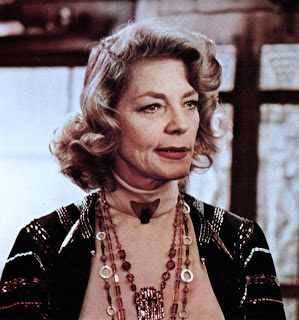
Martin Balsam plays a director for the company that owns the train and serves as an assistant to Finney during the investigation. Lauren Bacall plays a haughty, arrogant and meddlesome American passenger. One memorable has her suddenly presenting the murder weapon. Anthony Perkins, in his usual quirky, tic-laden style, is Widmark’s secretary and personal translator.
 Sean Connery and Vanessa Redgrave portray
  British subjects on their way home following time spent in India and Baghdad, respectively. (Connery was the first star signed to the picture with regards to suspects. Lumet knew that assigning a strong name like his would help attract the others.) Miss Redgrave would later play Christie herself in the 1980 film Agatha. Wendy Hiller
 is a Russian princess traveling with her personal maid Rachel Roberts. (These two scared me as a child as well! Hiller was mysterious and used a distinctive accent and Roberts seemed like a severe, blonde variation on The Child Catcher from Chitty Chitty Bang Bang.)
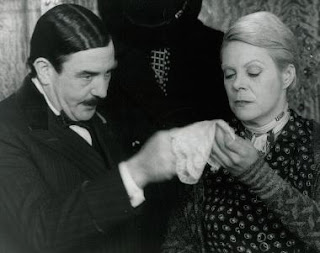 As a meek missionary, Ingrid Bergman impressed
 everyone with a lengthy take during her interrogation scene, fretting over her "little brown babies." It won her an Oscar over some tough competition (even she didn’t thing she should have won it!) She had been approached to play Hiller’s role, but wisely opted for the smaller, but more dynamic part.
Michael York and Jacqueline Bisset play an attractive young married couple, with he a Hungarian diplomat and she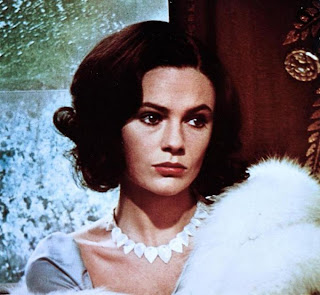 a delicate and exquisitely beautiful wife. Other familiar faces/suspects include car salesman Denis Quilley, talent agent Colin Blakely and sleeping car conductor Jean-Pierre Cassel. (In one of those connections I always love, Cassel was King Louis XIII in The Three Musketeers when York played d’Artagnan, though there are many such connections in this movie. Cassel’s son Vincent is a busy actor himself at present.)
 After more than a little frustration and some red herrings, Finney gathers everyone into one place so that he can reveal his
 theory as to who has done Widmark in. The monologue he had to deliver was eight pages long and he had to do it several times in order to get all the camera coverage needed in the immensely cramped quarters of the dining car. The dénouement is one of the more unusual resolutions to be found in a mystery and one I won’t spoil here, but the recreation of it in the film definitely gave me the willies as a child in the audience of a dark movie theater.
I cannot explain how much I love the poster art for this motion picture (the one at the top of the posting.) The renderings of the stars arranged together with pieces of some of their profiles or heads creating the jagged edges of a giant dagger. This alternate poster utilizes the then-popular "box style" of star billing. In one of my first ever posts here, I talked about my fascination with the pictures of the actors arranged on the cover of The Three Musketeers tie-in book. Maybe I’m just a collector at heart but I love having all those stars crammed together in one place like that!
A lot of other all-star Christie adaptations would follow this one, but none of them quite matched this one all the way in terms of period flavor and a general feeling of dread and tragedy, though they would offer up delights of their own. (They also couldn’t compare to the box office take, however, this being the highest-grossest British film ever up to that time.)
As a follow up to the star-studded and highly successful Orient Express, producers put together Death on the Nile, the next adventure in the glamorous, but dangerous, life of Christie's famed sleuth Poirot. Played this time by Peter Ustinov (as Albert Finney declined to participate in this film and undergo another round of the tedious makeup), he is on a trip to Egypt and in the company of wealthy (and selfish) heiress Lois Chiles.
She is on honeymoon, having recently stolen best friend Mia Farrow's hunky boyfriend Simon MacCorkindale and married him. Unfortunately, Farrow is in hot pursuit, hilariously turning up at every locale to make them suffer. Even more unfortunately, Chiles and  MacCorkindale board a paddle steamer to travel the legendary Nile and virtually every fellow passenger on the vessel would be quite pleased to see Chiles six feet under! As in the prior film, the well-dressed cast is comprised of many distinctive and talented actors.
Angela Lansbury is a (very) tipsy romance novelist presently being sued by Chiles for libel. Olivia Hussey is her protective daughter. Jon Finch plays an anti-Capitalist who resents Chiles' ostentatious wealth. Miss Bette Davis is a cranky, jewel-loving widow who covets Chiles' pearls while her dour handmaid Maggie Smith blames Chiles' family for the ruination of her father.
Jane Birkin is Chiles' somewhat oppressed maid. George Kennedy plays Chiles' crooked attorney and Jack Warden is a doctor who hates Chiles for her damaging public criticism of his clinic.
Naturally, the chances of all these people being together at once on the same boat is preposterous, but it's the hallmark of Christie's type of mystery. In any case, Chiles soon winds up dead, but Farrow, the one who wanted her destroyed more than any other, has an airtight alibi! Ustinov must delve into every detail of the matter and solve the case.
He's hastened in his desire when another passenger turns up deceased. Then another! This is surely one of the most violent and deadly of the mysteries from this period, which typically only involve one murder or perhaps two.
 One's tolerance for films like this will depend on one's love of things like wondrous Egyptian scenery, a palette of well-known cinematic faces and a head-scratching
 mystery. Then there are Anthony Powell’s Oscar-winning costumes, including such outré items as a pair of diamond-studded heels worn by Chiles and a pair of shoes worn by Davis that were made from the skin of twenty-six pythons! Some less-interested viewers may balk at the lengthy running time or the deliberate pacing (it's close to an hour before much of anything significant happens.)
Standouts in the cast include Davis’s cantankerous  biddy and Smith as her put upon aide. Their bickering and sniping supplies much of the fun in the film and Davis has a hysterical shoreline greeting from some of the local Egyptian children. When Davis asks Smith how a trip down the Nile would suit her, she replies, “There is nothing I would dislike more. There are two things in the world I can't abide it's heat and heathens.” Davis then responds, “Good!” and orders Smith to begin packing.
 Lansbury gives an audacious, completely over-the-top
 performance, which is nevertheless delightful. She never lets up on her flouncy, barely navigable character. Farrow is entertainingly nutso, popping up again and again, her snowy skin and red hair contrasting against the taupe settings. Ustinov and pal David Niven also make an interesting pair as they work on solving the mystery, with Ustinov giving into the comedy a little more than his predecessor.
 Chiles, who looks wonderful in her character's
 striking clothes and hats, is in way over her head acting-wise. Vocally, she lets the air out of some of her more caustic lines and a more adept performer might have really added not only some spice, but some more menace and reason for people to dislike her (other than for her sometimes shitty acting.)
Mention must be made also of Nino Rota’s music.  A majestic, deliberate theme paddles the boat down the Nile, giving the film a lustrous quality from the very beginning, which like the river, continues on at the end credits. The same artist, Richard Amsel, who had provided Orient’s poster art, did the same for this film. You must click on the small versions here in order to see his beautiful work in a larger size.
The endless use of fantasy scenarios can be a little tiring (how many times does the viewer need to see the scuffle in the saloon as Ustinov discusses it?!), but first-time viewers who are still trying to figure it all out shouldn't mind too much. It's a beautiful, star-filled, solidly constructed film, the likes of which is no longer made. (Okay, yes, these have all been remade for TV, much more realistically, but with far less star power and, in a lot of cases, less fun!)
1980 brought a new tack with the Agatha  Christie mysteries. Instead of using Hercule Poirot as the investigator, another one of the author’s famous sleuths was utilized, the nosy, but intuitive old biddy, Miss Jane Marple, played here by Angela Lansbury in The Mirror Crack’d.
This, of course, serves as a bit of an interesting prelude to Lansbury’s long-running series Murder, She Wrote (the title of which is even a variation on one of Margaret Rutherford’s old Miss Marple movies Murder, She Said!), though Lansbury never looked like Miss Marple on her later TV series. Here, she is done up in powdery, plain, old lady makeup even though she was but fifty-five at the time.
The plot concerns the making of a big screen film about Queens Elizabeth I and Mary of Scotland near Lansbury’s home, thus heralding the arrival of a once-great star who has been saddled recently with many emotional problems. Elizabeth Taylor plays the star (in a role first offered to Natalie Wood) and her old Giant costar Rock Hudson plays her husband. Somewhat zaftig Taylor, who
 it wouldn’t have been difficult to call a has been at this particular point in her career (she had yet to enjoy the renaissance that she would a short time later following a total mind and body overhaul) is just about to kick off the filming of her new picture when she is stricken with a sort of bug-eyed, trancelike fit and soon after begins receiving death threats.
 Things are complicated by the arrival of her glamorous costar Kim Novak, who has always enjoyed a bitter rivalry with Taylor. (Who knows how Taylor regarded Novak in real life? Novak looks unbelievably trim, yet curvaceous here.)
 The pair needles each other with all sorts of hilarious put-downs and catty remarks. For example: “Chin up, darling…both of them!” and “There are really only two things I dislike about you. Your face.”
Then there’s harried producer Tony Curtis who spends countless hours on the phone to L.A., appalled at being stuck in a tiny village such as St. Mary Mead. It’s a fulltime job just keeping the ladies happy and away from each other, though. Another suspicious type is Taylor and Hudson’s secretary Geraldine Chaplin whose devotion to Taylor is in question.
 When Lansbury injures her leg in an
  accident, she must call upon her police inspector nephew Edward Fox to help assist with the mystery solving. (Since he’s the actual authority, it’s really her assisting him with some of the peskier details of the crime.) His deceptively demure and unassuming nature allows him occasional access to information he might not normally be able to acquire as an officer of the law.
I have deliberately skirted around the murder in this film (and have tried not to spoil the endings of the others discussed here as well), because I dislike spoilers in general, especially when some of the movies I talk about at this site may not have been seen by some of the readers who visit here and I like for people to be able to discover “new” old movies with  the possibility of still being surprised by them.
That said, there is an interesting aspect to the plotline of this film that takes its inspiration from one of the more harrowing aspects of the actress Gene Tierney’s life and that’s fun for film buffs to see. There’s also a wordless appearance by a future well-known actor portraying Taylor’s costar in the film being produced. It’s a hooty treat to see him in his period finery and with his hair all fluffed up.
Though he hardly looks terrific in this film, it’s h ard to believe that Hudson would be dead of AIDS in just five years. In 1980, the idea of such a thing didn’t seem fathomable to most people. He, Curtis and Lansbury were all born the same year, despite her playing someone much further on than them. She was only seven years older than Taylor, but had been playing well beyond her years (just as Taylor was often playing below hers!) since almost the beginning of her career.
In 1982, the last of the films I’m focusing on today was  released, Evil Under the Sun. A return to Poirot, as played again by Peter Ustinov, the whole thing seems to be a gay man's wet dream, which may be why some more mainstream viewers are left cold by it.
Look at the evidence. You get two dueling divas (Maggie Smith and Diana Rigg) all done up in fussy costumes and doling out catty comments, fey Roddy McDowall wincing around as an obvious homosexual, virtual drag queen Sylvia Miles who looks like Harvey Fierstein in a fright wig, hunky, delectable Nicholas Clay trotting around in a very revealing swimsuit, a wealth of Cole Porter music and even a glamorous make-over at the end!! What's not to love?
Taking place on a stunning Mediterranean island, it has Ustinov visiting a resort to investigate the mystery of an expensive diamond that has wound up a phony. While there, he, as is always the case, becomes embroiled in a murder investigation.
 Smith, an ex showgirl, runs the place and is dismayed to see her old rival, the now successful (and successfully married) Rigg arrive. Smith gets to deliver this gem about Rigg:
 “Arlena and I were in the chorus of a show together, not that I could ever compete. Even in those days, she could always throw her legs up in the air higher than any of us... and wider.” Other guests are also unhappy with Rigg and do little to disguise their distaste. She, of course, looks sensational in the colorful and extravagant clothes of the era and is given several pithy lines to deliver. At one point, she tells her awkward stepdaughter, “Linda do stop standing there like a cough
  drop and say good morning to Monsieur Poirot!”
Speaking of the stepdaughter, she is probably the worst aspect of the film. Someone decided on the casting of a 99 and 44/100% talent-free girl named Emily Hone in a featured role. Billed as "Introducing" Emily Hone, she would make one more very minor film before disappearing entirely from the cinematic landscape. It's quite fun to see Rigg picking on her, but she doesn't get to for long.
 This film has a nice little gallery of celebs on hand and each has their little moment or two of glory "under the sun".
  Several, such as Smith, Jane Birkin, Colin Blakely and Denis Quilley, had appeared in previous Christie films. James Mason, who plays Miles’ husband is looking a little embalmed here and, sadly, would be dead within two years. Once you have heard Miles call him by his character’s name of Odell, you aren’t likely to forget it. Miles bizarre performance mystifies me more than any of the criminal aspects of the story!
The scenery in this film is utterly exquisite and, as was typically the case for these movies, the costumes are wonderful  (done here by Anthony Powell, who had also done the ones for Nile.) One of the best aspects (aside from seeing Rigg and Smith one-upping each other) is the vastly underused and unappreciated actor Clay. Best known for playing Lancelot in Excaliber, he is just divinely handsome and effective here. You can trust that there will be a tribute to him at some point in The Underworld.
These films have an unfortunate hamstringing effect on actors in that they are required to perform mostly as suspicious props rather than real people in order to keep the air of mystery and menace going. It’s necessary to keep all avenues open for as long as possible in order to prolong the mystery. Still, there are often juicy little moments to be had within this framework and I always love to see my stars appearing in projects as elegant as these were.
Ustinov clearly had an affinity for the character of Poirot (and h e even designed the swimsuit shown here himself!) because he played him six times in all. There were three TV movies (set in the present!) after Evil Under the Sun and, in 1988, the film Appointment With Death. By that time, unfortunately, the budget had dwindled considerably, though there was still a modicum of enjoyment to be had and a handful of star power amongst the cast. Audiences just weren’t willing to go out and pay to see that type of film any more. In more recent years, David Suchet made a great success out of playing the detective in a long series of television movies and Joan Hickson successfully took on Miss Marple in the same way.
 My mother’s was Franco Nero (and I claim him, too, because I selfishly want more than one!) Some fans a couple of years before him might have liked Cornel Wilde. Recent ones have included Ioan Gruffudd and Richard Gere (please…) The one my generation probably identifies the most with the role is Excalibur’s Nicholas Clay. Mr. Clay is the divine subject of today’s posting!
 In 1971, at age 25, Clay filmed The Night Digger, a mysterious drama concerning two sisters (Patricia Neal and Pamela Brown) who take in a boarder/handyman (Clay) who may very well be responsible for some ugly strangulation killings taking place nearby! The hunky, humpy Clay had several shirtless scenes, including one in his tightie-whities and, most surprisingly, a love scene with Neal who was twenty years his senior.
 Neal, who had recovered from a debilitating stroke not long before, was making her second foray before the camera in the wake of it. (Her prior film, The Subject Was Roses, netted her an Oscar nomination, but it was three years before she followed it up with this.) Her stroke was written into the plot rather than have her try to mask the resultant symptoms of it.
 Clay was charming and dangerous all at once. His unusual features (sort of caveman-ish, at times, to be honest) were alternately beautiful or rather brutish, depending on the angle and the lighting. He was already establishing a screen persona that equated to desirability at the risk of personal danger.
 First, however, Clay won the starring role in The Darwin Adventure, the tale of famed naturalist and scientist Charles Darwin, who sails off around the southern tips of the world in order to investigate the geology and try to inform himself about the evolution of mankind. His five-year voyage around the globe aboard the HMS Beagle is filled with strenuous conditions and events.
 Adventure or not, Charles Darwin was a bit of a hard sell to many moviegoers and the movie had little impact (and, in fact, is extremely scarce today!) He was a game lead actor for such a film, but it didn’t help set his movie career on fire.
 life more than once. When their time on The Great White Way was over, she made a British television movie called In This House of Brede, about a wealthy businesswoman who decides to become a nun and Clay was cast in a supporting role.
 in a British miniseries called Life of Shakespeare (with Tim Curry as the title personage!) Then, in 1979, he one of many notable British stars to appear in Zulu Dawn, a prequel to the eye-popping action film Zulu. Along with American Burt Lancaster, the film included Simon Ward, Denholm Elliott, Bob Hoskins, Peter Vaughn, Christopher Cazenove and Peter O’Toole.
 most of them played by stalwart actors such as Nicol Williamson, Helen Mirren, Liam Neeson and others.
 waiting and waiting for the moment to arrive when we got to see Clay without his armor?!
 Oliver Mellors in an adaptation of Lady Chatterley’s Lover.
 His beefy, manly persona is too much for her to resist any further and the two embark upon a passionate, but doomed, love affair.
 While the images of him rolling around with Kristel, planting flowers in her hair (and I do I mean ALL of her hair!) probably didn’t help legitimize his acting career, it did give the world the gift of his hunky, undressed self.
 1982 found him once again surrounded by a bevy of great and fun actors in the Agatha Christie whodunit Evil Under the Sun. As the husband of a sickly looking Jane Birkin, he played the handsome and virile Patrick Redfern who rather openly carries on an affair with the elegant (and delightfully bitchy) Diana Rigg, his old costar from The Misanthrope on Broadway.
 into the score, it’s an elegant and classy affair. Everything, however, takes a back seat to the sight of Nicholas trotting around in a snug, abbreviated pair of swim trunks that caress his sun-kissed body. (Look. I take these things very seriously! Ha ha!) As always, his acting was terrific and he was a joy to watch.
 When Sebastian (played by a young Michael Biehn) turns to Christianity and, in turn, rejects the love of Clay, Clay orders him to be shot to death by a team of his fellow archers. The film is given an unusual present day wraparound story, setting the tale of Sebastian more in the category of a dream or flashback. Whatever the case, it’s always nice to see Clay in a homoerotic scenario.
 This same year would see him as one of the leads in one of American TV’s most hooty miniseries (and that is saying something!) The Last Days of Pompeii told the story of various citizens of that legendary city scrambling around due to various dramas until everything climaxes with the eruption of Mount Vesuvius. Clay played a wealthy, kind Greek, living among Roman people, who pines for priestess Olivia Hussey. Hussey’s high priest brother (ironically enough, former Lancelot Franco Nero) will have none of it.
 kindly whore Lesley-Anne Down, statesman Laurence Olivier (and his wife Siobhan McKenna), social-climbing Ned Beatty (!), overseer of the gladiators Ernest Borgnine (!) and blind slave Linda Purl (!!) and you have a smorgasbord of cheesy, campy delights. Nicholas practices the discus in a teensy skirtlet and wrestles with Regehr. It’s yet another opportunity to see Clay in his physical glory, but his days in the sun were becoming quite numbered.
 of classic fairy tales produced by Golan & Globus for Cannon Films in the mid 80s. The series was intended to consist of sixteen films, but after the first one, Rumpelstiltskin, starring Amy Irving and Billy Barty, flopped at the box office, the remainder, including this one, went straight to home video.
 Collectors praise the Jerry Goldsmith score as one of his all-time best, but the movie has been M.I.A. for years.
 American audiences saw less and less of Clay after this. He returned to the U. K. to work on a few television series including Gentlemen and Players (which featured a theme song by Petula Clark) and Virtual Murder, a crime investigation series that costarred him with Kim Thompson (of Stealing Heaven.) The offbeat show took its cue from The Avengers, and has devoted fans even now though there were only six episodes, but it was abruptly cancelled and scarcely seen again.
 In the GCI-heavy miniseries The Odyssey, which starred Armand Assante and a gallery of other familiar faces like Isabella Rossellini, Bernadette Peters, Christopher Lee, Vanessa Williams, Eric Roberts and Geraldine Chaplin, Clay played Menelaus. Now 50, his face was buried under a large beard.
 Though Clay would continue working steadily, mostly in British projects, through 1999, he was stricken with liver cancer and died far too prematurely in May of 2000 at the age of 53. The three films for which he is best known and best loved in The Underworld all came within a period from 1981 – 1982, but we thank him for them! Excalibur, Lady Chatterley’s Lover and Evil Under the Sun were all made better by his presence.


