The roman à clef (or as it is sometimes called when it happens in the cinema, the film à clef) has been a part of movie-making from the earliest days. One that springs to mind from long ago is 1931's
The Miracle Woman, a version of female evangelist Aimee Semple McPherson's life, that starred Barbara Stanwyck. Harold Robbin's novel based on the killing of Lana Turner's gangster boyfriend became
Where Love Has Gone (1964) while his take on Howard Hughes provided us with
The Carpetbaggers that same year. Jacqueline Susann's fill-in-the-real-names book about drugs and sex in show business gave us the immortal
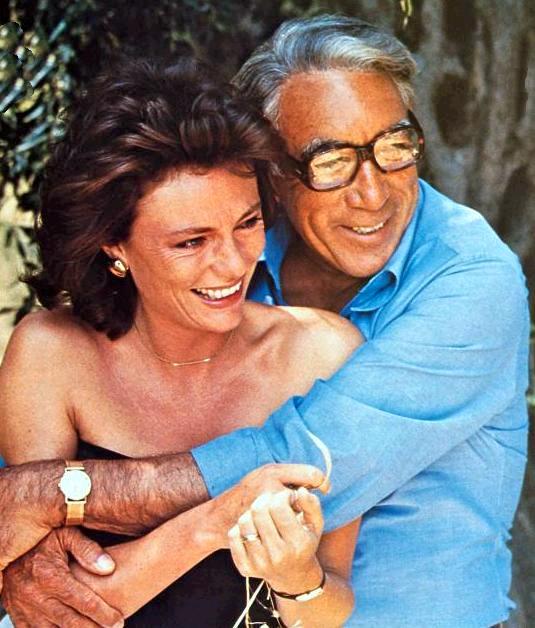
Valley of the Dolls (1967.) In case you haven't noticed, often times these pseudo-stories inspired by fact yield some deliciously trashy and hooty motion pictures! One of the most blatant examples of a film à clef is today's featured movie,
The Greek Tycoon, released in 1978.
There can be no mistake from the portraiture (not to mention text) on the movie's poster just who this project is portraying. Yet the makers were careful to (very slightly!) adjust the names and situations in order to avoid a lawsuit launched from the considerable power of either the Kennedys or what was left of the Onassis family. The result is a truly bizarre concoction in which scene after scene plays out much like what happened with Aristotle Onassis and Jacqueline Kennedy and their families, yet tweaked just enough that it provides a weird distortion of the scenarios at hand.

We first meet billionaire “Theo Tomasis” (Anthony Quinn) while onboard one of his whaling vessels which is operating illegally. As the authorities close in for arrest and seizure, Quinn springs on them the fact that his ship is actually Japanese-owned (the sale having taken place moments beforehand!), which extricates him from any wrongdoing. This is a conglomeration of similar situations the real Onassis had been involved in when he sailed his own ships under a Panamanian flag to avoid taxes and later sold his whalers to the Japanese.
Next, we see Quinn descend upon his luxurious estate in which female after female rushes to him in practical ecstasy at the sight of him (one of them being Lucy Gutteridge in her film debut.) We know that he is wealthy beyond all reason because at the buffet table of his lawn party, there is a towering stack of deli meat, punctured every so often by a cherry tomato on a stick! This was a first for me, but maybe I don't get out enough.
We meet members of Quinn's family here, including his brother “Spyros” (Raf Vallone, whose own wife throws herself at Quinn, too!), his wife “Simi“ (Camilla Sparv) and his son “Nico” (Edward Albert.) Ari Onassis didn't have a brother, but he did have a frenemy named Stavros Niarchos who is represented in the form of Vallone in this piece.
Sparv is strenuously coiffed and made up to resemble Tina Onassis as much as possible. Albert represents Alexander Onassis, though, unlike real life, there is no daughter (Christina Onassis) in sight.

Also at this gathering are “Senator Jack Cassidy” (James Franciscus) and his wife “Liz” (Jacqueline Bisset, which means a Jacqueline is playing a Jacqueline, but can't use that name!) Quinn is immediately interested in getting to know Bisset better and manages to get Franciscus to extend his trip one more day by dangling a former British Prime Minister in front of him, who will be at a later event on Quinn's gigantic yacht. A similar occurrence happened in real life between Onassis, Kennedy and former PM Winston Churchill.
Quinn takes Bisset around his amazing yacht, his lack of refinement amusingly showing through when he describes one of his stunning sculptures as being of value because the subject has "nice tits!" The real Ari had bar stools on his yacht made from white whale foreskin. Once, visiting Greta Garbo landed on one and he exclaimed, "Madame, you are now sitting on the world's largest penis."
Bursting onto the scene is Quinn's not-so-secret mistress “Sophia Matalas” (Marilu Tolo), a fiery, flamboyant actress meant to suggest Maria Callas, a world-famous opera diva who carried on a long affair with Onassis. The two are engaged in a feisty relationship that combines tempestuous fighting with enthusiastic sex. Tolo parades around completely naked for one extended scene in which she and Quinn argue and tussle around on the bed.
As the story progresses, Quinn travels to the U.S. where Franciscus is now President. His brother “John” (Robin Clarke) is his right-hand man at all times, clearly meant to be Robert Kennedy. Bisset is pregnant with the couple's first child (a departure from real life in which Jackie had two children prior to entering the White House), but before too long endures the death of her baby (which really did happen when little Patrick Kennedy only lived two days after his birth.)
Meanwhile, Sparv has decided to divorce Quinn after having suffered through his public affair with Tolo and having lost his affection. While he claims to still care for her (and Sparv is quite lovely), he can't even bring himself to kiss her on the lips, contorting his face in order to avoid it! He and Tolo, despite earlier plans, don't proceed to marry. It seems he has something else on his mind.
Against Franciscus' express desires, Bisset takes Quinn up on an offer to recuperate and escape the Washington rat race on his yacht. (A real trip like this occurred with Mrs. Kennedy, though she was chaperoned by her sister.) She arrives in Greece and is treated to the splendid scenery, history and beauty of the region. He even takes her to the Temple of Poseidon, seen in the background at right!
She absorbs the Greek culture (including a festive dance with plates flying), listens to Quinn's backstory, shops extensively (always with the famous “Jackie O” sunglasses in place!) and soaks up the beautiful sun and air of the surroundings.
Sensing that it is time to return to the States, she rejoins Franciscus at their Cape Cod home. Things, however, are not to be left to flower again thanks to the bullet of an assassin's gun. (While the killing of the President is unlike the real-life scenario, it must be said that it is quite shocking and vivid when it comes!)

The funeral sequence is unintentionally funny for a couple of reasons. Number one, why is the receiving line made up solely of Bisset, brother-in-law Clarke and his wife Katheryn Leigh Scott (with a prominent Catholic priest to the side)?? Also, the story all takes place in contemporary (1978) times, yet Bisset is done up in widow's weeds that mirror the clothing that Mrs. Kennedy wore fifteen years prior in real life! Did the viewer really need to be conked over the head with costuming that demonstrative? We get it!
Eventually, Bisset decides she's had enough of playing the part of the cocooned widow and decides to return to Onassis and his splendid yacht. She expresses to Clarke that she is tired of sharing her grief over Franciscus with “all of them” - ostensibly indicating the large “Cassidy” family, yet we have never seen any of them but Clarke and his wife!
Once back in Greece, she and Quinn pragmatically discuss the idea of marriage. They actually (just as it was with Kennedy and Onassis) arrange all the details – financial and romantic – of how it will play out. She is free to do anything she pleases so long as ten days a month are shared with him. She also receives a financial settlement if they split that's based upon the number of years they are together.
They wed in a ceremony that has vague similarities to the one shared by Ari and Jackie, right down to the rather traditional lace wedding gown, though Bisset's shows far more neck and collarbone than Jackie's did (and Bisset opts to ditch the bow in the back of her hair.)
Their honeymoon night is less than spectacular when the libidinous Quinn reveals that he is likely going to pay Tolo a visit the following day and may bed her in the process. This prompts Bisset to send him packing from her suite unsatisfied.
Everyday married life is not always peachy, either. One day, when he crudely corrects her and shuts her down in front of some business associates, she strides away fuming. When he attempts to approach her about it, she goes frantic and starts screaming, flailing and kicking, a situation that creates an amusing visual!
In fact, there is a fair amount of roughhousing in the movie. When Quinn isn't canoodling roughly with Tolo or sparring with his son Albert, he's pouncing on Vallone for marrying and subsequently destroying Sparv. He's seen here yanking Vallone out from under his desk and pulling him across the room!
Things really hit rock bottom, though, when Quinn is delivered some shattering news about a member of his family. This is something that wounded the real life Greek tycoon as well and helped to speed his health decline.
With Bisset off on one of her jaunts, he can only rely on his beloved country and the people (and the dogs!) of it to help salve his tortured heart.
He takes part in a brief dance with some fellow Greek gentlemen (one of several
Zorba-like moments in the movie) as the sun sets on his extraordinary life.
Quinn, a Mexican actor who had toiled away in ethnic parts from the mid-1930s on until finally reaching stardom, was still a viable big-screen leading man, but one in need of a hit. This did qualify, technically, making back more than double its budget, but it was certainly not a jewel in his cinematic crown. Directed by J. Lee Thompson, who'd successfully helmed Quinn's
Guns of Navarone (1961), the two would collaborate again the year after this for
The Passage.
Though he wore a bathrobe and jockey shorts for his love scene with Tolo, Quinn did show off some sixty-three year-old side nudity at one point in the movie. Considering his age, it could be worse, but I don't know if the world was really waiting with open eyes for it!
Quinn had several things in common with Onassis, not the least of which was his heavy libido. He stated in his autobiography that it was his desire to impregnate as many women as possible (and he did have at least twelve children!) One thing that differentiated the two was that Quinn was 6' 1”, quite a bit taller than the diminutive Onassis. Nevertheless, Ari had purportedly claimed that if anyone was ever to portray him in a movie, Quinn was his pick. Quinn died in 2001 at age eighty-six of complications from throat cancer.
Bisset rose from small roles in various 1960s films (such as
Casino Royale and
Two for the Road, both 1967) to costarring status opposite some of the day's biggest leading men. There was Frank Sinatra in
The Detective (1968), Steve McQueen in
Bullit (1968), Paul Newman in
The Life and Times of Judge Roy Bean (1972, in which she played his daughter!) and, of course, her part in the massive blockbuster
Airport (1970) opposite Dean Martin. When
Tycoon was filmed, she was in the midst of a huge torrent of publicity thanks to her wet t-shirt appearance in
The Deep the year before.
Incredibly, she Franciscus and Albert were all three cast in the 1980 disaster (not just disaster movie, but an actual disaster!)
When Time Ran Out... She still had a few key movies to go such as
Rich and Famous (1981),
Class (1983) and
Under the Volcano (1984), but soon segued into supporting character roles. She's still working steadily at age sixty-eight and is still very beautiful despite having had no plastic surgery according to her.
Italian actor Vallone was busy from the early-1950s on, working in 1961's
El Cid and occasionally appearing in American productions like 1963's
The Cardinal, 1965's
Harlow (the Carroll Baker one) and 1966's
Nevada Smith with Steve McQueen. The year before
Tycoon, he graced another glossy howler,
The Other Side of Midnight. He worked up until two years before his death at age eighty-six in 2002, having published an autobiography in 2001.
Albert (the son of venerable actor Eddie Albert) made a splash in 1972 with
Butterflies Are Free and the next year in
Forty Carats, but really didn't achieve regular leading man status, at least not in films of significant consequence. Blessed with beautiful skin (thanks to his Mexican mother Margo) and luminescent green eyes, he typically made an impression in whatever he appeared in.
Even taking into consideration the more commonplace man-to-man affection of the characters' culture, Quinn often has his hands all over Albert in
The Greek Tycoon and who could blame him? He's pretty dreamy! Sadly, Albert was taken from us far too early, at age fifty-five, of lung cancer in 2006.
See below the real Alexander Onassis, before and after surgery to straighten his nose.
Franciscus is an Underworld favorite who's been profiled here before. His granite-jawed, clean-cut looks led him to play the role in
Tycoon that was based on JFK, but he also went on, just a couple of years later, to play the actual JFK in the TV-movie
Jacqueline Bouvier Kennedy (1981), which starred Jaclyn Smith as the title figure! Like Albert, he died far too young at fifty-seven of emphysema in 1991.
Swedish actress Sparv made a name for herself in the mid-60's with films like
The Trouble with Angels (1966), the Matt Helm flick
Murderer's Row (1966) and
Mackenna's Gold (1969) with Gregory Peck, but soon fell off the cinematic radar for a few years. This was a rare return to the big screen after having turned more to TV. No stranger in real life to being married to wealthy, powerful men, she was the spouse for three years to producing giant Robert Evans. Now sixty-nine, she retired shortly before marrying her third husband in 1994.
Italian actress Tolo began working in films, many of them sword & sandal epics, in 1960. This marks one of her infrequent English-speaking projects, others being
Candy (1968) and
Bluebeard (1972), with Richard Burton. She later worked on an episode of
Charlie's Angels as well as landing a role in the lengthy (and very campy) TV-miniseries
The Last Days of Pompeii (1984.) Having exited the business in 1985, she is now sixty-nine.
This is a picture of Tina Onassis and Maria Callas together.
Sterling character performer Charles Durning has a supporting role in the movie as an American businessman and official who finagles shipping deals and agreements with Quinn. Durning just passed away in December of 2012 at age eighty-nine.
One hopes that the role Luciana Paluzzi signed on for was larger and more prominent than what appears in the final cut because apart from one brief exchange with Quinn near the beginning, she is practically a background extra for the rest of the time! A former Bond Girl from
Thunderball (1965) and an attractive leading lady in several other films, she began to get stuck in trash like
Klansman (1974) and
The Sensuous Nurse (1975.) Perhaps sensing the writing on the wall, she quit acting the same year
Tycoon hit theater screens and is now seventy-five.
Clarke was no doubt chosen for his looks which suggest the features of Bobby Kennedy (shown below.) A supporting actor in movies and TV shows of the 1970s and '80s, he has been less active since the millennium.
Scott, who plays Clarke's wife, was made famous by her role on
Dark Shadows from 1966-1970. She then began to pop up in movies like
The Great Gatsby (1974) and
Brannigan (1975.) Considering that Ethel Kennedy had eleven children by Bobby, it might have been fun to have shown Scott either pregnant or surrounded by toddlers, but perhaps that was too representative of the truth for this “fictional” work. Scott, now seventy, still works today.
Quinn goes to see a doctor who is played by Tony Jay. This may delight fans of
The Golden Girls who will recall him as Laszlo, the sculptor who took turns sketching Dorothy, Rose and Blanche for a nude statute in a memorable episode.
Typical of the press for this film at the time was the following photo caption blurb:
It is simply preposterous for anyone to believe that these characters were anything other than the real-life counterparts noted above. I don't know what's more strange, seeing a project (like the awful 1976
Gable and Lombard or the ghastly, incoherent
Liz & Dick 2012 Lifetime movie) in which the real names are used, but the story bears precious little relation to the truth, or a piece like this, in which fake names are used and the truth is purposefully tweaked to avoid litigation.
Anyway, the end result is mostly unfulfilling because we spend too much time comparing reality to fantasy instead of truly investing in the story at hand. I think the aforementioned
Where Love Has Gone,
The Carpetbaggers and
Valley of the Dolls were more fun because they used reality as merely a launching point for their own florid storylines rather than trying to adhere strictly to what the facts purportedly were. Other than the scenery, some of the clothes, the familiar cast and a few campy moments, this doppelganger hasn't got a great deal to offer.






 12. Actress Lili Damita wed Errol Flynn and gave birth to Sean Flynn. Sean went missing during a photojournalism jaunt in Cambodia and was presumed dead in 1971 (officially declared so in 1984.) A desperate Damita tried and tried to recover her son and only child, or at least his remains, but was unsuccessful. After Errol Flynn's death (and the end of his spousal checks), Damita wed for a third time, but divorced again after twenty-one years.