Showing posts with label game shows. Show all posts

Wednesday, March 27, 2013

In the Mood for a Little Dick?

0 comments
Those who plumb the depths of The Underworld have seen me reference today's featured actor in posts about open shirts and, in particular, games shows before. As one of my childhood crushes, he alternately enticed me and almost scared me with his overtly expressive face and manner. He seemed to me like a recipe of 1 cup George Maharis, 1 cup Burt Reynolds, a pinch of Dick Shawn and 3 tablespoons of Paul Lynde! Though my tastes have changed as I've grown up (I lean towards hairy chests versus smooth, for example), I still have a soft spot for the exuberant, grinning comic actor Dick Gautier.

Mr. Gautier was born, appropriate for his later life spent mostly in costume, on Halloween of 1931 in Culver City, California. His last name came courtesy of a French-Canadian father who had left behind a career as a lumberjack and railroad worker to work in the movies as a grip at MGM. His mother worked as a seamstress. An early interest in sports came to nil, with injury keeping him on the sidelines, so he began to use his fertile, offbeat sense of humor in school plays.

As he transitioned from his teens into young adulthood, he began to hone his comedic writing and performing skills and also sang locally, backed by a band. He entered the U.S. Navy (looking dazzlingly handsome if you ask me!) and served his peace-time stint by producing and performing in shows for the Special Services department. After his honorable discharge, he continued to perform his brand of zany comedy at San Francisco clubs, eventually heading to New York City where he continued this path.

While giving it his all in in 1960 at a Big Apple club called The Blue Angel, he was spotted by the accomplished dancer-choreographer-director Gower Champion, who was preparing a new musical. The musical, all about the hubbub that occurs when a rock 'n roll teen idol is drafted into the Army and stops to give one last kiss to a young, small town female fan, was called Bye Bye Birdie.

Gautier auditioned for and won the part of the singer, Conrad Birdie, over 750 other hopefuls. Clad in a shiny gold jumpsuit, he swiveled and swaggered his way into the hearts of audiences. His work also drew the attention of the Tony Award nominators who put him in the running for Best Featured Actor in a Musical. Unfortunately, Dick Van Dyke, the LEAD of the show, had also been idiotically placed in that same category in order to avoid competition with Richard Burton of Camelot and he won (as did Burton.)

The role of Conrad Birdie was modeled after Elvis Presley (and, to a lesser degree, Conway Twitty) and Gautier adopted the unkempt hair and open-collared mode of dress that Presley had made famous in the 1950s. Gautier, though, was already pushing thirty by this time and had earlier married a woman who would give him three children before their unfortunate divorce.
He played the part on Broadway until 1961, whereupon he continued briefly to enact the role on tour, then did a show in Las Vegas for several months. Eventually returning to California, he began working on TV pilots and landed a small role in the 1964 movie Ensign Pulver. This sequel to Mister Roberts (1955) had him putting his Navy background (and ship-shape physique!) to good use, only this time in a comedic way in support of stars Robert Walker Jr, Burl Ives, Walter Matthau and Tommy Sands. (Also on board were Larry Hagman, future game show icon Peter Marshall and future multiple Oscar-winning actor Jack Nicholson.)

Sadly, when the feature film adaptation of Bye Bye Birdie was made in 1963, the Tony-nominated title role he'd originated went instead to the similar, but decidedly less alluring, fit and charismatic, Jesse Pearson. Pearson had done the part on a national tour. Tellingly, his acting career was all but over after just six or seven years afterwards.

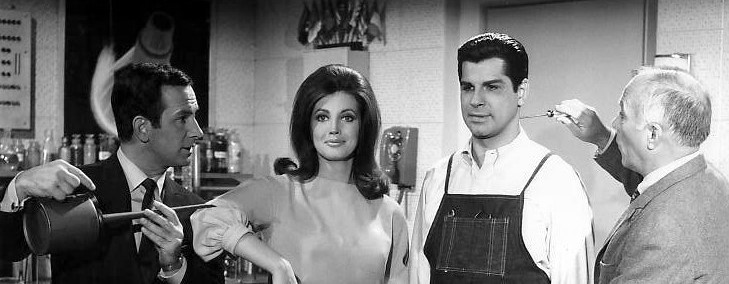
Now, in between club engagements, Gautier began to appear on a variety of popular TV series of the time including Gidget, The Patty Duke Show (as shown here), Bewitched and the Pete Duel/Judy Carne sitcom Love on a Rooftop, among others.

In 1966, he began a recurring role on the spoofy hit spy series Get Smart, which starred Don Adams and Barbara Feldon. He portrayed a handsome robot named Hymie who was on hand to help the lead spies on several occasions.

In the episode shown below, Hymie had a love interest in fellow robot Octavia (played by Gayle Hunnicut), though she was built by the other side.
Gautier only made six appearances as Hymie during the course of Get Smart's run, but it's a testament to him that he is fondly remembered by fans of the show now and has been for many years.

He also worked on another feature film, Divorce, American Style (1967), which starred his old Birdie castmate Dick Van Dyke along with Debbie Reynolds and a host of others such as Jason Robards, Jean Simmons, Van Johnson and Lee Grant.

Additionally in 1967, Gautier costarred in his own TV series. The show, called Mr. Terrific, concerned a gas station attendant played by Stephen Strimpell who occasionally works for a top-secret government bureau by taking a pill that gives him one hour (and just one!) of courage, strength and the ability to fly. Gautier was his womanizing, in-the-dark co-attendant.

The series (similar to that same year's Captain Nice and in a way a forefather to The Greatest American Hero) only made it seventeen episodes before being cancelled. Notably, actress Barbara Stuart guest-starred in one episode and before the year was out, she and Gautier married. (They're seen at left a bit later in their marriage.) During the course of their union, she served as stepmother to his three children Chrissie, Randy and Denise.

As the '60s drew to a close, Gautier helped (along with Peter Marshall!) to write the screenplay for the hooty marijuana-themed flick Maryjane (1968), which starred Fabian, Diane McBain and Patty McCormack (of The Bad Seed fame.) He also popped up as a guest on series such as The Flying Nun (seen here with Ruta Lee), The Debbie Reynolds Show, The Doris Day Show and several installments of Love, American Style.
He also, starting with Hollywood Squares in 1967, began to do TV games shows, something that would become a prominent aspect of his career, especially during the '70s. As a lover of crossword puzzles and other mentally-challenging hobbies, Gautier found it gratifying, personally and financially, to take part in many quiz shows.

In 1973, Gautier was reunited with his Ensign Pulver costar Larry Hagman for another go at a series. This one was a sitcom called Here We Go Again and had Hagman marrying Diane Baker, but living only a stone's throw away from his ex-wife Nita Talbot and her ex-husband Gautier. Thus, “comic hilarity” ensued with regularity as the scrambled up former couples with common children (including Kim Richards!) between them kept getting involved in various exploits. The show was canned after thirteen episodes. (It's a shame because he was looking fantastic at that stage, too!)
Plenty of TV work followed, though, from The Mary Tyler Moore Show as one of Mary's dates (seen here at left) to Banacek to The Rockford Files. Then in 1975, he tried once again to get a TV series of his own to stick. This time it was a send up of Robin Hood called When Things Were Rotten, co-created by Mel Brooks.
Gautier played Robin Hood opposite Maid Marian as embodied by Hee Haw's Misty Rowe! Dick Van Patten and Bernie Kopell, among others, were on hand as part of the Merry Men. Chock full of Brooks' patented type of zany comedy, I can recall absolutely loving this show (and it's fun opening credits) as a kid, but it was up against Little House on the Prairie and Tony Orlando and Dawn, so it was trounced in the ratings.

Of course, I already, even at the tender age of eight, had a crush on Dick Gautier. I just thought he was the most handsome, suave, amusing guy with an ever-present twinkle in his eye. I haven't seen this show since it aired (and was yanked off the airwaves after thirteen episodes!), so it may be positively wretched, but I can tell you that Brooks thought enough of the idea to give it a go again many years later with Robin Hood: Men in Tights (1993), not that that turned out particularly well either.

It's hilarious to me now to think that in 1975, my eight year-old brain just hated Misty Rowe out of sheer jealousy! She got to romance my man. I also thought she was trashy and cheap from having seen her in her busty, leg-baring duties on Hee Haw. I'm going to have to see if I can find clips of this long-forgotten show and find out what my reaction is now.

He was seemingly everywhere in the '70s: doing stage work in which he was Luther Billis to Ruta Lee's Nellie Forbush in South Pacific (later play Emile in another production, an entirely different sort of role acting-wise and musically), guest-starring on multiple TV series and hobnobbing with gossip maven Rona Barrett (with whom he's pictured below.)
An occasional feature film came along such as the original Fun with Dick and Jane (1977), which starred George Segal and Jane Fonda or the less-than-stellar Billy Jack Goes to Washington (also 1977.) TV movies like Sex and the Married Woman (1977, as seen here with Joanna Pettet) and plenty of guest spots kept him busy. He did The Hardy Boys/Nancy Drew Mysteries, The New Adventures of Wonder Woman, Man from Atlantis and, of course, The Love Boat.
Most often on these shows, he was a smarmy, macho, overconfident type who seemed to forget to close the majority of the buttons on his shirts! He embodied and epitomized that open-necked, gold-chain-wearing, tan, polyester persona that people often associate with the 1970s. Sure, it's corny now – might even have been then, but to my young mind he was smokin'! Ha!
Get a load of the running get-up he is wearing in this 1980 TV-movie Marathon, with Herb Edelman (best known as Dorothy's ex-husband Stan on The Golden Girls) and Bob Newhart.

This was also his fertile period on games shows, be it appearing on Liar's Club, Break the Bank, Celebrity Sweepstakes, Match Game, Password Plus, Super Password, Body Language, Tattletales (with then-wife Barbara Stuart) or, later, celebrity editions of Family Feud.

Gautier was always very artistic as well. An accomplished painter, he also perfected the art of the caricature and created countless renditions of famous people as well as original cartoon creations.
He also enjoyed making miniature furniture for use in dollhouses, which he constructed. (Okay, how jealous was I that this kid got to make dollhouse furniture with papa Dick Gautier while my own father sat on the sofa drinking Miller Lite, speaking to me only when I stepped in front of the football game on TV with a loudly-barked, “Ya make a better door than a window!”)

Though he continued to work on TV (in shows like Charlie's Angels, Happy Days, Too Close for Comfort – I can only imagine him and JM J Bullock in the same episode!, Trapper John, M.D. and Quincy M.E.), he soon began to turn his attentions toward his skill with illustration. In 1985, he published a book on drawing and it was followed over the years by close to a dozen more like it.
Plenty more TV appearances continued, such as on Zorro and Son (as seen here), Fantasy Island, Knight Rider and Alice, but by the time of the mid-'80s, Gautier started to find steady work that didn't use his famous, smirking, rubber face. He started to become heavily involved in voice-acting for animated programs.

Some of the programs he worked on included the 1980s version of Jonny Quest, G.I. Joe (as Serpentor, shown here), The Transformers, The Pirates of Dark Water, Captain Planet and the Planeteers and Cow and Chicken. He still popped up from time to time on various live-action shows such as Charles in Charge, The Munsters Today (with John Schuck and Lee Meriwether, as shown below), The Golden Palace and even Nip/Tuck.
Blessed with an impossibly voluminous head of hair, Gautier kept it thick and dark (and unintentionally amusing) through the '80s and '90s.
Some welcome flecks of silver began to appear after the millenium.
But how's he holding up today, you might ask? Well, first of all Dick Gautier is EIGHTY-ONE at present, which is quite hard to believe. Even harder to believe is that he looks THIS GOOD. It's just not fair... Married since 2003 for the third time to a psychiatrist named Tess (see below), he is a grandfather and even a great-grandfather (of three) and enjoys a quiet life in Studio City, California, about a half hour away from where he was born!
In The Underworld, we love goofy, grinning, offbeat, charming, animated Dick Gautier and often let out a (gentle) scream of glee when he shows up on our television screen. We thank him for all those years of fun times, whether hamming it up on game shows or giving television programs a bit of zest and zing (with not a little bit of beefcake in the process!)

Thursday, January 10, 2013

Meeting My "Match!"

0 comments
Mercy, things have been nuts in The Underworld lately! It's like someone opened a stop-gap at work and it's all been headed my way. As a result, I haven't been able to blather on here in my preferred manner. To bridge the gap until my next post, I'm going to ruminate a little about one of my favorite game shows. Posting a recent pick of Jo Anne Worley on Match Game sort of whetted my appetite for more on that program.


Match Game first saw the light of day all the way back in late 1962 (when it was called The Match Game.) The pilot episode for the series involved two celebrity guests, Peggy Cass (later to become a fixture on To Tell the Truth) and Peter Lind Hayes (a then-famous comic singer and TV sitcom actor.) They each headed a team of three and sought to match answers amongst themselves to such benign questions as “Name a kind of muffin.” Then points would be earned for matches within the teams and the first one to reach 100 points proceeded to a bonus round, which involved matching an audience survey.

The host of that very first pilot and the resultant program was none other than Gene Rayburn, a radio personality and sometime actor who had just come off a run on Broadway as Dick Van Dyke's replacement in the smash hit Bye Bye Birdie. Rayburn would come to be known as the face of Match Game from 1962 until the mid-'80s (and is, of course, still the only host to have made any sort of impression with it in many peoples' eyes.)
Having been picked up as a series, the first episode aired on New Year's Eve of 1962 and this time featured Miss Arlene Francis (already a cornerstone of What's My Line?) and Skitch Henderson (a multi-talented composer and band leader who worked on The Tonight Show.) It was produced in New York City. With such scintillating questions such as “John loves his _____” and “Name a flavor of pudding,” the show ran into ratings trouble and was cancelled before the end of its first season.

Producer Mark Goodson (who was a game show legend, co-creating with Bill Todson such programs as Beat the Clock, Password, The Price is Right, I've Got a Secret, What's My Line?, Card Sharks and Family Feud) thus didn't see any point in worrying when one of the show's writers submitted a question that could be seen as suggestive, even perverse.

Dick DeBartolo posed the question, “Mary likes to pour gravy all over John's ______” and Goodson allowed it and others. Remarkably, in the wake of these potentially hilarious questions (which caused titters amongst the panelists and audience, but were nonetheless answered with restraint by the contestants) the ratings began to bounce back up! No less than Miss Jayne Mansfield (complete with dog in tow!) appeared as a panelist on at least one occasion, her competitor on this day being comedian Orson Bean. Bean would return years later on the '70s version of the show, as well as on many others including To Tell the Truth.


For most of the next five years, The Match Game won its time slot and became a top three hit amongst all daytime game shows. It was still doing well ratings-wise when NBC cancelled it in 1969 as part of a scheduling-marketing change in their daytime line-up. Most of those involved with The Match Game figured that it had moved on to that big bonus round in the sky. For his part, writer DeBartolo was hardly unemployed. He had managed to secure a steady position at the notoriously irreverent Mad magazine and holds a record for having had material of his published in the most consecutive issues (from 1966 – 2009!) That's him on the far right with Rayburn during a much later appearance with trash-TV host Geraldo Rivera.

But as it turned out, DeBartolo's warped sense of humor would find itself being put to use again, but this time in an all-new updating (this time on CBS) called Match Game '73! This time, there would be only two contestants and those two would do their best (over the course of two rounds) to match a six-pack of celebrity panelists. Again, Gene Rayburn would host. The first week of shows had the following panelists: Michael Landon, Vicki Lawrence, Jack Klugman, Jo Ann Pflug, Richard Dawson and Anita Gillette. Richard Dawson would become a permanent fixture, as would Charles Nelson Reilly and, at her husband Jack Klugman's express suggestion, Brett Somers.

Now with the 1970s in swing, the colorful program opened each episode with a twinkling, twirling portal that showed each star's face as the legendary announcer Johnny Olson (of The Price is Right fame -- “Come on down!”) called their name. Needless to say, this method of opening the show was and is my all-time favorite and I love to see who will be the next face revealed as the portal spins around!

As funky electric guitar music hummed, Olson, with his distinctive voice would say, "Get ready to match the stars!" One never knew WHO was going to pop up as the window revolved!
Again, the questions were suggestive (such as "After being hit by a steamroller, Norman had to slide his ______ under the door."), but now there was a tad more freedom in what the panelists could list as their answer. Even so, boobs and buns were about as far as anyone dared go. If genitalia, or anything very close to such, was mentioned, it was bleeped out and blacked out before airing! This lent a charming sort of wink-wink bent to the proceedings as the people involved would push the envelope of certain questions without ever actually opening it.
Match Game '73 was an instant hit, immediately becoming not only the #1 game show on television, but sometimes the #1 show on daytime, period! Host Rayburn (and his memorable long-necked microphone) began to abandon the buttoned-up, staid qualities that he'd generally displayed on the original program and proceeded to enjoy the loosey-goosey atmosphere of the new incarnation.

One reason the show got wackier as the week went on was that five shows were filmed in one day and five the next over the course of a Saturday and Sunday. Rayburn lived in Cape Cod, Massachusetts and would fly to Los Angeles, where the new show was taped, every two weeks, meaning that an entire month's worth of episodes were created in just four days. (With little to no preparation required beforehand, this was quite the cushy job! Wheel of Fortune has always been done the same way which means that Vanna White basically works four days a month, though she also has wardrobe fittings, promotional blurbs, occasional trips, etc... to deal with as well.)

Since a dinner break was called for towards the end of the day's taping – during which the host and panelists would often have a drinkie-poo – it soon became evident that the Thursday and Friday installments tended to be even more fun that then others and were particularly “can't miss.” Somers and Reilly reveled in taking pot-shots at one another, he ribbing her about her looks and she (and he himself) joshing about his less-than-burly manner.

Dawson, meanwhile, became extremely popular thanks to his proficiency in the bonus round, in which contestants had to match one celebrity of their choice (which was almost always Dawson) in completing a certain phrase (for example, “Tough _____” or “______ Chicken.”) He frequently took on a mincing quality meant to ape Hollywood Squares' Paul Lynde, though it was different enough (or bad enough?) that it only vaguely resembled its source.

Recurring characters would pop up in the (now lengthier and more involved) questions including Old Man Periwinkle, Horrible Hannah, Ugly Edna and, memorably, Dumb Dora and Dumb Donald. Rayburn would start a question, “Dumb Dora is so dumb...” to which the audience would roar back, “How dumb is she?!” As it continued, Match Game audiences grew more and more enthusiastic and vocal, sometimes to the delight, but sometimes also to the consternation, of the participants.
On many occasions, things would go haywire as Rayburn, Somers, Reilly, Dawson and Miss TV herself, frequent guest Betty White, would depart from the norm and get up from their seats to take part in all sorts of mayhem. Rayburn crashed through his entry door, White engaged in a fauz-striptease as bump 'n grind music played, Reilly fell to the floor in faux pain, Dawson ran out to kiss women in the audience and Rayburn drew a halt to the proceedings to fix broken mics or chairs.


Reilly, who had one of the most hideous toupees ever, would often take to wearing hats on the show while it was being “worked on.” One one occasion, he stunned viewers by briefly showing them his bald noggin under the Panama hat he had been wearing. Ironically, like Rayburn, he'd also gotten his Broadway start in 1960's Bye Bye Birdie (albeit in a small role) and would later act and direct several times on The Great White Way.

From 1973 to 1977 (with the name of the show augmented to fit each new calendar year), Match Game ruled the daytime airwaves and was a favorite program to many folks, young, old and in-between. In 1975, a weekly nighttime version called Match Game PM was introduced (with one episode being filmed at the tail end of each Saturday and Sunday tape day), which often featured stars of an even more notable caliber than the ones who often figured into the daytime version. This was a self-contained format (never spilling into a second episode) that I, as a structured type, appreciated a lot. It ran until 1981 and yielded 230 episodes.

At least two famous folks were contestants on Match Game before they'd made their mark. One was NFL coach and commentator Brian Billick (who now writes for MSN.com), shown here in all his lantern-jawed, leather-jacketed glory. Another was Kirstie Alley, miffed from the start at Rayburn's mispronunciation of her then-unusual first name and acting rather above it all throughout.
Things on the show began to sour a bit when 1978 brought the Star Wheel. By now, the finale of each game was more or less Richard Dawson's moment in the sun. For whatever reason, the powers that be decided to mix it up by putting the panelists' names on a huge wheel that the contestants would spin to see who they'd be trying to match in the bonus round. Not only did this lead to many mismatches in answers, but it took the wind out of Dawson's sails (who, by now, had his own mega-hit show Family Feud.) Things were never the same after this.

Dawson departed Match Game in 1978 after several months of surly demeanor and rotating male celebrities were placed in his signature spot such as McLean Stevenson and Robert Donner. At its peak, it had drawn 12.5 million viewers, setting records in daytime ratings that stood until General Hospital caught fire several years later with its “Luke and Laura” storyline. Now, after Dawson's departure and unsuccessful fiddling with the show's time slot (and, of course, the unavoidable slide in popularity that virtually all programs face eventually), the show was removed from CBS in 1979.
The series still had enough drawing power, though, to continue in a syndicated version and did so until 1982, adding three more years to its overall run. After this, various attempts were made to recapture the success of the '70s version, but none of them could make it. NBC bit once more with 1983's The Match Game-Hollywood Squares Hour, with Rayburn still hosting his half, but it didn't even last a year. A 1990 incarnation with Ross Shafer and a 1998 one with Michael Burger both tanked. This last one only featured five celebs in an effort to scale back... (In both 1985 and 1987, attempts were made to re-launch the show with Rayburn, but they didn't come to fruition.
Other tries have been made to get the show going again (including a bizarre re-working of it in 1996 with Dallas' Charlene Tilton as the host, which never got past the pilot stage.) Most likely, in this more crass, anything goes era, the entertainingly coy way in which suggestiveness was handled in prior years can never be replicated. Certainly the later editions of the game left much to be desired in their handling of the risque and were instead just crude and unfunny... None but about four episodes of the 1960s Match Game exist thanks to the practice of wiping/erasing tapes after each broadcast, but practically all of the '70s rendition have been saved for posterity.

By now, all of the principal on-camera participants from the glory days of Match Game have gone on to that great big bonus round in the sky. Rayburn died in 1999 at age eight-one of heart failure. Reilly passed away of pneumonia in 2007 at age seventy-six. Somers was gone just several months later of colon and stomach cancer at age eighty-three. The last of the four, Dawson, was taken by esophageal cancer just last year at age seventy-nine. With them, they took some of the funniest moments in game show history, but thankfully their legacy lives on through rebroadcasts of their hilarious shenanigans.