


I hope you liked this little gallery of oldsters being reached for comment in their twilight years. As these stars die off, I'm afraid there are few who can take their place (including ones who have taken home Oscars of their own!)
 “Word of Mouth” is a filler segment in which an old time star will be interviewed about a certain film or fellow actor and reveal his or her thoughts on the subject. (You've all seen them. You can hear someone - I used to know who - say, "Damn good actress!" as the opening montage ends.) Most of the time, the star being interviewed has been spackled and painted to look as good as they can in light of their age. There's often an elegant sort of background, with pretty flowers or furnishings, sometimes just a rich-looking curtain. (Or sometimes not!) Many times the star is someone we either don't see a lot of or hardly ever see at all! (Still other times, the person is now dead, but the network interviewed them as in-depth as they could beforehand and are now releasing the video from it!)
 In this one, one of the earliest I can remember seeing, Miss June Allyson tells about how, during her first days working at MGM, she used to walk to the bus stop and wait for a ride because she didn't own a car and couldn't afford one yet. None other than Judy Garland, riding in her own chauffeur-driven vehicle, saw her reporting to the studio this way and would have none of it. She picked Allyson up every day after that. What's more, if Garland was done early, she would head home, but send the driver back to fetch Miss Allyson and take her home when that time came. Before too long, Allyson got her own car, but she never forgot the expression of kindness that Judy Garland offered. They became close friends and worked on some of the same movies, but not “together.”
 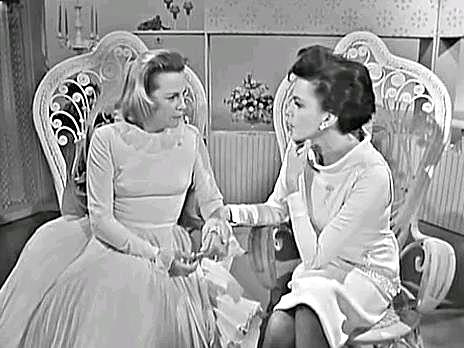 Allyson made a guest appearance on Garland's 1963 variety show (at a time when she was in the throes of alcoholism herself, having just lost husband Dick Powell) and later helped bring attention and funds to The Judy Garland Museum in Grand Rapids, Minnesota. (Incidentally, this museum was the site of a 2005 robbery of one of the sets of ruby slippers from The Wizard of Oz, a crime that has not yet been solved.) Miss Allyson died in 2006 at the age of eighty-eight of bronchitis and respiratory failure.
 I especially love it when Maureen O'Hara is shown because I love her voice and she has such beautiful skin and eyes. She's also the perfect blend of sincere and humorous. When she's speaking of Charles Laughton, the tremendous actor who played Quasimodo in The Hunchback of Notre Dame, there's a reverence and feeling of awe at the lengths he went to to portray that character. When she's speaking about frequent costar John “Duke” Wayne, there's a familiarly frank level of candor that comes through, laced with amusement. My very, very favorite “Word of Mouth” is the one in which she describes having to drive a sloshed Duke home from his club when he insisted that she pull over at a certain house so that they could “have a drink.” They made it to the door, he proceeded to enter and request his drink (which the inhabitants provided without issue) and then left. However, neither she nor Wayne knew these people and she thinks they didn't know them either! To hear her tell this story is anecdotal magic. Miss O'Hara is still with us today at the age of ninety-one.
 Kitty Carlisle, another one of my favorite people, recollected her experiences as a young singing actress going to work for The Marx Brothers on A Night at the Opera. She described how the brothers had worked out their schtick so thoroughly on the road that by the time they filmed the movie version, it was completely perfected. More captivatingly, she recalled how she had taken the part in order for her singing voice to be shown off, but that during filming, the playback was someone else that the studio had hired! She retreated to her dressing room and called her agent, staying there in tears for days, crying over everything and everyone including Irving Thalberg until finally she was allowed to shoot the sequence with her own voice on the soundtrack. Always a very stalwart and determined person of character and taste, it's great to know she was concerned with standing her ground even then in the 1930s! Miss Carlisle lived to be ninety-six, passing away of heart failure in 2007.
 Few performers from the golden age of Hollywood are as animated and “on” as Ann Rutherford. Though she played Mickey Rooney's girlfriend a dozen times in his Andy Hardy movies, she is possibly best known for playing Scarlett's younger sister Carreen (opposite Evelyn Keyes' Suellen) in Gone with the Wind. As the stars of that film started to die off and interest in it continued to reach new heights, Rutherford and Keyes (two opposite types, to be sure) were called upon to reflect on the experience of filming the gargantuan epic. She took to distinctively wearing her thick hair pulled back and draped with a long, colorful scarf. She had also worked, among other things, on the Laurence Olivier-Greer Garson rendition of Pride and Prejudice in 1940. Her “Word of Mouth” has her telling about the way the actresses massive skirts would topple the delicate antique furniture decorating the set. She developed a love of antiques, collecting one slightly broken figurine from the trash and salvaging it, though the studio cared not a whit about any of their pieces.
  She recalls one time when Olivier was seated at a desk that wasn't the right height for the camera. So the carpenters simply sawed part of the legs off of the beautiful example of antique furniture! Having retired in 1950, Rutherford made another film at MGM in 1972, They Only Kill Their Masters, and a cameo in 1976's Won Ton Ton: The Dog Who Saved Hollywood. She's still kicking today at ninety-one and even appears in public from time to time, such as earlier this year at a TCM film festival!
 Gloria Stuart (of Titanic fame) sort of wound up with a low-rent backdrop for her interview. As an actress from the 1930s who then went through some significant dry spells before being rejuvenated, career-wise, by James Cameron's shipboard saga, she had plenty to share. In one of her clips, she talks about being placed in a boat, in a studio-built lake, where crooner Dick Powell sang to her over and over as the scene was filmed from various angles for Gold Diggers of 1935. All her character had to do was just sit there and be mesmerized by the vocal attention, but after a while that became rather difficult to sustain. Having managed to preserve herself rather well, she, at age eighty-seven, actually had to be aged with makeup in order to portray the elderly Rose in Titanic! Stuart developed lung cancer in 2005, but lived until 2010 when she died at the amazing age of one hundred.
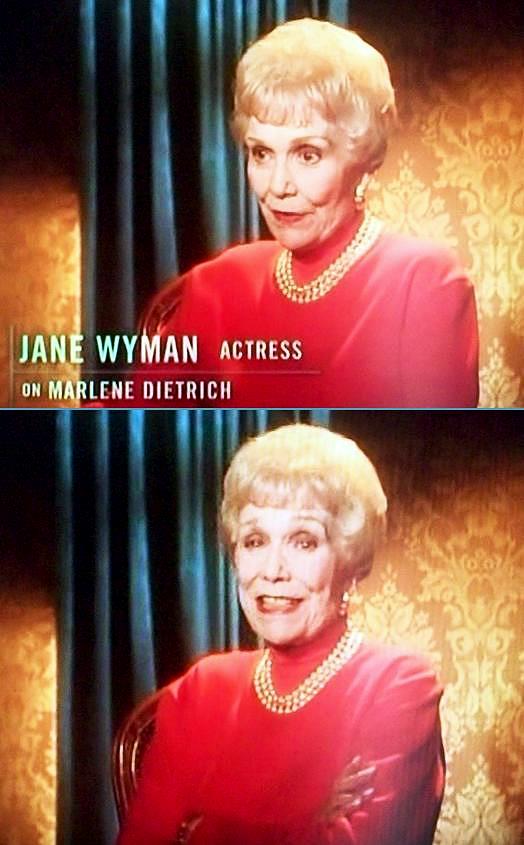 Miss Jane Wyman was nailed down for some recollections of her days in Hollywood. The Oscar-winning actress worked one time for Alfred Hitchcock on his cockeyed 1950 thriller Stage Fright. (I say cockeyed because the script had the camera “lying” to the audience, a fatal structural flaw that was off-putting and helped lead to the movie's failure.) Wyman's costar was Miss Marlene Dietrich, who had no hesitation whatsoever in making endless requests, suggestions and so on, always with an eye towards making things better. One valuable piece of advice she gave Wyman was to “always make them look at you,” meaning the audience. Both Hitch and Wyman were bemused by Deitrich's commandeering manner and would acknowledge her, maybe nod, and then proceed to do things the way they wished, but Wyman found the whole thing endearing. (Hitch was rather confounded with Wyman
  in that she kept resisting the deglamorization that was called for in her character, most likely due to being paired with one of the cinema's most all-time exotic and glamorous stars, Miss Deitrich.) Wyman, after serving a lengthy term as the matriarch of Falcon Crest, retired completely from acting in 1993 at age seventy-six. She lived until 2007, however, dying at the age of ninety from natural causes. A devout Catholic (despite starring in the sometimes lurid Crest) and a member of the Dominican Order, she was actually buried in a nun's habit!
 Joan Leslie is someone who never appeared on my radar at all for many, many years. It wasn't until I saw the Joan Fontaine melodrama Born to Be Bad that I discovered Miss Leslie and realized how appealing and attractive she could be. Her “Word of Mouth” relates the story surrounding her appearance in Yankee Doodle Dandy with James Cagney (who took home the Oscar for that film.) She mentions his generosity in helping the still-burgeoning actress work out a little song and dance routine with him, the very first take of which was printed and used in the finished product. Leslie made some TV movie appearances, the last one being in 1991, and is still kicking even now at age eighty-six.
 Another Cagney costar who had nothing but praise for him was Virginia Mayo. Mayo worked with him in one of his iconic roles, a psychotic criminal in White Heat. According to Mayo, there was no need to attempt to “act” in his presence, but merely to just know ones lines and say them in accordance to what what happening in a scene with him. Any necessary fear, tension, romance or anything else would come about because of the intense way he approached his craft. Basically, one just hung on and tried to stay with it! She felt that he deserved even more Academy Awards, but that in the '30s and '40s, it was not considered appropriate to award someone playing a gangster versus someone portraying a hero, real or fictional.
  My own striking memory of Miss Mayo is from a 1971 appearance on Rod Serling's Night Gallery. She was fifty-one then and playing a washed up actress being vilified in the media by pudgy gossip reporter Patty Duke. Duke kept hurling invectives towards Mayo about her faded looks and age, but Mayo actually looked quite amazing! She certainly looked better than her antagonist. In the 1990s, Mayo worked on a few low-budget horror and thriller movies, retiring completely by 1997. She died in 2005 at the age of eighty-four from heart failure and pneumonia.
 Sometimes “Word of Mouth” will feature a two-fer (or maybe even more), with a couple of stars commenting on the same movie. Such was the case with On the Town. Betty Garrett and Ann Miller both were shown discussing the filming of that musical, the first studio musical to employ location filming in New York City. According to the ladies, MGM originally planned to take only the three leading men to The Big Apple, but then the gals found out and wanted to go too. Reportedly, Miller was the one who fretted with the studio heads until they gave in and allowed the ladies to go, too. Only one tiny scene of the girls, filmed of them from behind as they waved goodbye to a ship, made it into the final cut.
  Garrett was rarely, if ever, one of the glamorpusses that frequently ruled the day in Tinseltown. She always seemed to come off as far more down to earth and does the same in her interview segment. Garrett enjoyed a second act when her film career ended (thanks in part to the infamous Hollywood blacklist), playing recurring character Irene Lorenzo on All in the Family and the landlady on Laverne & Shirley (eventually becoming Laverne's stepmother.) Miss Garrett worked up until 2009, but died of an aortic aneurysm in February of this year at the age of ninety-one. As for Miss Miller, she had a small part in David Lynch's Mulholland Dr. in 2001, which was her last screen role. She died in 2004 at the (comparatively young, for this group anyway!) age of eighty from lung cancer.
 Miller's costar from Kiss Me Kate, operatic soprano Miss Kathryn Grayson, occasionally pops up on “Word of Mouth” as well. This series of shots of her are from the DVD for Kiss Me Kate, but snippets from the same sit-down have been used for the feature we're discussing today, too. (Apparently, she also came upon a discarded wig from Ava Gardner in Earthquake!) She tells on herself for not being able to adeptly navigate her movement on the treadmill during the number “We Open in Venice,” seeming to always be a bit behind everyone else. Then, with more serious expressions, she recalls the physical pain that Cole Porter was in at the time of the filming of the 1953 movie. Grayson exited the movie biz in 1956 due to the lack of appropriate musical material for her,
  but did a little bit of TV for two years after. Then, after twenty years, she popped up on Baretta as a guest star and then proceeded to make three appearances on Murder, She Wrote, playing the same townsperson each time. From 1989 on, she did no more acting work on TV. She lived until 2010, when she died of natural causes at the age of eighty-eight.
 In any case, she surely doesn't come off in a very luxurious way the way her elders had before her. It's far more subdued and austere looking. That's fine if she wants to come off more as a "serious actor” and I reckon she looks pretty good for her age, but would just a smidge of color on the face or a hairdo kill her? Anyway, she's shown here discussing the marvels of nearly-forgotten (except to classic film buffs) actor John Garfield. Garfield, a Group Theater actor (an organization that eventually led to the Actor's Studio, where Woodward trained) was a dynamic and explosive actor who was blacklisted and died of a heart attack at thirty-nine before Woodward had made her first movie. Miss W. is eighty-one at present.
 In fact, after having teamed up as man and wife in The Catered Affair in 1956, they reappeared as costars in 1971's notorious Bunny O'Hare. Initially intended to be a senior citizen take-off of Bonnie and Clyde called “Bunny and Claude,” with amusing social commentary, it instead was edited into more of a slapstick comedy, prompting Ms. Davis to sue American International Pictures (though the suit was eventually dropped.) Mr. Borgnine is a hero in The Underworld for his role in, natch, The Poseidon Adventure, but we also respect the fact that he has sustained a SIXTY-plus film career and continues to act today at the incredible age of ninety-four. Some may have scoffed at his marriage to Norwegian makeup magnate Tova Traesnaes, who is almost a quarter of a century his junior, but they are edging up to their 40th wedding anniversary! Utterly sharp as a tack and so good-natured, he is a rarity in his field. Near the end of next month he will turn ninety-five and we wish him all the best!