Now you know that even with the title “March Madness” and even though I occasionally throw out a sports figure such as Jim Brown, Frank Gifford or Joe Namath (and they’re all formerly from football, my game of choice), that I’m not really going to blog about basketball!  We celebrate March Madness (and most other occasions, as regular visitors know) in an entirely different way in The Underworld. Oh, there will be some baskets and perhaps a few balls, but not of the Sweet Sixteen/Final Four variety. Posts here that concern TV bulges are far and away the most popular. Today, I’m going to toss a few more out to you, but I’m not even going to limit it to TV. We have a couple from the music industry, movies and even a stage play! This post is more brief than I would like, but I am still nose-deep in work and home concerns. I didn’t want to go too long without trying for a shot.
 To continue with the shot I presented above featuring Tony Perkins in 1960’s Tall Story, there are a couple of times when alert viewers can make out Tony Jr. He wears a pair of chinos in one scene that are rather revealing as he walks through a porch on campus, but his short little basketball togs are perhaps a bit more revealing. (If players wore their uniforms like this these days, I might be more apt to stay awake and watch!) Incidentally, player number 45 on the opposing team is none other than Gary Lockwood, at the time quite a hunky young fellow and looking great in his shorts, too!
 At one point in the movie, the climax actually, so to speak, Perkins has been banned from playing in the big game and is trying to convince the coaching staff to let him in. While “hiding” behind Anne Jackson, who plays the wife of one of his teachers, he proceeds to strip out of his street clothes and hop into his uniform. This allows the viewer to see him in his tighty-whities and even get a bit of an outline of that which he shared with several actors and actresses over the course of his career, Tab Hunter included.
 His costar in the film was Miss Jane Fonda, making her big screen debut. The movie was directed by Joshua Logan who was noted for keeping a plethora of healthy and handsome young men on hand in his films (he directed South Pacific, whose number “There is Nothin’ Like a Dame,” filled with tan, burly, hairy hunks, makes one wonder why any of them care!) This same year, Perkins starred in Psycho and from then on, he faced typecasting as twitchy, nervous, potentially-dangerous types.
 One of the cinema’s most popular and handsome leading men ever was Mr. Paul Newman. In 1963, for the anti-hero drama Hud (in which audiences nevertheless found themselves drawn to Newman‘s character!), Newman struck a pose for the still photographer that was quite an eye-(and mouth-)opener. I have yet to profile Mr. Newman in The Underworld because I try to focus on lesser-known performers who may not have received their due, but the fact remains that he is one of my all-time favorite performers and I almost always enjoy watching him (and watching him!) in practically anything.
 One of Newman’s friends and three-time costars (in 1966’s Harper, 1969’s Winning and 1974’s The Towering Inferno) was Robert Wagner. There was a pretty revealing photo of RJ not too long ago here that I wondered might be just a fluke, a shadow or something unusual in his pocket. Now, here we are again and I must say I think it must have been the real deal! No wonder Nat married him twice. Newman had to direct Wagner in Winning and one of the scenes was tutoring him through a love scene with Newman’s real-life wife Joanne Woodward. Lucky Joanne, both at work and at home!
 Do you know who belongs to the crotch above? Astute filmgoers probably recognize it. It’s from a 1967 film that really put its neophyte leading man on the map. He’s been a star ever since. He’d made one brief movie appearance before this, but after this movie, he was a major Hollywood hitter for many years and still commands substantial attention in the industry.
 The crotch in question belongs to Dustin Hoffman and the shot is from The Graduate, a smash hit that earned him an Oscar nomination as Best Actor (the award went to Rod Steiger for In the Heat of the Night.) He later won for both Kramer vs. Kramer (1979) and Rain Man (1988.) More recent popular success came with Meet the Fockers in 2004 and the various incarnations of the animated Kung Fu Panda.
Let’s make some music for a moment. First up is mid-’70s singing sensation Rex Smith. Smith was the front man for a band called REX before heading to Broadway where he played Danny Zukko in Grease.  He starred in the 1979 music business-oriented TV-movie Sooner or Later, one song of which, “You Take My Breath Away” proved to be his biggest his as a vocalist. Andy Warhol, in his famous published diaries, made mention of Rex and his impressively large member. We don’t know how he knew that, but if Smith turned up at a party in this get-up, it wouldn’t have been hard to figure things out. Smith later worked in a revival of The Pirates of Penzance and filmed a movie version of it with Kevin Kline, Linda Ronstadt and Miss Angela Lansbury. Then came a stint as the host of Solid Gold, a temporary role on Darryl Crawford and the role of Joe Gillis in the Canadian production of Sunset Boulevard opposite Miss Diahann Carroll. Marrying for the first time in 1987 at age thirty-two, he’s currently with his third wife.
 I posted a shot of The Bee Gees in an earlier bulge-filled posts, their hairy bods covered in gold lame, with jackets unzipped and pants taut. Even that photo can’t hold a candle to this one of Barry and some very distressed blue jeans. For me, Barry was always the most handsome of the Gibb brothers, including little Andy, but he tended to stick with his family and not too a tremendous amount apart from them (though there was that album with Barbra Streisand, for which he co-wrote all the songs and contributed vocals on the title duet, “Guilty.”)
 Turning to television, always a fertile place for spotting bulges, at least in the ‘60s through the ‘80s, we have a shot of hunkalicious Robert Conrad of Hawaiian Eye and The Wild Wild West. A little guy, but one who packed a major punch and was in astonishing shape for the time, he occasionally showed his basket on The Wild Wild West (or in shots from the gym like this one), but his bigger claims to fame were his chest and his unbelievably round bubble butt. He's one of those guys who, when watching West, you sometimes just have to halt and say out loud, "God, he's gorgeous..."
 King of the outlined penis on TV was Michael “Little Joe Cartwright” Landon of Bonanza. His revealing taupe pants of the mid-to-late seasons belong in some sort of VPL Hall of Fame. Thus, I have to include yet another shot of him in a publicity photo from the show, this one close to the end of its run. Alison Arngrim has spoken of his penchant for going commando at times during Little House on the Prairie, but I was never able to see anything during that show (and, truth to tell, haven’t seen any of it in ages.)
 I do not know this actor, but his name was Mitch Litrofsky. A brief career consisted of a role on Search for Tomorrow in the early 1980s and roles in 1989’s Music Box with Jessica Lange and the 1992 exploitation drama Eyes of the Prey. His career in TV and films ended soon after, though he remained a devotee of the theatre along with his business interests. Now in his fifties, he’s rather handsome minus the curls. He’s included here today because this portrait fits the bulge bill!
 One of my friends here at The Underworld, Kirgissfair, recently mentioned Robert Fuller of Laramie and the final season of Wagon Train (and later Emergency!) Though he sported some really tight pants on Laramie, still photos are not in wide supply. Though you can’t see a lot in this one, you can tell that there was plenty happening downstairs. This next one isn’t really any more revealing, but he still cuts a nice figure in his cowboy gear.
 When I did a recent post about Stuart Whitman, I spotted him in the Barbara Eden TV-movie thriller The Woman Hunter. In it, he is not only shirtless a few times, but also shows off his package in some of the era’s polyester slacks. (If only there was a better print in existence that could depict it a bit better.)
Likewise, when I was viewing Hotel for my recent tribute to that show, I couldn’t help but notice something budding in the establishment’s flower shop.  Floral clerk Terrence McNally had a rather obvious outline through his three-piece suit. It had to have been a happy place to work. McNally was a bit player in many of the most popular 1980s series including Dallas and Dynasty (and occasional movies like 1980’s Nine to Five and 1981’s Looker.) His career petered out in the mid-’90s after stints on The Young and the Restless, Models, Inc and Baywatch. He also had a role on one episode of Star Trek: The Next Generation.
 Speaking of Star Trek, this next man was a guest on a memorable episode of the original series. Does he look at all familiar? He played Lt. Uhura’s combat trainer in the installment The Gamesters of Triskelion, the one that had Kirk, Chekov and her competing in the ring for their lives. His name is Steve Sandor and he was a very prominent presence in 1970s and ‘80s TV. A burly, brawny, 6’4” hunk of man, he appeared on practically all of the hit shows from that time. This series of photos is from an appearance he made on Charlie’s Angels in 1976.
  True, his fluffy hair is more than a tad campy, but that meaty, hairy, tan chest melts my butter and is just the type of guy I grew up adoring on television. Back then, it was utterly commonplace to see an apartment groundskeeper roaming around with no shirt on. What a disappointment when my first apartment building didn’t even HAVE a groundskeeper, just an old couple, the man who did maintenance and the wife who took in the money…
 I came upon this snap of David Hasselhoff, posed for some sort of ad or bit of publicity. Talk about a guy who inspires just as many admirers as detractors! Sometimes, he comes off so handsome and appealing and then others he is a campy, hot mess. Unfortunately, it seems to be the latter that occurs more often than not. At least he seems in on the joke most of the time. Hasselhoff had two tiny bit roles on TV in 1973 and 1975 before making his movie debut in a trashy, low-rent comedy called Revenge of the Cheerleaders. His character’s name was Boner and he even had a split-second frontal nude scene, though I do not recommend sitting through the film to catch it unless you’re a true fan of his. It would seem that the only way to go from there was up, but he’s had more of an up and down career.
NotFelixUnger, a true friend of The Underworld, recently asked for something on Gordon Thomson (slithery Adam Carrington of Dynasty fame.) These shots were the best I could come up with on such short notice, but I wanted to include him in this post. You can’t see, too, too much happening in this first set of shots, but as I’ve said before bulges and VPL (visible penis line) canbe very hard to capture. It’s always more obvious in motion, so to speak.
Thomson and his on-screen mother Joan “Alexis” Collins had a very strong working relationship and their characters  were often shown together. Here, Gordon is shown just after a morning workout in his old Yale sweatshirt and an abbreviated pair of black, satin workout shorts (practically all workout shorts were small like this back then… as All in the Family’s Edith warbled, “Those were the DAYS!”) Good luck finding a regular guy being caught dead in something like these today.
Even though this is a bulge posting,  I went ahead and added a shot of Mr. Thomson from the rear, thinking it might make a nice early Easter present for NFU. (Why didn’t I just wait for a week or two and have a post called “Easter Baskets”?? Maybe next year…)
This next pic was probably the most revealing one I could find of Thomson on the fly (pun intended!) He performed most of the scene behind a railing, but could be caught briefly on the way up the stairs for a better view. When the series was cancelled in 1999, Thomson went on to work on the daytime soap Santa Barbara. The 1991 reunion movie posed something of a conflict for him and in a startling move, no one seemed to even try to work it out! So to both his and Collins’ dismay, the part of Adam went to a completely inappropriate actor who bore no relation in the slightest  to the character. Thomson did sue Aaron Spelling productions over this ignominious slight as he had become a major part of the series soon after having joined it in 1982. Soaps have been his calling ever since from Sunset Beach to Passions to Days of Our Lives, though he did have a role as Richard Dreyfus’ lover in that ghastly 2006 film Poseidon. Most of his footage was cut out prior to the film’s release (along with practically any scene that wasn‘t action oriented…)
I always feel that bulges on TV are practically dead and buried now that people seem to make more of an effort to be discreet and men’s clothes are much looser in general. Imagine my surprise lately when seeing the new series GCB (which is a rarity for me in that I never watch scripted network programs!) and the camera took its place directly beneath the proud crotch of costar David James Elliot! The 6’4” former Canadian citizen is still looking amazing, now at age fifty-one! Amusingly, the tall drink of water (of which I’d gladly sip!) is paired with the diminutive (4’11”) Kristin Chenoweth on the (terrific) series.
 For our final two presentations, I hope I saved the best for last. First up is staggeringly hunky actor Marc Singer. Famous for the miniseries V (along with the resultant series) and for playing The Beastmaster in a fur loincloth, he had been working on TV since the early ‘70s and acting on stage before that. In 1976, he appeared in a filmed presentation of one of his stage successes, The Taming of the Shrew.
 Just like I might watch more basketball if the uniforms were shorter, I might watch more Shakespeare if the costumes were this tight!
I’d like to know how anyone can look at these snaps of Singer in the THE tightest tights ever created and not simply gasp. What a body (and the face ain’t bad, either!) Mr. Singer has never stopped working, though his fame dissipated considerably as the 1990s dawned and he began to appear in a large number of straight-to-video movies.  In 2001 and 2002, he made appearances on the new TV version of The Beastmaster and as recently as 2011, he had a guest role on the new rendition of V. Today, at age sixty-four, he still works in movies, they just tend to be straight-to-video and, thus, don’t get the same type of viewership or attention that features (or even TV work, really) would bring.
My final photo of the day is from the 1982 German film Querelle. The provocative, overtly-stylized movie starred Midnight Express  star Brad Davis as a sailor desired by many people around him, most importantly his repressed commanding officer Franco Nero. The movie is one long phallic symbol and bulgefest, but someone opted to take this picture of Davis (center) and two of his well-endowed shipmates. The photo gives new meaning to the term half-mast! I hope you got a kick out of this return to a popular subject. I’ll be back asap with more movie and TV profiles.
 In his prime, I'm betting that several of my devoted divers would like to have had a nibble or even a bite of today's featured actor. From the very beginning, he was called upon to drop his shirt and show off a lightly-hairy barrel-chest. He proceeded to continuously let the world in on it, perhaps even after he should have, but we forgive him. A man who eagerly sought to show that he was capable of far more than that, he succeeded several times, but mega-stardom still eluded him. At least he was smart enough not to squander his earnings and could live very comfortably in retirement. We're referring to Mr. Stuart Whitman,
  an actor whose career spanned half a century and who is an Underworld hero for one role in particular, which we'll get to in due time.
Stuart Maxwell Whitman came into the world on February 1st, 1928 in San Francisco, California. (Had he not been born with an already nice last name, Stuart Maxwell would also have been a decent stage name!) His parents lived and worked all over the place, including both U.S. coasts, to the point where Whitman had attended 26 different schools by the time he entered high school. Fabled Hollywood High was the high school he attended and thankfully by then the family had settled in for a long spell. He graduated in 1945 and the following year, his parents had another son! Kipp Whitman eventually grew up to act as well, but not to the same level of fame or frequency of his older brother.
 WWII was over, but Whitman enlisted in the U.S. Army and served in the Corp of Engineers. While in the army, he took an interest in boxing and was quite successful at it, winning all but one of his 32 bouts in the ring. Upon his discharge in 1948, he utilized the G.I. Bill to attend drama school in Hollywood and also pursue the same at Los Angles City College. Aptly enough, he made his debut as a boxer in the stage play Here Comes Mr. Jordan, which was a success. A very athletic young man (with an impossibly thick crop of dark hair), he also considered pursuing a career in football, but a leg muscle injury put an end to that.
 While appearing on stage at City College, a talent scout spied him and figured rightly that he would make a good motion picture actor. Whitman appeared briefly in two now-classic sci-fi films in 1951, When Worlds Collide and The Day the Earth Stood Still, directed by industry greats George Pal and Robert Wise, respectively. He received no billing, nor any lines and had no way of knowing that things would only get marginally better in the next couple of years until he was finally trusted with actual roles.

 One way he could get some dialogue, practice his craft and play actual characters was on television, still a fledgling entertainment medium in the very early 1950s. He popped up on The Range Rider and Boston Blackie and was granted three different episodes of The Roy Rogers Show. There, in 1952, he was already appearing with his shirt practically torn off and sprawled on the floor with his legs spread to the camera! Oh happy day. In this 1952 episode, he played an outlaw who is injured in a gunfight and must hole up in a room with his cohorts, all the while threatening to expire from his injury.

 1952 also marked the year Whitman married for the first time. Patricia LaLonde would ultimately bear four children to the actor, making it necessary to keep plugging away at his career! In between his acting gigs, the industrious young man purchased a bulldozer and began hiring it out, with himself at the controls, for $100 a day, good money in the 1950s. This labor with heavy machinery kept him in clover while he waited for stardom to arrive.
 He continued to work in feature films, but always in uncredited bit roles. He was a cattle buyer in the Gene Autry western Barbed Wire, an army officer in Robert Mitchum's One Minute to Zero and an orderly in Glenn Ford's The Man from the Alamo. The last film was directed by Budd Boetticher, at least, and he continued to work with strong craftsmen when he took a small part in Douglas Sirk's All I Desire, starring Barbara Stanwyck. He finally managed to get billing in the Tony Curtis football programmer The All American in 1953.
His days of unbilled bit roles weren't over yet, however. He continued to toil away with parts like “Sergeant” in The Veils of Bagdad with Victor Mature, “Telegrapher” in Glenn Ford's Appointment in Honduras and “Patient” in Walking My Baby Back Home. His next credited role came in 1954's Rhapsody with Elizabeth Taylor, though he was tenth in the line-up. (He's shown here in the blue suit, speaking to her.) Things would continue in this unspectacular fashion (with tiny parts in Brigadoon and Interrupted Melody, among others) until 1957!
 After playing Anne Bancroft's worried husband in The Girl in Black Stockings (a campy, hooty mystery), he at last won a part of some level of substance and challenge. In Johnny Trouble, he portrayed the title character, a rough and tumble ex-marine who enrolls in college and lives in an apartment building/dormitory overseen in a fashion by an old woman who lives there as well.
  The woman was played by none other than Miss Ethel Barrymore in her final screen role. She becomes convinced that Whitman is actually her grandson, the child of her wild son who ran off many years before. As Whitman's parents are due to arrive for a visit, she braces herself for a potential reunion with her estranged son.
The movie (a remake of 1943's Someone to Remember) also featured Carolyn Jones as Whitman's pregnant girlfriend and Jack Larson  (of Adventures of Superman fame, as Jimmie Olsen) and Edd Byrnes as fellow students. Whitman and Larson received “Introducing” credits even though both had been kicking around for years in the movies. Speaking of kicking around, check out Stu lying on the bed in his boxers and cowboy boots! Why, yes, I'll take one of those, please... (Editor's Note: I am told that this is actually actor Edward Castagna, as "Tex," and not Whitman, but I like the picture enough to leave it here regardless!) Whitman was almost thirty years old, though, and still trying to break through as a movie actor of note.
He continued to pop up on the small screen from time to time, but things started to come together better in 1958. He was given a fairly showy supporting role in Darby's Rangers, a William Wellman war drama that starred James Garner and also included the hunks Peter Brown and Corey Allen. (He inherited Garner's role in the film when Garner took over Charlton Heston's leading part, after Heston departed over a contract dispute.) That's a young Jack Warden to the right or Whitman in this pic! He also had a part in the well-heeled Gary Cooper soap opera Ten North Frederick as Cooper's undesired, trumpet-playing son-in-law. China Doll, that same year, reunited him with Victor Mature as the two played U.S. Air Force officers during WWII.

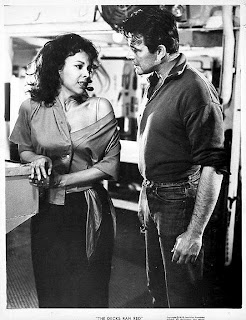 Still in 1958 came The Decks Ran Red, a ship-bound drama concerning a murder scheme masquerading as mutiny in which Whitman and Broderick Crawford hope to kill the crew of their boat and claim the salvage of its cargo. James Mason played the ship's captain while Dorothy Dandridge was on hand as a sexy distraction. In this middling, low-budget thriller, Whitman takes part in one of the first (if not the very first) interracial kisses in a Hollywood film and races around the ship in a pair of extremely snug pants.

 After this prolific year in which he gave varied performances in a wide variety of films, he was definitely on his way. William Faulkner's acclaimed novel was turned into the soapy film The Sound and the Fury, starring Yul Brynner, Joanne Woodward, Margaret Leighton and others. Whitman played the hunky, carnival worker who (alleged) teenager Woodward falls for. He then supported Don Murray, Richard Egan and Lee Remick in These Thousand Hills, playing a delinquent cowhand. Finally for 1959, he played alongside then-hot singer Fabian and Carol Lynley in Hound Dog Man.
 Biblical epics were still hot in 1960 and The Story of Ruth
  was intended to star Stephen Boyd and newcomer Elana Eden along with Tom Tryon, Peggy Wood and Viveca Lindfors, but Boyd dropped out, feeling he had no connection to his role of Boaz. Whitman, whose chiseled, modern face and heavily pomaded hair didn't exactly bring forth images of ancient history, was nonetheless happy to take on the role. He had been earning the reputation for playing jerks and tough guys and was pleased to portray something of a different dimension.
The same year, he starred in Murder, Inc., about an organized crime syndicate in which his character was unwittingly caught up. Mai Britt and Peter Falk costarred, with Falk winning the bulk of the acting praise (and an Oscar nomination! The winner was Peter Ustinov in Spartacus.)
 1961 brought the now-forgotten film The Fiercest Heart, in which he starred with Juliet Prowse, Raymond Massey and Geraldine Fitzgerald. He and Ken Scott (unlikely) played British soldiers stationed in South Africa who are engaged in battle with the Zulus when Whitman isn't romancing Prowse. (This was initially to be called “Journey into Danger” as evidenced by this costume test shot. And we do like the lack of shirt and those snug trousers!) He dipped his toes in the Biblical well again with the pat and contrived Francis of Assisi, playing the third corner of a rather inappropriate triangle that also included Bradford Dillman (as the title figure) and Dolores Hart (who played a nun here and eventually became one in real life!)

 He also teamed up with John Wayne for The Comancheros as a dandified gentleman accused of killing a man in a duel. Initially enemies, they find common ground when they have to fend off a batch of the outlaws named in the title. The unusual pairing worked well and helped to build Whitman's box office appeal. (The movie had originally been earmarked to star Gary Cooper and James Garner, but Cooper's health and Garner's contract disputes with Jack Warner meant that the casting had to be changed.) He's shown here with Ina Balin, who played his love interest in the movie.
But apart from these films, the successful and the less so, this year would also prove to be a very important one for Whitman, bringing him into that exclusive club of actors and actresses who have been in the running for an Oscar statuette.  He had traveled to London to play a part that had once been earmarked for Richard Burton, but was now left vacant. The dicey role was a bit of a risk, but one he was willing to take. In The Mark, he portrayed an ex-con who had been imprisoned for intent to commit child molestation!
The newly-released man secures a job, visits regularly with prison psychiatrist Rod Steiger and even enters into a relationship with pretty Maria Schell, until a new and unrelated sex crime makes him an easy suspect for suspicion arrest. Further angst comes from the fact that Schell has a lovely young daughter whose presence sometimes discomfits Whitman.
 This was a more than daring subject for 1961 (daring now, even), though the content was softened by making his character more of a potential pedophile rather than an actual one. Thus, it was perceived that his role could withstand some degree of sympathy as he struggled to withstand the pull of his disease and seek treatment for it rather than give in to it and act upon it. For his demanding and complex work, he received a Best Actor nomination from the Academy of Motion Picture Arts and Sciences. Without any studio support, he had to tender his own campaign for the statuette
  that was ultimately unsuccessful. In an ironic turn of events, the award went instead to Maximilian Schell for Judgement at Nuremburg, the brother of his costar in The Mark, Maria Schell!
In 1962, he costarred with Ben Gazzara in Convicts 4, a prison drama based on a true story. Gazzara was the convict, sentenced to death, but seeking a commuted sentence of life in prison, while Whitman played the well-meaning and encouraging warden. The movie was dotted with supporting roles and cameos by such folks as Broderick Crawford, Sammy Davis Jr., Rod Steiger, Ray Walston and Vincent Price. The same year, Whitman also took part, along with many other actors, in the staggering, star-studded WWII epic The Longest Day.
 He went to France in 1963 to work with director Rene Clement and famed actress Simone Signoret in The Day and the Hour. The story had him as an American pilot who lands in Nazi-occupied France during WWII and is aided by Signoret. The two got off on the wrong foot in real life until Whitman proved to her that he wasn't just another empty-headed American leading man and instead took his craft seriously.
 The following year brought one of his showiest
  and most bizarre roles in Shock Treatment. Here, he portrayed a washed-up actor who is coerced into feigning mental illness so that he can be admitted to a mental asylum. The reason is that a fellow patient, Roddy McDowall, has killed his rich employer and may have stashed away $1,000,000. It is Whitman's objective to find this out. Complicating matters are Carol Lynley, as an amorous asylum inmate, and Lauren Bacall
  as a seemingly nefarious doctor on staff.
This is a black and white film despite the lobby photos and the still to the left being in color. If nothing else, the campy movie gave us all yet another chance to view Whitman with his shirt off. His ploy to gain entrance into the mental hospital involves his situating himself, bare-chested, amongst some clothing store mannequins.  At thirty-six, he was still displaying a very fit and sexy physique at a time when not everyone took the trouble to maintain his or her self through exercise.
He also starred in the rugged western Rio Conchos, which contained an eclectic cast of actors such as Richard Boone, Anthony Franciosa, Edmond O'Brien, football hero Jim Brown (in his film debut) and Wende Wagner (who later gained fame on The Green Hornet.) The rough and tumble movie contained a scene in which he and others are tortured by flogging while being dragged by horses.
 To round out his films of 1964, there was the British-made Signpost to Murder. This one paired him with his The Sound and the Fury costar Joanne Woodward and combined elements of a couple of his previous roles. He played a prisoner who's serving time for murder, unable to obtain a parole hearing, but who finds that if he escapes and remains at large for two weeks, he will be able to get a new trial thanks to a very old law still on the books. He escapes and holes up at the home of Woodward where, unfortunately, another murder occurs! I must say I love his downward-styled hair here versus the usual upswept look he sported most of the time.

 He remained in Britain to film the expansive and elaborate comedy Those Magnificent Men in Their Flying Machines. Set in 1910, it concerned a race from London to Paris between a variety of international aviation enthusiasts and their rudimentary aircraft. He played an American entrant, smitten with the girlfriend (Sarah Miles) of British flyer James Fox. The large cast included Robert Morley, Gert Frobe (Goldfinger), Jean-Pierre Cassel, Terry-Thomas, Red Skelton and Benny Hill. It is indicative of his level of fame at the time that he is the top-billed performer in the movie.
 He was presented with another opportunity that would take him to Spain and Namibia, and is the role I referred to at the start for which he is a favorite in The Underworld,
  but which would put the final nail into the coffin of his marriage. You see, while he was making all these films in England, France and elsewhere, his wife Patricia was at home with their four children and began to suspect Whitman of infidelity. (This feeling was egged on by rumors given to her by a mutual friend, though he adamantly denied them. He certainly hadn't been banging Sarah Miles because the two despised each other almost from the outset and never even conversed apart from their scripted lines.) Thus, she filed for divorce, ending their marriage in 1966. Later that same year, he married Caroline Boubis (shown with him here), the French daughter of an industrialist.

 But back to the movie... George Peppard was slated to star in Sands of the Kalahari, a survival drama set in the desert, but after two days of filming, he departed, leaving a sizeable hole in the production. Whitman, who'd already missed out on playing Peppard's role in The Carpetbaggers and Steve McQueen's role in Nevada Smith, convinced the producer of all three, Joseph E. Levine, that he could and should take over the role. He joined Stanley Baker, Susannah York, Theodore Bikel, Harry Andrews and Nigel Davenport as a group of plane crash survivors who struggle to remain alive in the punishing Kalahari.
They are fortunate enough to find a degree of fruit on hand and a spacious cavern as well as a water supply, but some nearby baboons present a threat to their ongoing survival.  More dangerous than the primates, even, is the knowledge that one of the humans is most likely a murderer! Whitman begins the film in a linen shirt and pants, but as the story goes along, he very fortunately tears his clothing to shreds and winds up in the briefest pair of faded cut-off shorts, perfectly contrasting with his tan hirsute physique. Once seen, this sight is not likely to be forgotten.
This survival of the fittest story has Whitman getting in touch with his more beastly side as he and the baboons square off and the result is that he comes off as a mucho-macho hunk of manliness. I recall seeing this one time many years ago on TV and being fascinated by it, but it soon fell through the cracks of viewability. Thankfully, a stunning DVD has recently been released  that allows us to see all the elements of the film (from the scenery of the desert to the scenery of Stuart Whitman) in all its pristine glory. As one can see in these shots, not very much had changed since Roy Rogers, when he was shirtless on his back with his legs spread or Johnny Trouble when he was depicted in boxer shorts and cowboy boots with his feet propped up!
Next, in 1967, came An American Dream. This was an adaptation of a Norman Mailer novel about a talk show host, gunning for the mob and examining police corruption on the air, who finds himself in between both factions when his wealthy wife goes careening off a balcony and he is the primary suspect. His wife, an utter shrew for all time, is played by  Eleanor Parker while his current girlfriend is chanteuse Janet Leigh, all done up in mod-style hair, clothing and make-up. (By the way Janet, Joan Crawford called and would like her lighting back!)
The film (which takes a downward turn once the colorful and wretched Miss Parker makes her exit) was released in that far-out year of my birth, but apparently didn't make much of an impact, so in some markets the title was changed to “See You in Hell, Darling,” but to little effect. Whitman might have seen the writing on the wall where his cinema career was going and decided to make something out of a career in television instead.
In 1962, a TV western called The Virginian had seen significant success in the relatively rare 90-minute format.  Whitman sought to emulate the success with 1967's Cimarron Strip, a western series that was also 90-minutes. It focused on Whitman as the marshal of a strip of land in between the Kansas Territory and Indian territory. Costarring as regulars in the series were Percy Herbert, Randy Boone and Jill Townsend, while most episodes typically featured at least one or two notable guest stars.
Maurice Jarre provided the opening theme, which is still highly regarded among western TV fans today. In fact, the whole shebang is affectionately remembered by many viewers who either watched it during its run from 1967-1968  or who saw it during a stint on the Encore Westerns channel. Despite its quality in storytelling and performances, the series only lasted one season thanks to low ratings and high costs.
Its cancellation seemed to mark a significant shift in the quality of projects that Whitman performed in from then on. 1970 brought him the obscure German war film The Last Escape and something called The Invincible Six, a take-off on The Dirty Dozen that costarred Curd Jurgens, Ian Ogilvy and Elke Sommer. He also starred in the TV-movie The Man Who Wanted to Live with Burl Ives and Sandy Dennis, a creepy story about organ harvesting that predates Coma by a few years. Then there was 1971's City Beneath the Sea, a typically silly, but colorful, Irwin Allen adventure with plenty of recognizable names and faces including Robert Wagner, Richard Basehart, Joseph Cotten and James Darren. He also costarred in the near-legendary Revenge with a very “on” Shelley Winters and Bradford Dillman, his old Assisi costar.
 He went off to Spain to appear in Captain Apache with Lee Van Cleef and Carroll Baker before hitting Mexico to work with Miss Barbara Eden and Robert Vaughn in the hoot-filled, made-for-TV mystery-thriller The Woman Hunter. Here, at forty-four, the ol' bod was beginning to slip away a bit, but he was still doffing his shirt for the camera and didn't look too bad in long shots. He was shirtless several times as his character painted on the beach or swam. At one point, he is purportedly skinny-dipping and asks Miss Eden to turn away as he emerges from the shore and puts some cut-offs on. Later, he strips to some boxers and invites her to swim with him, later trying to playfully canoodle with her in the surf.
 Quite possibly (and probably) his career nadir was the 1972 mess
  Night of the Lepus, which had Janet Leigh and him, both substantial stars not too many years before, fighting off giant killer bunny rabbits! Also along for the dreadful ride were Star Trek's DeForest Kelley and faded western star Rory Calhoun. It would be hard to come up with a more pathetic excuse for a horror movie as the actors cower in fear of docile, unimposing bunnies with ketchup smeared on their mouths...
Also on the animal front, but marginally better thanks to the Disney film-making machinery that was in place as the studio churned out movie after movie, was that same year's Run, Puma, Run. The now forgotten film had him working with Frank Aletter, Harey Carey Jr. and the title beast. He was also appearing more frequently on TV as a guest on such shows as The F.B.I., The Streets of San Francisco and Love American Style and in TV-movies such as The Man Who Died Twice, Interetect and The Cat Creature (with Meredith Baxter, David Hedison and Gale Sondergaard.)
In 1974, he joined several other actors whose careers were in jeopardy (Laurence Harvey, Joanna Pettet and John Ireland) to film the serial killer/cannibal horror flick Welcome to Arrow Beach.  He played the local deputy to Ireland's sheriff. Meg Foster also starred as one of the potential victims. This was also the year that his second marriage came to an end. He and Caroline had one son, Justin, which brought his total to five and may be a reason why he seemed to work continuously, even in drek.
By now, though he was still working very frequently, the projects were mostly low-rung. Shatter was an unusual 1975 Hammer film that had him playing a hit man who eventually becomes a target himself. Peter Cushing, a frequent Hammer performer, costarred along with a most Asian cast. He was also leading man to Stella Stevens in the campy, trashy Las Vegas Lady and to Cloris Leachman in the campy, trashy Crazy Mama, not that either film isn't fun on its own terms.
He also costarred in the Fred Williamson combination Blaxploitation/Organized Crime flick Mean Johnny Barrows.  He had established a niche of playing deputies or other police figures in thrillers and horror movies. Such was the case again in Shadows in an Empty Room, though this one had the twist of his methods of detection being about as brutal as the suspect's! John Saxon and Martin Landau, two other stars in career trauma, were in it as well. He's shown here with Gayle Hunnicutt.
Along with several TV guest appearances, he had five films released in 1977. They just tended to be of a lesser profile than his earlier efforts.  His role in Charles Bronson's The White Buffalo was a small one, as was Clint Walker's in the same movie. His role was bigger, but the project was worse, in Ruby, a horror flick with Piper Laurie and Roger Davis. He was back in sheriff territory for Eaten Alive, another gory chiller with Neville Brand, Carolyn Jones and Mel Ferrer. He and Vera Miles starred in the Kentucky Derby-oriented drama Run for the Roses. Finally, there was the oddball movie The Ransom, in which a Native American starts killing the residents of an Arizona town and will continue to do so unless he's paid money. Oliver Reed and Deborah Raffin were also in this one.
 After working in some Italian-made movies and on the Franco Nero TV-movie The Pirate, Whitman joined Rod Taylor and Elke Sommer for Jamaican Gold in 1979. He also played a version of infamous religious leader Jim Jones in the Mexican-made Guyana: Cult of the Damned, a project that was far overshadowed by Powers Boothe's rendition the year after in Guyana Tragedy: The Story of Jim Jones. In any case, he was once again surrounded by celebs whose expiration date had arrived beforehand, in this case Gene Barry, John Ireland, Bradford Dillman, Yvonne De Carlo and Joseph Cotten. Ireland, in particular, popped up in five movies with Whitman during the '70s and '80s.
 All-star TV projects like The Last Convertible, The Seekers and Condominium were alternated with cheap action films such as Delta Fox (with John Ireland and Richard Jaeckel), Cuba Crossing (with Robert Vaughn) and Under Seige. By 1981, he found himself playing a reverend in the infamous camp classic Butterfly, a Pia Zadora showcase that managed to include Stacy Keach, Edward Albert, James Franciscus, June Lockhart and Orson Welles within its cast.

 Through the '80s and well into the late '90s, he made multiple appearances on TV series such as Fantasy Island, The A-Team, Simon & Simon, Knots Landing and Murder, She Wrote. He also played Jonathan Kent, the adoptive parent of Clark Kent/Superboy in ten episodes of The Adventures of Superboy. Throughout those decades, he continued to work in movies as well, most of them forgettable, straight-to-video efforts. He did, however, pop up as Joanne Whalley-Kilmer's father in Trial By Jury, costarring Armand Assante, William Hurt, Gabriel Byrne and Kathleen Quinlan. In 2006, when he was sevnty-eight, he wed for a third time to the far-younger Julia, a Russian submarine captain's daughter, and the two live in Santa Barbara, California.
Stuart Whitman learned a lot about the value of land while operating that bulldozer back in the 1950s.  All the while he was acting, he invested his earnings wisely in real estate and development and in time he was rumored to be worth $100 million! Why, knowing that, he continued to work in any number of routine, at times worthless, projects is anyone's guess. Perhaps he just liked acting and when the big guns didn't call anymore, he just worked where he could. To examine his resume is to see a staggering number of TV and movie appearances over the years. He made close to a hundred movies and did well over a hundred TV roles.
Still with us today at eighty-four, he hasn't done any screen work since 2000 (which was fifty years after his on-screen acting debut.) He occasionally attends western conventions (he is the recipient of the Silver Spur award) and other fan events. Two of his sons have securely established themselves as grips and electricians in the industry, but none of his five offspring has made a career of acting.  As should be obvious to any frequent visitor to The Underworld, we typically love our men chesty, tan and solid (and we also admire decent legs!), so Whitman earns a place in our heart for his turn in Sands of the Kalahari and other works of his which let us sample what he had to offer!
 We celebrate March Madness (and most other occasions, as regular visitors know) in an entirely different way in The Underworld. Oh, there will be some baskets and perhaps a few balls, but not of the Sweet Sixteen/Final Four variety. Posts here that concern TV bulges are far and away the most popular. Today, I’m going to toss a few more out to you, but I’m not even going to limit it to TV. We have a couple from the music industry, movies and even a stage play! This post is more brief than I would like, but I am still nose-deep in work and home concerns. I didn’t want to go too long without trying for a shot.
 To continue with the shot I presented above featuring Tony Perkins in 1960’s Tall Story, there are a couple of times when alert viewers can make out Tony Jr. He wears a pair of chinos in one scene that are rather revealing as he walks through a porch on campus, but his short little basketball togs are perhaps a bit more revealing. (If players wore their uniforms like this these days, I might be more apt to stay awake and watch!) Incidentally, player number 45 on the opposing team is none other than Gary Lockwood, at the time quite a hunky young fellow and looking great in his shorts, too!
 At one point in the movie, the climax actually, so to speak, Perkins has been banned from playing in the big game and is trying to convince the coaching staff to let him in. While “hiding” behind Anne Jackson, who plays the wife of one of his teachers, he proceeds to strip out of his street clothes and hop into his uniform. This allows the viewer to see him in his tighty-whities and even get a bit of an outline of that which he shared with several actors and actresses over the course of his career, Tab Hunter included.
 His costar in the film was Miss Jane Fonda, making her big screen debut. The movie was directed by Joshua Logan who was noted for keeping a plethora of healthy and handsome young men on hand in his films (he directed South Pacific, whose number “There is Nothin’ Like a Dame,” filled with tan, burly, hairy hunks, makes one wonder why any of them care!) This same year, Perkins starred in Psycho and from then on, he faced typecasting as twitchy, nervous, potentially-dangerous types.
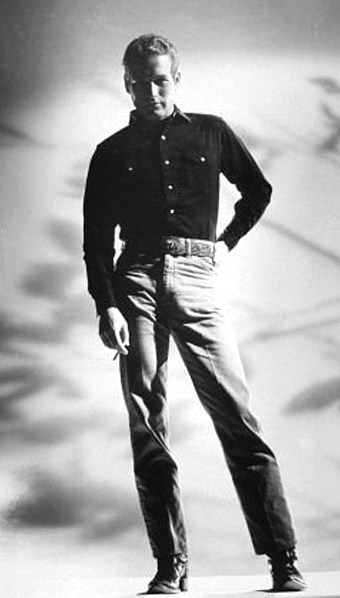 One of the cinema’s most popular and handsome leading men ever was Mr. Paul Newman. In 1963, for the anti-hero drama Hud (in which audiences nevertheless found themselves drawn to Newman‘s character!), Newman struck a pose for the still photographer that was quite an eye-(and mouth-)opener. I have yet to profile Mr. Newman in The Underworld because I try to focus on lesser-known performers who may not have received their due, but the fact remains that he is one of my all-time favorite performers and I almost always enjoy watching him (and watching him!) in practically anything.
 One of Newman’s friends and three-time costars (in 1966’s Harper, 1969’s Winning and 1974’s The Towering Inferno) was Robert Wagner. There was a pretty revealing photo of RJ not too long ago here that I wondered might be just a fluke, a shadow or something unusual in his pocket. Now, here we are again and I must say I think it must have been the real deal! No wonder Nat married him twice. Newman had to direct Wagner in Winning and one of the scenes was tutoring him through a love scene with Newman’s real-life wife Joanne Woodward. Lucky Joanne, both at work and at home!
 The crotch in question belongs to Dustin Hoffman and the shot is from The Graduate, a smash hit that earned him an Oscar nomination as Best Actor (the award went to Rod Steiger for In the Heat of the Night.) He later won for both Kramer vs. Kramer (1979) and Rain Man (1988.) More recent popular success came with Meet the Fockers in 2004 and the various incarnations of the animated Kung Fu Panda.
 He starred in the 1979 music business-oriented TV-movie Sooner or Later, one song of which, “You Take My Breath Away” proved to be his biggest his as a vocalist. Andy Warhol, in his famous published diaries, made mention of Rex and his impressively large member. We don’t know how he knew that, but if Smith turned up at a party in this get-up, it wouldn’t have been hard to figure things out. Smith later worked in a revival of The Pirates of Penzance and filmed a movie version of it with Kevin Kline, Linda Ronstadt and Miss Angela Lansbury. Then came a stint as the host of Solid Gold, a temporary role on Darryl Crawford and the role of Joe Gillis in the Canadian production of Sunset Boulevard opposite Miss Diahann Carroll. Marrying for the first time in 1987 at age thirty-two, he’s currently with his third wife.
 I posted a shot of The Bee Gees in an earlier bulge-filled posts, their hairy bods covered in gold lame, with jackets unzipped and pants taut. Even that photo can’t hold a candle to this one of Barry and some very distressed blue jeans. For me, Barry was always the most handsome of the Gibb brothers, including little Andy, but he tended to stick with his family and not too a tremendous amount apart from them (though there was that album with Barbra Streisand, for which he co-wrote all the songs and contributed vocals on the title duet, “Guilty.”)
 Turning to television, always a fertile place for spotting bulges, at least in the ‘60s through the ‘80s, we have a shot of hunkalicious Robert Conrad of Hawaiian Eye and The Wild Wild West. A little guy, but one who packed a major punch and was in astonishing shape for the time, he occasionally showed his basket on The Wild Wild West (or in shots from the gym like this one), but his bigger claims to fame were his chest and his unbelievably round bubble butt. He's one of those guys who, when watching West, you sometimes just have to halt and say out loud, "God, he's gorgeous..."
 King of the outlined penis on TV was Michael “Little Joe Cartwright” Landon of Bonanza. His revealing taupe pants of the mid-to-late seasons belong in some sort of VPL Hall of Fame. Thus, I have to include yet another shot of him in a publicity photo from the show, this one close to the end of its run. Alison Arngrim has spoken of his penchant for going commando at times during Little House on the Prairie, but I was never able to see anything during that show (and, truth to tell, haven’t seen any of it in ages.)
 I do not know this actor, but his name was Mitch Litrofsky. A brief career consisted of a role on Search for Tomorrow in the early 1980s and roles in 1989’s Music Box with Jessica Lange and the 1992 exploitation drama Eyes of the Prey. His career in TV and films ended soon after, though he remained a devotee of the theatre along with his business interests. Now in his fifties, he’s rather handsome minus the curls. He’s included here today because this portrait fits the bulge bill!
 One of my friends here at The Underworld, Kirgissfair, recently mentioned Robert Fuller of Laramie and the final season of Wagon Train (and later Emergency!) Though he sported some really tight pants on Laramie, still photos are not in wide supply. Though you can’t see a lot in this one, you can tell that there was plenty happening downstairs. This next one isn’t really any more revealing, but he still cuts a nice figure in his cowboy gear.
 When I did a recent post about Stuart Whitman, I spotted him in the Barbara Eden TV-movie thriller The Woman Hunter. In it, he is not only shirtless a few times, but also shows off his package in some of the era’s polyester slacks. (If only there was a better print in existence that could depict it a bit better.)
 Floral clerk Terrence McNally had a rather obvious outline through his three-piece suit. It had to have been a happy place to work. McNally was a bit player in many of the most popular 1980s series including Dallas and Dynasty (and occasional movies like 1980’s Nine to Five and 1981’s Looker.) His career petered out in the mid-’90s after stints on The Young and the Restless, Models, Inc and Baywatch. He also had a role on one episode of Star Trek: The Next Generation.
 Speaking of Star Trek, this next man was a guest on a memorable episode of the original series. Does he look at all familiar? He played Lt. Uhura’s combat trainer in the installment The Gamesters of Triskelion, the one that had Kirk, Chekov and her competing in the ring for their lives. His name is Steve Sandor and he was a very prominent presence in 1970s and ‘80s TV. A burly, brawny, 6’4” hunk of man, he appeared on practically all of the hit shows from that time. This series of photos is from an appearance he made on Charlie’s Angels in 1976.
  True, his fluffy hair is more than a tad campy, but that meaty, hairy, tan chest melts my butter and is just the type of guy I grew up adoring on television. Back then, it was utterly commonplace to see an apartment groundskeeper roaming around with no shirt on. What a disappointment when my first apartment building didn’t even HAVE a groundskeeper, just an old couple, the man who did maintenance and the wife who took in the money…
 I came upon this snap of David Hasselhoff, posed for some sort of ad or bit of publicity. Talk about a guy who inspires just as many admirers as detractors! Sometimes, he comes off so handsome and appealing and then others he is a campy, hot mess. Unfortunately, it seems to be the latter that occurs more often than not. At least he seems in on the joke most of the time. Hasselhoff had two tiny bit roles on TV in 1973 and 1975 before making his movie debut in a trashy, low-rent comedy called Revenge of the Cheerleaders. His character’s name was Boner and he even had a split-second frontal nude scene, though I do not recommend sitting through the film to catch it unless you’re a true fan of his. It would seem that the only way to go from there was up, but he’s had more of an up and down career.
 on Gordon Thomson (slithery Adam Carrington of Dynasty fame.) These shots were the best I could come up with on such short notice, but I wanted to include him in this post. You can’t see, too, too much happening in this first set of shots, but as I’ve said before bulges and VPL (visible penis line) canbe very hard to capture. It’s always more obvious in motion, so to speak.
 were often shown together. Here, Gordon is shown just after a morning workout in his old Yale sweatshirt and an abbreviated pair of black, satin workout shorts (practically all workout shorts were small like this back then… as All in the Family’s Edith warbled, “Those were the DAYS!”) Good luck finding a regular guy being caught dead in something like these today.
 I went ahead and added a shot of Mr. Thomson from the rear, thinking it might make a nice early Easter present for NFU. (Why didn’t I just wait for a week or two and have a post called “Easter Baskets”?? Maybe next year…)
 to the character. Thomson did sue Aaron Spelling productions over this ignominious slight as he had become a major part of the series soon after having joined it in 1982. Soaps have been his calling ever since from Sunset Beach to Passions to Days of Our Lives, though he did have a role as Richard Dreyfus’ lover in that ghastly 2006 film Poseidon. Most of his footage was cut out prior to the film’s release (along with practically any scene that wasn‘t action oriented…)
 seem to make more of an effort to be discreet and men’s clothes are much looser in general. Imagine my surprise lately when seeing the new series GCB (which is a rarity for me in that I never watch scripted network programs!) and the camera took its place directly beneath the proud crotch of costar David James Elliot! The 6’4” former Canadian citizen is still looking amazing, now at age fifty-one! Amusingly, the tall drink of water (of which I’d gladly sip!) is paired with the diminutive (4’11”) Kristin Chenoweth on the (terrific) series.
 For our final two presentations, I hope I saved the best for last. First up is staggeringly hunky actor Marc Singer. Famous for the miniseries V (along with the resultant series) and for playing The Beastmaster in a fur loincloth, he had been working on TV since the early ‘70s and acting on stage before that. In 1976, he appeared in a filmed presentation of one of his stage successes, The Taming of the Shrew.
 Just like I might watch more basketball if the uniforms were shorter, I might watch more Shakespeare if the costumes were this tight!
 In 2001 and 2002, he made appearances on the new TV version of The Beastmaster and as recently as 2011, he had a guest role on the new rendition of V. Today, at age sixty-four, he still works in movies, they just tend to be straight-to-video and, thus, don’t get the same type of viewership or attention that features (or even TV work, really) would bring.
 star Brad Davis as a sailor desired by many people around him, most importantly his repressed commanding officer Franco Nero. The movie is one long phallic symbol and bulgefest, but someone opted to take this picture of Davis (center) and two of his well-endowed shipmates. The photo gives new meaning to the term half-mast! I hope you got a kick out of this return to a popular subject. I’ll be back asap with more movie and TV profiles.


